JSTOR Global Plants Home
  • Home
  • Browse
  • About
  • Access
  • Account
    • Saved Items
    • Profile
  • Log in

Global Plants

Skip to Main Content
  • JSTOR Global Plants Home
  • Global Plants

    • Browse
    • About
    • Access
    • Account
      • Saved Items
      • Profile
Log in
  • Browse
  • About
  • Access
  • Account
    • Saved Items
    • Profile
Advanced Search

Compilation
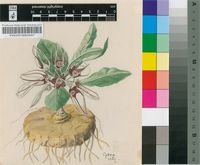
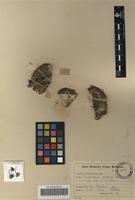
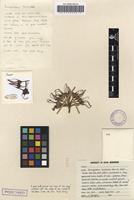
Brachystelma barberae

3 Images see all

Brachystelma barberae Harv. ex Hook.f.
Filed as Brachystelma barberae Harv. ex Hook.f. [family APOCYNACEAE]
Previous
Next

Name

Identification
Brachystelma barberae Harv. ex Hook.f. [family APOCYNACEAE ]
Related name
  • Brachystelma barberae

Flora

Entry for Brachystelma barberae [family ASCLEPIADACEAE]
Herbarium
South African National Biodiversity Institute, Compton Herbarium, Cape Town (SAM)
Collection
Flora of Southern Africa
Resource Type
Reference Sources
Entry From
Flora of South Africa, (2003) Author: Dr J.P. Roux
Names
Brachystelma barberae [family ASCLEPIADACEAE]
Common names
Dichaelia barberae (Harv. ex Hook, f.) Bullock in KewBull. 1953: 359(1953).
Information
Perennial herb. Tuber 80-200 mm diam., depressed and becoming irregular in shape with age. Stems 1-few, up to about 100 mm tall, somewhat coarsely pubescent. Leaves cuneate-oblong, oblanceolate or oblong, tapering into a short petiole, up to 100 x 25 mm, coarsely pubescent with more hairs on lower surface. Flowers subterminal, usually in two opposite, sessile umbels of up to 25 flowers in each, appearing as one terminal, spherical inflorescence; pedicels 10-20 mm long. Sepals linear-lanceolate, up to 10 mm long. Corolla 20-45 mm long; tube campanu-late, ±5 mm long, with crimson-brown bands on a yellowish background within, glabrous below, variably purple-pubescent around mouth; lobes united at tips, with an ovate-lanceolate base, becoming linear above with recurved margins, greenish on back, maroon to crimson-brown on inner surface, puberu-lous on back and front with hairs of same colour as surface and thus sometimes appearing glabrous within. Corona camp-anulate o
Habitat
Even if the remarkable inflorescence does not catch the eye in the wild, the putrid smell of the flowers is likely to attract attention. The flowers, sometimes produced before the leaves, number up to 50 on robust specimens, all open at one time in one spectacular global mass made up of two opposite sessile umbels. A tuber may produce more than one such annual stem in a season. The depth of the tuber under ground varies from near surface level to ±100 mm, depending on the soil structure. Generally the sandier the soil, the deeper are the tubers. It is of interest that such a robust, widespread species has no close relative in Southern Africa. Except for the variable size of flowers, no doubt linked with environ­mental conditions, the flowers are tolerably uniform in character. In one extraordinary specimen, collected by W. J. Louw near Potchefstroom in 1967, the tips of the corolla-lobes remained attached to the centre of the staminal column, thus preventing expansion into the normal cage-like structure. The pollinia are here described as durable because they are less delicately attached to the carrier than average, a condition which may facilitate pollination.
Use
59. Brachystelma barberae Harv. ex Hook.f. in Curtis's bot. Mag. t.5607 (1866), as barberiae; Schltr. in Bot. Jb. 18, Beibl. 45: 25 (1894); N.E. Br. in F.C. 4,1: 864 (1908); Medley Wood in Natal Plants 6: t.587 (1912); Phill. in Flower. PI. S. Afr. t.354 (1929). Iconotype: Transkei, valleys of Tsomo River; original painting by Mrs Barber (K).
Range
This species extends from Transkei through the grassveld of Natal, throughout the Transvaal into Rhodesia. It is usually scattered widely but has been recorded as locally exceedingly common in places.

Related Materials

  • Terms and Conditions
  • Privacy Policy
  • Cookie Policy
  • Cookie Settings
  • Accessibility
  • Help
  • Contact Us
  • Facebook
  • Twitter
ITHAKA

JSTOR is part of ITHAKA, a not-for-profit organization helping the academic community use digital technologies to preserve the scholarly record and to advance research and teaching in sustainable ways.

©2000-2026 ITHAKA. All Rights Reserved. JSTOR®, the JSTOR logo, JPASS®, Aluka®, and ITHAKA® are registered trademarks of ITHAKA.

╳