

Compilation
Brachystegia goetzei
3 Images see all
Name
Identification
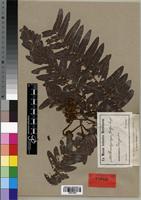
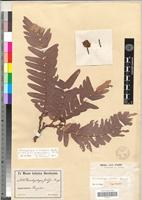
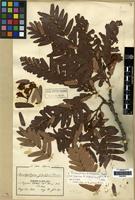
Isotype of Brachystegia goetzei Harms [family LEGUMINOSAE ] Verified by Not on sheet, Brachystegia longifolia Benth. [family LEGUMINOSAE ] (stored under name); Verified by Hoyle, A.C., 1962
Related name
- Brachystegia longifolia
- Brachystegia goetzei
Flora
Entry for BRACHYSTEGIA × longifolia Benth. [family LEGUMINOSAE-CAESALPINIOIDEAE]
Herbarium
Royal Botanic Gardens, Kew (K)
Collection
Flora of Tropical East Africa
Resource Type
Reference Sources
Entry From
Flora of Tropical East Africa, page 1, (1967) Author: J. P. M. Brenan
Names
BRACHYSTEGIA × longifolia Benth. [family LEGUMINOSAE-CAESALPINIOIDEAE], (pro sp.) in Hook., Ic. Pl. 14, t. 1359 (1881); Burtt Davy & Hutch, in K.B. 1923: 154 (1923); L.T.A.: 723 (1930), excl. syn. (B. holtzii tantum excepta); C. H. N. Jackson in Journ. S. Afr. Bot. 6: 38 (1940); B. D. Burtt in Journ. Ecol. 30: 76–78, 141,142 (1942), pro parte majore; T.T.C.L.: 93 (1949), pro parte, excl. syn. B. glaberrima; Hoyle in F.C.B. 3: 470, fig. 40/D, E (1952), pro parte; Hoyle & White in F.F.N.R.: 111, 118, fig. 22/H (1962). Type: Malawi, Shire Highlands, Buchanan 22 (K, holo.!, E, iso.!)
BRACHYSTEGIA goetzei Harms [family LEGUMINOSAE-CAESALPINIOIDEAE], in E.J. 30: 318, t. 13 (1901); Burtt Davy & Hutch, in K.B. 1923: 150 (1923); L.T.A.: 721 (1930); Topham in K.B. 1930: 355 (1930), pro parte, quoad cit. Tanganyika tantum. Type: Tanganyika, Mbeya District, Unyiha [Unyika], near Pisaki, Goetze 1423 (B, holo. †, E, iso. !, K, photo. !)
BRACHYSTEGIA holtzii Harms [family LEGUMINOSAE-CAESALPINIOIDEAE], in E.J. 33: 154 (1902); V.E. 1(1): 241 (1910); Burtt Davy & Hutch, in K.B. 1923: 150 (1923); L.T.A.: 724 (1930). Type: Tanganyika, Uzaramo District, Mogo Forest Reserve, Holtz 31 (B, holo. †, EA, iso. !, K, photo. !)
Information
Tree (2–)4–15(–25) m. high, often stunted by exposure, very variable in all parts especially habit and indumentum, displaying every intermediate expression and most combinations of the characters described for B. boehmii and B. glaberrima; most forms fall within the range shown in fig. 41. Bole often with conspicuous rounded bosses (even in forms otherwise close to B. boehmii); bark deeply furrowed to coarsely reticulate, grey or brownish; crown rounded to obconical or flat; main branching suberect to spreading; branchlets spreading in bunched systems with foliage usually rather pendulous in loose tufts (unless leaflets few). Stipules filiform to falcate, 1–3 cm. long, caducous to subpersistent, usually with reniform auricles. Leaves glabrous to tomentose, with (5–)6–12(–17) pairs of leaflets, the pairs very variable in spacing, the middle pairs usually the largest; rhachis usually 10–15 times as long as the petiole, channelled, usually with obvious but variable stipels or local expansions; leaflets oblong to narrowly triangular, (3–)4–6(–8) × (0.5–)1–2(–3) cm., very acute to broadly rounded or emarginate at apex, obliquely rounded or truncate to cordate at base; main nerves and larger veins usually more conspicuous than the open to rather close final reticulation. Panicles terminal (rarely also axillary), glabrous or fulvous-to dark brown-tomentose; peduncle usually slender and terete, rarely sulcate. Flowers greenish with white or cream stamen-filaments; bracteoles very variable in thickness and shape. Tepals (4–)5(–9); outer 4–6 imbricate, densely long-ciliate, often with 1 or more pubescent outside; inner 0 or 1–4, variable. Pod up to 15 × 5 cm., smooth or partly to completely scurfy, often warted when smooth or nearly so. Figs 35/11, p. 160, & 41, p. 189.
Range
DISTR. T4, 6–8
Altitude range
275–2000 m., mainly above 1000 m.
Distribution
TANGANYIKA Chunya District N. Lupa Forest Reserve, fl. 22 Sept. 1962, Boaler, Lupa transect I, No. 6 !TANGANYIKA Mbeya District Mbozi, fr. 29 July 1949, Hoyle & Greenway 1099 !TANGANYIKA Iringa District near Iheme, fl. 19 Oct. 1936, B. D. Burtt 5759!TANGANYIKA Songea District 3 km. N. of Songea, fr. 15 June 1956, Milne-Redhead & Taylor 10824 !
Distribution (external)
; Congo Republic
Mozambique
Malawi
Zambia
Angola
Notes
Recent authors have included B. glaberrima among glabrous forms of B. longi-folia, usually following my earlier opinion. I have now given more careful thought to the question of how to deal with the mass of forms in this group to which further collection continues to add new combinations of the characters of B. glaberrima and B. boehmii, sometimes with added complications apparently due to introgression from spp. 8–10, 14 and 15. The admitted scrap-heap grouped as putative hybrids under B. × longifolia seems to have originated through repeated crossing and back-crossing among the local forms of the two species mainly concerned, sometimes evidently to the point of swamping B. glaberrima sensu stricto in much of the area of overlap. Swarms of diverse forms occupy intermediate habitats and also seem to have invaded areas made available by destruction of forest, notably on the southern highlands of Tanganyika. Here B. D. Burtt (Iringa and Iringa-Mbeya road, Oct. 1936) collected a series of flowering specimens; Nos. 5762, 5759, 5811 and 5741, all with hairy panicles, range (in that order) from glabrous leaves with 7–10 pairs of leaflets to hairy leaves with 9–12 pairs.Boaler’s valuable series (Chunya District, Lupa Forest Reserve, transect I, fl. 22 Sept. 1962) includes Nos. 6, 8, 1, 4, and 5, ranging (in that order) from glabrous throughout with 6–7 pairs of leaflets to densely pubescent throughout with 8–10 pairs; No. 8 has a clearly defined tomentellous zone on the upper and outer part of each bracteole, but an otherwise glabrous panicle; this peculiar distribution of pubescence, so far unique in the genus, is correlated with tepals more like those of B. boehmii than in any other specimen in this series, while the leaves are intermediate between No. 6 and the associated B. spiciformis (Nos. 3 and 7) ! The possibility of rare crossing between the latter species and B. × longifolia is also suggested by Procter 1319 (Iringa District, Image Mt., July 1959) a remarkable, hairy specimen with 7–9 pairs of ovate leaflets and obscure, scarcely axillary stipule-bases, occurring where the putative parents occupy adjacent zones.The total range of forms included is largely covered by fig. 41, but Lindeman 712 (6 km. S. of Tabora, fl. 14 Sept. 1938), chosen as illustrative specimen of B. longifolia in T.T.C.L.: 93 (1949), is a good example of a borderline case, approaching B. glaberrima more closely than any of the forms illustrated. B. gossweileri Burtt Davy & Hutch, was believed to occur in Tanganyika on the basis of a small-leaved sterile specimen (Chunya District, 13 km. E. of Chunya, 22 Dec. 1961, Boaler 374) and the species was accordingly included when fig. 35 was prepared. More recent gatherings from the same locality are now available (20 May 1962, Boaler, Chunya transect I, Nos. 1–16, again sterile but comprising normal and coppice material in variety), as well as a specimen in young fruit (4 Dec. 1962, Boaler 759), stated to be from the same site but this time described as “10 miles [16 km.] east of Chunya”. These specimens show conclusively that the population forms part of the B. × longifolia complex as represented in the area generally and covers the leaf-variation of “ B. goetzei ”. Whether B. gossweileri, as understood elsewhere, can continue to be maintained as a species independent of the complex, is a problem still awaiting a satisfactory solution.