

Compilation
Brachystegia glaberrima
2 Images see all
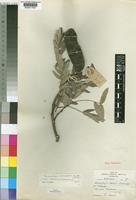
Name
Identification
Brachystegia glaberrima R.E.Fr. [family LEGUMINOSAE-CAESALPINIOIDEAE ] Verified by Hoyle, A.C., Brachystegia longifolia Benth. [family LEGUMINOSAE-CAESALPINIOIDEAE ] (stored under name); Verified by Hoyle, A.C., Brachystegia boumei Greenway [family LEGUMINOSAE-CAESALPINIOIDEAE ]
Related name
- Brachystegia boumei
- Brachystegia longifolia
- Brachystegia glaberrima
Flora
Entry for BRACHYSTEGIA glaberrima R. E. Fries [family LEGUMINOSAE-CAESALPINIOIDEAE]
Herbarium
Royal Botanic Gardens, Kew (K)
Collection
Flora of Tropical East Africa
Resource Type
Reference Sources
Entry From
Flora of Tropical East Africa, page 1, (1967) Author: J. P. M. Brenan
Names
BRACHYSTEGIA glaberrima R. E. Fries [family LEGUMINOSAE-CAESALPINIOIDEAE], in Wiss. Ergebn. Schwed. Rhod.-Kongo-Exped. 1: 66 (1914); Burtt Davy & Hutch, in K.B. 1923: 157 (1923); Hoyle & White in F.F.N.R.: 110, 117, fig. 22/G, t. 1/A, C, E (1962). Type: Zambia, Mporokoso, Fries 1177 (UPS, lecto.!, K, photo.!)
BRACHYSTEGIA longifolia [family LEGUMINOSAE-CAESALPINIOIDEAE], [sensu auct., e.g. C. H. N. Jackson in Journ. S. Afr. Bot. 6: 38 (1940), pro parte (“glabrous forms”); T.T.C.L.: 93 (1949), pro parte (vide notam), non Benth.]
Information
Tree (2–)5–15(–18) m. high, glabrous; bole often with conspicuous rounded bosses; bark rough, with few long deep furrows, grey; crown ± ovoid, becoming flattish only in age; main branches suberect; branchlets many, slender; foliage evenly spreading in all directions, not pendulous in tufts, maturing green above, glaucous beneath. Stipules shortly connate, linear to falcate, 1–2 cm. long, caducous; auricles 0 or small, usually lateral; intra-petiolar stipule-bases persistent, usually prominent, subtending flattened and keeled dormant buds. Leaves glabrous, with (4–)5–7(–8) widely-spaced pairs of leaflets, the middle and distal pairs subequal, spreading and conspicuously ladder-like in silhouette on the tree; petiole 1.5–3(–4) cm. long, usually subequal to the average of the intervals on the rhachis; pulvinus prominent and (though long) always forming less than one third of the petiole; rhachis 10–18(–20) cm. long (not more than 7 times as long as the petiole), channelled; stipels or local expansions usually obvious but variable; leaflets ± obliquely and narrowly triangular or subtrullate to ovate-elliptic or (rarely) oblong-elliptic, sometimes falcate, 3–10(–12) × (0.7–)1–3(–4) cm., obtuse or acute to rounded or retuse at apex, ± obliquely cuneate to subcordate at base; midrib subcentral; basal fanwise nerves (3–)4–5(–6), prominent and conspicuous above, the inner strongly ascending; main nerves and major reticulation above much more conspicuous than the final venation, both obscure beneath. Panicles terminal, up to 10 × 8 cm., glabrous; peduncle slender, terete, usually glaucous. Flowers green and cream; bracteoles 6–8 × 5–6 mm. Tepals 5–6(–7), usually 5–6 all sepaloid, imbricate, densely long-ciliate; rarely with 1–2 inner, linear or vestigial, usually glabrous. Stamens ± 10, ± free, filaments 9–12 mm. long. Ovary 2–3 × 1 mm., crispate-setose on the margins; style 8–10 mm. long; stigma rather large. Pod woody, up to 15 × 5 cm., smooth and usually shiny but often with warts (due to insect attack), never finely scurfy; sutural wings spreading, each 4–7 mm. wide. Fig. 40, p. 187.
Range
DISTR. T4, 7 rare (?) in Angola, Malawi and Mozambique
Altitude range
840–1500 m.
Distribution
TANGANYIKA Kigoma District near Mkuti R., fl. Sept. 1956, Procter 516!TANGANYIKA Tabora District near Kakoma, fl. Aug. 1935, C. H. N. Jackson 110! & fr. 25 June 1949, Hoyle 1040 ! & SE. Tabora, 22 km. S. of Lyela sawmill, fl. Sept. 1951, Groome 13 !
Distribution (external)
; Congo Republic
Zambia
Notes
Jackson (l.c.) and also Hoyle & Brenan in T.T.C.L. did not maintain B. glaberrima as a species distinct from what is here regarded as a hybrid complex, 12, B. × longifolia (apparently derived mainly from B. glaberrima × B. boehmii). Although very strict, the definition of B. glaberrima cannot be regarded as wholly satisfactory and difficulties are bound to arise in the identification of borderline specimens. Intro-gression of characters seems to have taken place singly as well as in groups; expression of characters may be unaltered or mingled, so that it may be possible to identify glabrous flowering material with all appropriate other characters as B. glaberrima and to name fruiting material from the same individual tree “ B. × longifolia ” because the pods are scurfy. As reliably correlated flowering and fruiting material from the same individual tree is almost unknown in the group, this unfortunate nomenclatural situation can only be avoided by resourceful collecting. By the same means it is possible to avoid the confusion that also arises between genuine examples of B. glaberrima from reasonably uniform populations and similar glabrous segregates of the B. × longifolia complex in heterogeneous populations. In naming individual specimens, less error is likely if doubtful ones are referred to B. × longifolia (see under this).The mature bark of B. glaberrima, with few long deep furrows as if clawed by a lion, is normally characteristic and remarkably constant in botanically uniform populations. It is, however, shown by individuals in heterogeneous populations of B. × longifolia, even those approaching B. boehmii in many characters.Hybrids seem to occur with 14, B. wangermeeana, notably in NW. Tanganyika (see 11 × 14 and under the latter).