

Compilation
Brachystegia filiformis
1 Images see all
Name
Identification
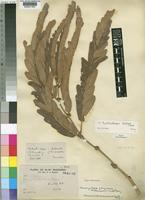
Brachystegia filiformis Burtt Davy & Hutch. [family LEGUMINOSAE-CAESALPINIOIDEAE ] Verified by Hutchinson; Burtt Davy, Brachystegia boehmii Taub. [family LEGUMINOSAE-CAESALPINIOIDEAE ] (stored under name); Verified by Hoyle, A.C., Brachystegia woodiana Harms [family LEGUMINOSAE-CAESALPINIOIDEAE ]
Related name
- Brachystegia woodiana
- Brachystegia boehmii
- Brachystegia filiformis
Flora
Entry for BRACHYSTEGIA boehmii Taub. [family LEGUMINOSAE-CAESALPINIOIDEAE]
Herbarium
Royal Botanic Gardens, Kew (K)
Collection
Flora of Tropical East Africa
Resource Type
Reference Sources
Entry From
Flora of Tropical East Africa, page 1, (1967) Author: J. P. M. Brenan
Names
BRACHYSTEGIA boehmii Taub. [family LEGUMINOSAE-CAESALPINIOIDEAE], in P.O.A. C: 197 (1895); Burtt Davy & Hutch, in K.B. 1923: 151 (1923); L.T.A.: 721 (1930); C. H. N. Jackson in Journ. S. Afr. Bot. 6: 37 (1940); B. D. Burtt in Journ. Ecol. 30: 75–78, 85, 86, 141 (1942); T.T.C.L.: 93 (1949); Hoyle in F.C.B. 3: 474, t. 33 (1952); Hoyle & White in F.F.N.R.: 111, 117, fig. 24, t. 1/B-D, F, G (1962). Type: Tanganyika, Tabora District, Igonda, Boehm 159a (B, holo. †, K, fragm.!)
BRACHYSTEGIA flagristipulata Taub. [family LEGUMINOSAE-CAESALPINIOIDEAE], in P.O.A. C: 198 (1895); Burtt Davy & Hutch, in K.B. 1923: 152 (1923); L.T.A.: 722 (1930); Topham in K.B. 1930: 355 (1930), pro parte, excl. Hendry 525. Type: Tanganyika, Uzaramo District, Stuhlmann 6400 (B, holo. †, K, fragm. & photo. !)
BRACHYSTEGIA filiformis Burtt Davy & Hutch. [family LEGUMINOSAE-CAESALPINIOIDEAE], in K.B. 1923: 150, t. 2, fig. 2 (1923); L.T.A.: 722 (1930); Topham in K.B. 1930: 356 (1930), quoad cit. Tanganyika. Type: Zambia, Broken Hill, F. A. Rogers 8605 (K, holo. !, BM, iso. !)
BRACHYSTEGIA woodiana [family LEGUMINOSAE-CAESALPINIOIDEAE], [sensu auct. quoad cit. Tanganyika, e.g. K.B. 1923: 151 (1923) & L.T.A.: 720 (1930) & K.B. 1930: 356 (1930), won Harms]
Information
Tree (2.5–)5–15(–21) m. high; pubescent to tomentose or more rarely the leaflets glabrous; bole without rounded bosses (so far as known); bark rough, long-persistent, ± coarsely reticulate, with many narrow fissures and transverse cracks, grey to brown (black when burnt only ?); crown flat-topped, with few, heavy branches and stout branchlets; foliage long, pendulous in tufts; flush pink to brick-red, turning through buff or yellow to pale green, maturing darker; fallen dead leaves dull reddish. Stipules shortly connate, filiform to linear-filiform or subspathulate, (2–)3–4(–5) cm. long, subpersistent, usually grading downwards into large brown and crimson bud-scales at flushing and upwards into the often bifurcate lower bracts at flowering-time; auricle usually persistent, reniform, (0.5–)1–1.5(–2) cm. long, rarely caducous or undeveloped; stipule-bases persistent, usually prominent, subtending flattened and laterally keeled dormant buds. Leaves with (13–)14–28(–30) pairs of leaflets, the middle or lower middle pairs the largest; petiole stout, 0.3–1 (–1.2) cm. long, the very stout pulvinus usually forming half to the whole; rhachis (8–)10–30(–35) cm. long, 20–50 times as long as the petiole, ± channelled; stipels or wings variable or 0, often obscured by coarse pubescence; leaflets narrowly oblong to narrowly triangular, (2.5–)3–6 × (0.7–)1–1.5 cm., rounded or obtuse to emarginate and then often asymmetric at apex, obliquely rounded or subtruncate to cordate at base; midrib subcentral or somewhat excentric; main nerves above (except the 4–6 fanwise basal nerves) scarcely more obvious (in mature leaflets) than the very closely reticulate veins (all areolations usually complete and equally prominent, 10–20 per square mm. at maturity, especially close in glabrous forms, otherwise often obscured by hair); lower surface typically pubescent to floccose with long yellowish crispate hairs throughout or with much denser rusty to dark brown spreading hairs on the midrib, but often glabrous or nearly so. Panicles ± erect above the foliage, terminal or terminal and axillary, up to 10 × 8 cm., much-branched, dense-flowered, always pubescent to tomentose with yellow to rusty and often dark brown hairs; peduncle short or 0, typically stout, sulcate when dry. Flowers yellowish-green with white filaments; bracteoles 6–10 × 4–7 mm., rather thick, pubescent to tomentose, with longer darker hairs on the usually prominent keel. Tepals (4–)5(–8), usually free; outer (4–)5 sepaloid, broad, imbricate, up to 4.5 × 3.5 mm., densely ciliate, often 1 or more pubescent outside; inner 0 or l–2(–3), linear to spathulate, 4–6 mm. long, glabrous or sparsely ciliate. Stamens ± 10, ± free, 10–12 mm. long. Ovary 4 × 2 mm., densely setose. Pod thickly and rigidly woody, up to 16(–20) × 5 cm., held conspicuously like a flag above crown of tree, maturing pale to yellowish-brown or pinkish, surface becoming finely scurfy throughout, usually at an early age, never (?) prominently warted through insect-attack (cf. 11, B. glaberrima and 12, B. × longifolia); sutural wings stiffly spreading, 5–9 mm. wide. Fig. 35/4, p. 160.
Range
DISTR. T1, 3–8
Altitude range
mainly 150–1500 m.
Distribution
TANGANYIKA Buha District Kasulu-Kigoma road, fl. Oct. 1954, Procter 262 !TANGANYIKA Rungwe District fl. Dec. 1912, Stolz 1717 ! & 1757 !TANGANYIKA Kilwa District Liwale, fr., Gillman 1044 !
Distribution (external)
; Congo Republic
Mozambique
Malawi
Zambia
Rhodesia
Botswana
Angola
Notes
Further synonymy in F.C.B. 3: 474 (1952)VARIATION. Apart from a rather wide range in size and number of leaflets and in their relative width, variation is greatest in the quantity and distribution of pubescence on the leaves. In this respect there are two main variants, connected almost everywhere by numerous intermediates:1. A very hairy (“typical”) form, very widespread but apparently most common in western Tanganyika. This was described by Taubert as having leaflets decreasing in size from apex towards base of the rhachis; I have not seen his holotype but find this statement difficult to believe.2. A less hairy and usually more slender form, often with quite glabrous leaflets and very rarely glabrous rhachis, is also widespread but found mainly (in extreme forms at least) in eastern Tanganyika; the leaflets are usually more oblong with more excentric midrib and often with ± emarginate asymmetric apex (cf. 14, B. wanger-meeana, but less extreme). Such forms occurring in the west may well have acquired some characters by introgression from B. wangermeeana and there is suggestive evidence of clinal variation across north-central Tanganyika.Putative hybrids with 14, B. wangermeeana are cited below the latter. Those with 11, B. glaberrima, are here treated as a widely dominant hybrid complex, 12, B. × longifolia (see under this).The comparatively high proportion of B. boehmii with glabrous leaflets in T8 may be due to introgression from B. allenii (see 9 × 13 and under the latter). Gillman 1228 and Tanner 162 (both from Masasi District, Mkwera), attain only 17 pairs of glabrous leaflets as compared with the local maximum per specimen, in obvious B. boehmii, of 21–28 pairs; Schlieben 5575 (Lindi District, Lake Lutamba) attains 21 pairs but has a glabrous inflorescence-axis, unique if it is B. boehmii.