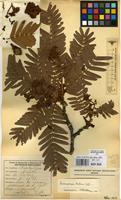
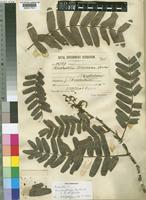
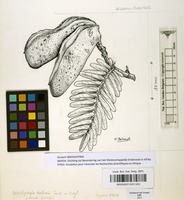
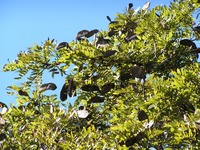
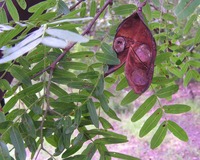
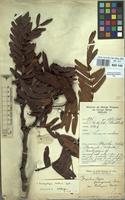
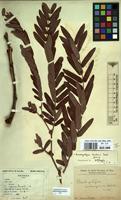
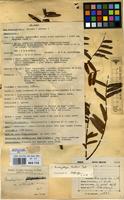
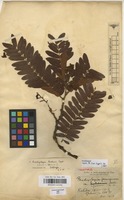
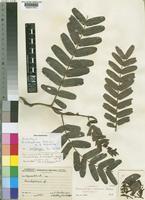
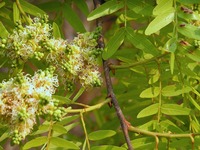
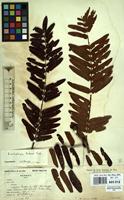
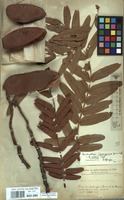
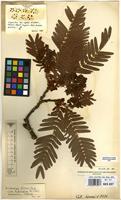
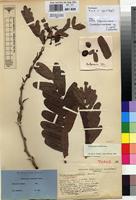
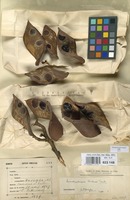
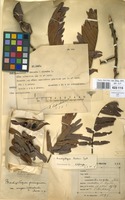
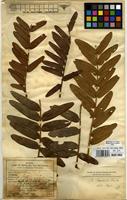
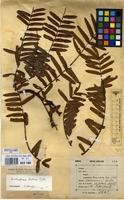
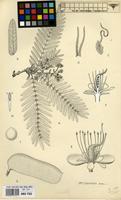
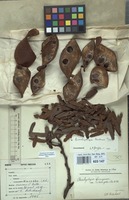
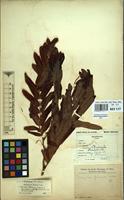
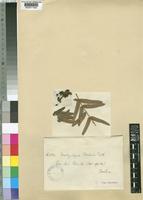
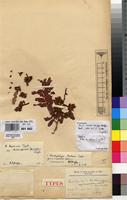
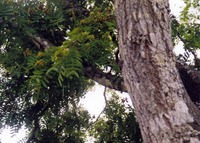
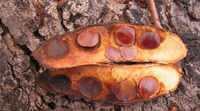
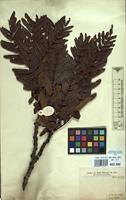
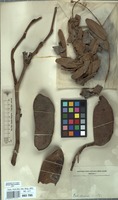
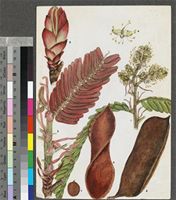
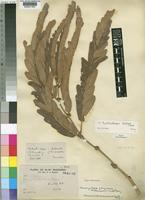
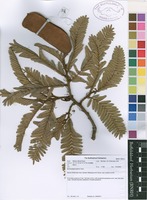
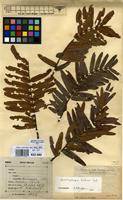
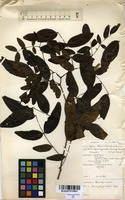
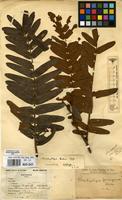
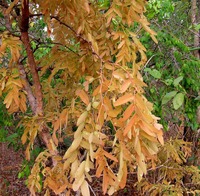
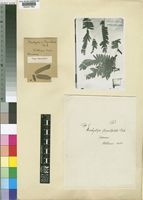
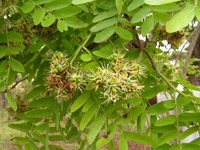
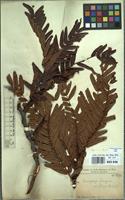
Tree (2.5–)5–15(–21) m. high; pubescent to tomentose or more rarely the leaflets glabrous; bole without rounded bosses (so far as known); bark rough, long-persistent, ± coarsely reticulate, with many narrow fissures and transverse cracks, grey to brown (black when burnt only ?); crown flat-topped, with few, heavy branches and stout branchlets; foliage long, pendulous in tufts; flush pink to brick-red, turning through buff or yellow to pale green, maturing darker; fallen dead leaves dull reddish. Stipules shortly connate, filiform to linear-filiform or subspathulate, (2–)3–4(–5) cm. long, subpersistent, usually grading downwards into large brown and crimson bud-scales at flushing and upwards into the often bifurcate lower bracts at flowering-time; auricle usually persistent, reniform, (0.5–)1–1.5(–2) cm. long, rarely caducous or undeveloped; stipule-bases persistent, usually prominent, subtending flattened and laterally keeled dormant buds. Leaves with (13–)14–28(–30) pairs of leaflets, the middle or lower middle pairs the largest; petiole stout, 0.3–1 (–1.2) cm. long, the very stout pulvinus usually forming half to the whole; rhachis (8–)10–30(–35) cm. long, 20–50 times as long as the petiole, ± channelled; stipels or wings variable or 0, often obscured by coarse pubescence; leaflets narrowly oblong to narrowly triangular, (2.5–)3–6 × (0.7–)1–1.5 cm., rounded or obtuse to emarginate and then often asymmetric at apex, obliquely rounded or subtruncate to cordate at base; midrib subcentral or somewhat excentric; main nerves above (except the 4–6 fanwise basal nerves) scarcely more obvious (in mature leaflets) than the very closely reticulate veins (all areolations usually complete and equally prominent, 10–20 per square mm. at maturity, especially close in glabrous forms, otherwise often obscured by hair); lower surface typically pubescent to floccose with long yellowish crispate hairs throughout or with much denser rusty to dark brown spreading hairs on the midrib, but often glabrous or nearly so. Panicles ± erect above the foliage, terminal or terminal and axillary, up to 10 × 8 cm., much-branched, dense-flowered, always pubescent to tomentose with yellow to rusty and often dark brown hairs; peduncle short or 0, typically stout, sulcate when dry. Flowers yellowish-green with white filaments; bracteoles 6–10 × 4–7 mm., rather thick, pubescent to tomentose, with longer darker hairs on the usually prominent keel. Tepals (4–)5(–8), usually free; outer (4–)5 sepaloid, broad, imbricate, up to 4.5 × 3.5 mm., densely ciliate, often 1 or more pubescent outside; inner 0 or l–2(–3), linear to spathulate, 4–6 mm. long, glabrous or sparsely ciliate. Stamens ± 10, ± free, 10–12 mm. long. Ovary 4 × 2 mm., densely setose. Pod thickly and rigidly woody, up to 16(–20) × 5 cm., held conspicuously like a flag above crown of tree, maturing pale to yellowish-brown or pinkish, surface becoming finely scurfy throughout, usually at an early age, never (?) prominently warted through insect-attack (cf. 11, B. glaberrima and 12, B. × longifolia); sutural wings stiffly spreading, 5–9 mm. wide. Fig. 35/4, p. 160.