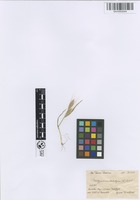
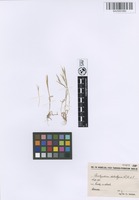
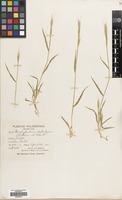
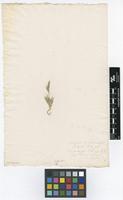
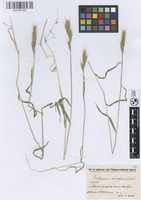
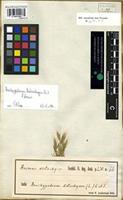
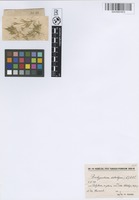
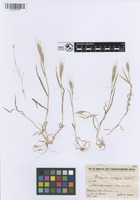
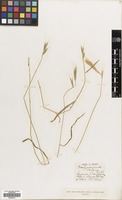
annual; culms fascicled, or simple or branched below, often very strongly and repeatedly geniculate, ascending, 1/2–1 1/2 ft. long, glabrous or sparingly hairy below the nodes, smooth or slightly rough in the upper part, 3–4-noded, internodes exserted, uppermost ultimately becoming by far the longest; sheaths rather tight, herbaceous, striate, spreadingly hairy or finely pubescent or glabrescent, spreadingly ciliate along the upper margins, finely tomentose at the nodes; ligules very obtuse, finely pubescent to villous, up to 3/4 lin. long; blades linear, tapering to an acute point, 2–4 in. by 1 1/2–2 lin., flat, slightly rigid to subflaccid, scabrid and more or less spreadingly hairy all over; false spike erect, straight, 2-ranked, 4–1- (rarely to 6-) spiculate, up to 3 in. long; rhachis slightly rough except at the scabrid margins, striate; pedicels stout, very short or obsolete; spikelets erect, adpressed, 1/2 to more than 1 in. long, glabrous or sparingly hairy, 6–12-flowered; glumes subulate-lanceolate, very acute, lower 2 1/2–3 lin. long, 4- to sub-6-nerved, upper about 3 1/2 lin. long, 7-nerved, nerves very prominent; valves lanceolate-acuminate, 4–4 1/2 lin. long, firmly chartaceous, scaberulous above, 7-nerved; awn 4–9 lin. long, very short or absent in the lowest florets; pales about 3 1/2 lin. long, keels very rigidly ciliate in the upper part; stamens 3 (in the South African specimens) or 2; anthers oblong to ellipsoid, 1/4– 1/3 lin. long; grain oblong-linear, convexo-concave, about 3 lin. long. null