

Compilation
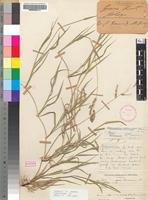
Brachiaria stolonifera
1 Images see all
Name
Identification
Brachiaria stolonifera Gooss. [family POACEAE ] Verified by Not on sheet, Urochloa mosambicensis (Hack.) Dandy [family POACEAE ] (stored under name); Verified by Not on sheet,
Related name
- Brachiaria stolonifera
- Urochloa mosambicensis
Flora
Entry for Urochloa mosambicensis Hackel Dandy [family GRAMINEAE]
Herbarium
Royal Botanic Gardens, Kew (K)
Collection
Flora Zambesiaca
Resource Type
Reference Sources
Entry From
FZ, Vol 10, Part 3, (1989) Author: W. D. Clayton
Names
Urochloa mosambicensis Hackel Dandy [family GRAMINEAE], in Journ. Bot., Lond. 69: 54 (1931). — Sturgeon in Rhod. Agric. Journ. 50: 429 (1953). — Chippindall in Meredith, Grasses & Pastures of S. Afr.: 382 (1955). — Jackson & Wiehe, Annot. Check List Nyasal. Grass.: 65 (1958). — Clayton & Renvoize in F.T.E.A., Gramineae: 603 (1982). Type: Mozambique, de Carvalho (K, isotype).
Panicum mosambicense Hackel [family GRAMINEAE], in Bol. Soc. Brot. 6: 140 (1888). Type as above.
Urochloa pullulans Stapf [family GRAMINEAE], in F.T.A. 9: 590 (1920). — Sturgeon in Rhod. Agric. Journ. 50: 428 (1953). — Jackson & Wiehe, Annot. Check List Nyasal. Grass.: 65 (1958). Type as above.
Urochloa rhodesiensis Stent [family GRAMINEAE], in Proc. Trans. Rhod. Sci. Ass. 32: 26 (1933). — Sturgeon in Rhod. Agric. Journ. 50: 428 (1953). Types: Zimbabwe, Nyamandhlovu, Rattray 500 (SRGH, syntype; K, isosyntype); Harare, Stent 3669 (SRGH, syntype; K, isosyntype), Stent 5416 (SRGH, syntype; K, isosyntype), Stent 5547 (SRGH, syntype; K, isosyntype).
Brachiaria stolonifera Goossens [family GRAMINEAE], in Kew Bull. 1934: 195 (1934). Type from S. Africa.
Urochloa stolonifera Goossens Chippindall [family GRAMINEAE], in Meredith, Grasses & Pastures of S. Afr.: 381 (1955). Type as above.
Information
Tufted or stoloniferous perennial, the basal sheaths silky pubescent. Culms 20–170 cm. high, ascending. Leaf laminae broadly linear, ± hispid. Inflorescence of 3–20 racemes, these 1–14 cm. long, bearing usually single spikelets on a narrowly winged rhachis. Spikelets 2.5–5.5 mm. long, ovate, glabrous, pubescent or setosely fringed, acuminate sometimes to a subulate tip. Inferior glume 2/3–5/6 length of spikelet, elliptic-oblong, 3–nerved, slightly cartilaginous and shiny, often with a tuft of hairs from middle of back. Superior glume and inferior lemma usually without cross-nerves. Superior lemma granulose to rugulose, with a macro 0.5–1.2 mm. long.
Habitat
Savanna woodland and open grassland, often on seasonally flooded clays or disturbed sites
Range
Uganda and Kenya to S. Africa; introduced to many other tropical countries as a forage plant.
Altitude range
0–1600 m.
1600
0
Distribution
Botswana N 11 km. N. of Tsau, 11.iii.1965, Wild & Drummond 6854 (K; SRGH).Zambia C Chilanga, Mt. Makulu Res. St., 15.i.1958, Angus 1817 (K).Zimbabwe N Hurungwe (Urungwe) Distr., Mana Pools. Nat. Park, 15.ii.1983, Dunham 256 (K; SRGH).Malawi N Rninplii, 12.ii.1968, Simon & Williamson 1777 (K; SRGH).Mozambique N Marrupa, 5.ii.1981, Nuvunga 462(K).Botswana SW Central Kalahari Game Reserve, Deception Valley, 19.iii.1983, Smith 4204 (K; SRGH).Botswana SE Mahalapye, xii.1963, Yalala 380 (K; SRGH).Zambia E Chipata, 31.xii.1957, Stewart 100 (K).Zambia S Mapanza Mission, 23.xii.1952, Robinson 21 (K).Zimbabwe W Hwange Distr., Victoria Falls Nat. Park, Chamabondo, Matika 30/75 (K; SRGH).Zimbabwe C Harare, Agric. Exp. St., 1.ii.1954, Sturgeon in GHS 45321 (K; SRGH).Zimbabwe E 78 km. S. of Mutare, 13.ii.1974, Davidse, Simon & Pope 6623 (K; MO; SRGH).Zimbabwe S Chiredzi Distr., Magudu Ranch, 21.ii.1967, Cleghorn 1376 (K; SRGH).Malawi C Lilongwe Agric. Res. St., 8.ii.1951 Jackson 395 (K).Malawi S Zomba, 16.i.1950, Wiehe N/40 (K).Mozambique Z Mocuba, Namagoa, Faulkner 26 (K; PRE).Mozambique T Estima to Inhacapirire, 26.i.1972, Macêdo 4692 (K).Mozambique MS Chemba. 12.iv.1960, Lemos & Macuácua 69 (K).Mozambique GI Massingir, 15 km. from Lagoa Nova, 10.iv.1972, Myre, Lousã & Rosa 5738 (K).Mozambique M Maputo, 9.i.1941, Torre 2476 (COI; K).
Notes
U. mosambicensis is variable, but Burt et al. (Austral. Journ. Bot. 28: 343–356, 1980) comment that its morphological and agronomic characters intergrade so much that infraspecific taxa cannot be separated.