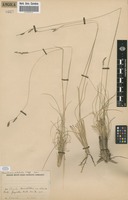
Perennial, compactly cæspitose, 1–1 1/2 ft. high; innovations intravaginal. Culms erect, quite simple, very slender, compressed at least downwards, 1-noded with the node far below the middle, glabrous and smooth. Leaves crowded at the base; sheaths tight, striate, glabrous or more or less, but usually sparingly, hairy upwards, the basal long-persistent forming tough tight coats around the leafy and the flowering shoots; ligules a ciliolate rim; blades filiform, subterete, or laterally slightly compressed, narrowly channelled on the face or more deeply so (to beyond the middle) with one of the margins inflexed, pithy in the centre, subacute, 3–9 in. long, 1/4 to almost 1/2 lin. in diam., striate, more or less loosely hairy, particularly towards the base, hairs fine, white, springing from a minute tubercle. Inflorescence of 3–1 erect or oblique secund spiciform sessile racemes; common axis filiform, up to 1/2 in. long, glabrous or sparingly hairy at the insertion of the racemes. Racemes dense, up to 3/4 in. long, alternate, 2-seriate, more or less purple; rhachis trigonous, straight or wavy, 3/10– 4/10 lin. wide, puberulous, scaberulous and more or less loosely white ciliate along the lateral angles, usually dark purple on the back, internodes 3/4–1 lin. long; pedicels solitary, extremely short, angular, scabrid, setulose below the subdiscoid tips. Spikelets contiguous, oblong, about 1 3/4 lin. long, more or less tinged with purple, hairy. Glumes slightly unequal, quite or in part purple; lower oblong, subobtuse, with minutely denticulate tips, about three-quarters the length of the spikelet, membranous, strongly 9-nerved, sparingly hairy along the sides; upper slightly longer than or as long as the spikelet, broad-lanceolate or oblong, subobtuse, 5–6-nerved with few cross-veins, loosely white hairy all over. Lower floret ♂ or neuter: valve oblong, acute or subacuminate, as long as the spikelet, similar in texture and colouring to the upper glume, 5-nerved with the inner side-nerves distant from the midnerve and connected by cross-veins, loosely hairy; valvule lanceolate-oblong, somewhat shorter than the valve; anthers 1 lin. long if present. Upper floret hermaphrodite, oblong, obtuse, white, its sides exposed upwards and vividly contrasting with the purple glumes and the lower valve, very smooth, shining; valve and valvules thinly crustaceous; anthers 1 lin. long.