JSTOR Global Plants Home
  • Home
  • Browse
  • About
  • Access
  • Account
    • Saved Items
    • Profile
  • Log in

Global Plants

Skip to Main Content
  • JSTOR Global Plants Home
  • Global Plants

    • Browse
    • About
    • Access
    • Account
      • Saved Items
      • Profile
Log in
  • Browse
  • About
  • Access
  • Account
    • Saved Items
    • Profile
Advanced Search

Compilation
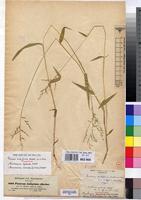
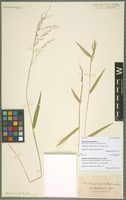
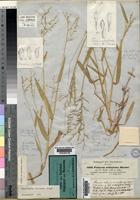
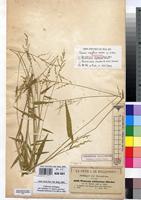
Brachiaria epaleata

15 Images see all

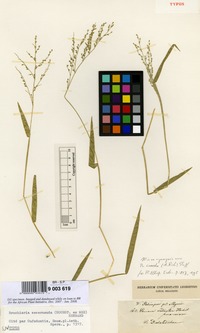
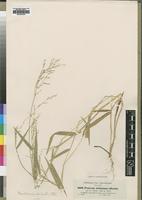
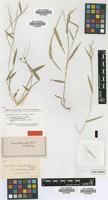
Isosyntype of Panicum secernendum Mez [family GRAMINEAE]
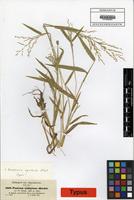
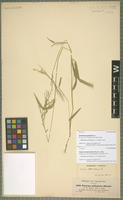
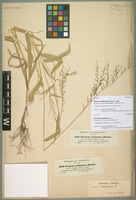
Syntype of Brachiaria epaleata Stapf [family POACEAE]
Type of Brachiaria epaleata Stapf [family GRAMINEAE]
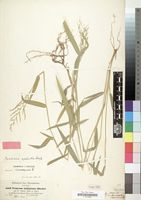
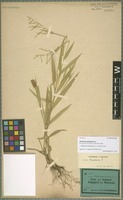
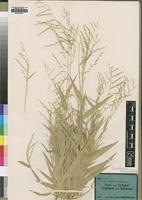
Syntype of Brachiaria epaleata Stapf [family POACEAE]
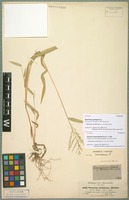
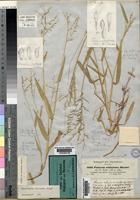
Syntype of Panicum nudiglume Hochst. [family POACEAE]
Syntype of Brachiaria epaleata Stapf [family POACEAE]
Brachiaria comata (A.Rich.) Stapf [family POACEAE]
Isosyntype of Brachiaria secernendum Mez [family POACEAE]
Syntype of Brachiaria epaleata Stapf [family POACEAE]
Isosyntype of Brachiaria secernendum Mez [family POACEAE]
Isosyntype of Brachiaria epaleata Stapf [family POACEAE]
Syntype of Brachiaria epaleata Stapf [family POACEAE]
Previous
Next

Name

Identification
Brachiaria epaleata Stapf [family GRAMINEAE ] (stored under name); Verified by Not on sheet.,
Related name
  • Brachiaria secernendum
  • Panicum nudiglume
  • Brachiaria comata
  • Panicum secernendum
  • Panicum distichophyllum
  • Brachiaria epaleata

Flora

Entry for BRACHIARIA epaleata Stapf [family POACEAE]
Herbarium
Royal Botanic Gardens, Kew (K)
Collection
Flora of Tropical Africa
Resource Type
Reference Sources
Entry From
Flora of Tropical Africa, Vol 9, page 1, (1917) Author: (By O. STAPF.)
Names
BRACHIARIA epaleata Stapf [family POACEAE]
Panicum nudiglume A. Rich. [family POACEAE], Tent. Fl. Abyss. ii. 372 (partly); not of Hochst. ex Steud.
Information
Annual, up to 1 1/2 ft. high. Culms slender, terete, suberect or ascending from a short decumbent base, rooting from the lower nodes, sparingly branched below with the branches suberect and flowering, 5–6-noded, uppermost internode by far the longest, sparingly and minutely pubescent or slightly rough upwards. Leaf-sheaths subherbaceous, tight, striate, glabrous except on the sometimes pubescent or shortly ciliate outer margin; ligules a fringe of short stiff hairs; blades linear-lanceolate to sublinear from a shortly rounded, never clasping, base, tapering to an acute point, 2–4 in. by 2–5 lin., somewhat stiff, green, quite glabrous or with a few hairs at the base, margins cartilaginous, closely crisped, spinulously ciliolate, primary lateral nerves 3–5 on each side, fine, differentiated from the numerous and close secondary nerves only below, midrib very slender. Panicle long-exserted, asymmetrically obovate in outline or subsecund at least downwards, 2 1/2–4 in. by 1–2 in., of 6–8 moderately distant solitary slender interrupted and compound or simple racemes; common axis slender, subterete and channelled at the base, then subtriquetrous, ciliate along the sharp angles, terminating with a spikelet. Racemes slightly flexuous or the shorter almost straight, the lowest 1 1/2–3 in. long and obliquely erect, the upper much shorter and more spreading, all simple or the lower compound to beyond the middle with the secondary racemes loose and 3/4– 1/3 lin. long; rhachis very slender, triquetrous, up to 1/5 lin. wide, ciliolate along the angles; pedicels solitary or geminate, filiform, angular, loosely pubescent, with some longer hairs at the tips, the longest up to 1 1/2 lin. long. Spikelets or pairs of spikelets or secondary racemes distant by 3 1/2–2 lin., or the solitary spikelets of simple racemes and racemules often by slightly less than their own length, all the spikelets oblong, subacute or rather obtuse, slightly flattened on the back, 1 1/2 lin. long, greenish, quite glabrous. Glumes very unequal, the lower broad-ovate, obtuse or subacute, clasping, over one-third the length of the spikelet, 3- or sub-5-nerved; the upper corresponding in shape and size to the spikelet, thinly membranous, 5-nerved. Lower floret neuter, reduced to the valve which resembles very much the upper glume but is slightly depressed on the back. Upper floret hermaphrodite, oblong, subacute, almost 1 lin. long, whitish; valve and valvule thinly crustaceous, delicately striate, rugulose, the transverse rugæ very short. Anthers 1/2 lin. long.
Distribution
Abyssinia Nile Land Gallabat; Matamma, Schweinfurth, 1146! Samen; low places by the Tacazze River near Jelajeranne, Schimper, 1612!

Related Materials

  • Terms and Conditions
  • Privacy Policy
  • Cookie Policy
  • Cookie Settings
  • Accessibility
  • Help
  • Contact Us
  • Facebook
  • Twitter
ITHAKA

JSTOR is part of ITHAKA, a not-for-profit organization helping the academic community use digital technologies to preserve the scholarly record and to advance research and teaching in sustainable ways.

©2000-2026 ITHAKA. All Rights Reserved. JSTOR®, the JSTOR logo, JPASS®, Aluka®, and ITHAKA® are registered trademarks of ITHAKA.

╳