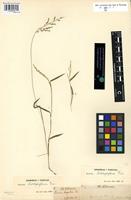
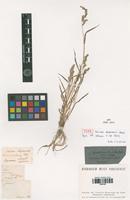
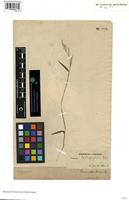
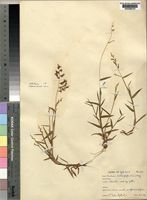
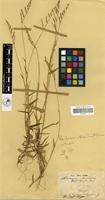
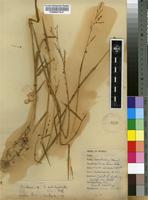
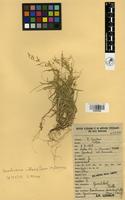
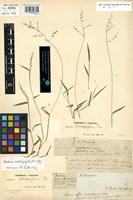
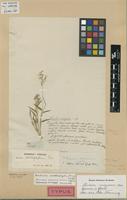
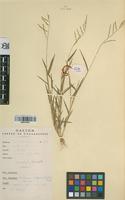
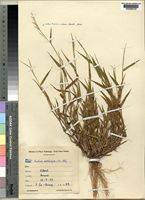
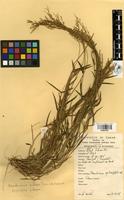
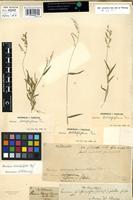
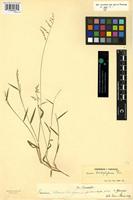
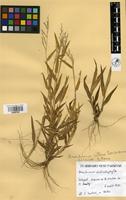
Annual, 1/2–1 1/2 ft. high. Culms very slender, terete, geniculate, usually ascending from a decumbent or prostrate and rooting base, often much branched below, the culms and branches gathered in more or less dense bunches, 5- to many-noded, the uppermost internode usually very long and like the preceding internodes (or at least their upper parts) pubescent, rarely glabrous. Leaf-sheaths more or less herbaceous, rather tight, those supporting a branch slipping off the internode and rolling round the branch, finely striate, more or less pubescent, sometimes densely so, or finely hirsute, rarely glabrous; ligules reduced to a narrow ciliolate rim; blades lanceolate or linear-lanceolate from a suddenly contracted rounded base, gradually tapering from very low down to an acute point, 1–2 in. by 2–3 lin., rarely longer, rather stiff and somewhat succulent, green, glabrous or more or less pubescent, margins markedly cartilaginous and usually crisped downwards, spinulously ciliolate to serrulate, primary lateral nerves 3–4 on each side, very fine and differentiated from the numerous and close secondary nerves only below, midrib very slender. Panicle at length long-exserted, secund, 1 1/2–3 in. long, of 4–8 obliquely spreading or almost horizontal distant solitary slender spike-like mostly simple racemes; common axis very slender, terete and adaxillarily channelled or more or less flattened upwards, terminating with a spikelet, scabrid along the angles, otherwise pubescent or glabrous. Racemes straight or slightly curved, the lowest 1/2 to over 1 in. long, gradually decreasing upwards, simple or very rarely slightly compound at the base with very short and scanty secondary racemes; rhachis more or less triquetrous, 1/8– 1/7 lin. wide, scabrid along the angles, pubescent or hirtellous, or glabrous; pedicels mostly solitary or the lower paired, all very short and relatively stout, so that the spikelets are subsessile, or the longer of the lowest pairs up to 1/2 lin. long, of the same vestiture as the rhachis, but usually with some longer stiff hairs. Spikelets secund, more or less 1-seriate or lower down irregularly 2-seriate, evenly distant by 1/2–1 lin. and then laterally contiguous, rarely much more remote and spreading, except towards the base where the raceme may become interrupted, oblong to obovate-oblong, acute or apiculate, slightly flattened on the back, 1–1 1/4 lin. long, pale. Glumes very unequal; the lower ovate, subacute, sometimes mucronulate, clasping, very thin, slightly less than half the length of the spikelet, 3- to sub-5-nerved, the inner nerves anastomosing; upper glume corresponding in outline and size to the spikelet, membranous, somewhat prominently 5-nerved, usually pubescent, often with the hairs more numerous, longer and white below the tip so as to form a small tuft, or sometimes quite glabrous. Lower floret neuter: valve very like the upper glume, if not slightly longer, less hairy, more faintly nerved and slightly depressed between the inner nerves; valvule oblong, acute, delicate, more or less reduced or almost suppressed. Upper floret hermaphrodite, slightly shorter than the lower, or equalling it and then their tips frequently exposed when quite mature, broad-oblong, subacute, pale; valve and valvule crustaceous, delicately granular. Anthers 1/2 lin. long.