JSTOR Global Plants Home
  • Home
  • Browse
  • About
  • Access
  • Account
    • Saved Items
    • Profile
  • Log in

Global Plants

Skip to Main Content
  • JSTOR Global Plants Home
  • Global Plants

    • Browse
    • About
    • Access
    • Account
      • Saved Items
      • Profile
Log in
  • Browse
  • About
  • Access
  • Account
    • Saved Items
    • Profile
Advanced Search

Compilation
Botrychium crenulatum

3 Images see all

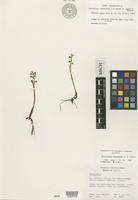
Holotype of Botrychium crenulatum W.H.Wagner [family OPHIOGLOSSACEAE]
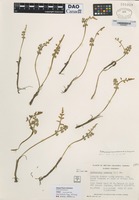
not on sheet of Botrychium crenulatum W. H. Wagner [family OPHIOGLOSSACEAE]
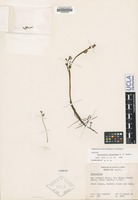
Isotype of Botrychium crenulatum W. H. Wagner [family OPHIOGLOSSACEAE]
Previous
Next

Name

Identification
Botrychium crenulatum W.H.Wagner [family OPHIOGLOSSACEAE ] (stored under name); Verified by Rabeler, Perkins, & Price, 1990 Botrychium crenulatum W.H.Wagner [family OPHIOGLOSSACEAE ] Verified by W.H. Wagner,
Related name
  • Botrychium crenulatum
Common name
  • Dainty moonwort, Flora of North America Vol. 2

Flora

Entry for Botrychium crenulatum W. H. Wagner [family OPHIOGLOSSACEAE]
Herbarium
Flora of North America (FNA)
Collection
Flora of North America
Resource Type
Reference Sources
Entry From
Flora of North America, Vol 2,
Names
Botrychium crenulatum W. H. Wagner [family OPHIOGLOSSACEAE], Amer. Fern J., 71: 21. 1981
Treatment Author(s)
Warren H. Wagner Jr.
Florence S. Wagner
Information
Trophophore stalk 0.5--7 mm; blade yellow-green, oblong, 1-pinnate, to 6 × 2 cm, thin, herbaceous. Pinnae to 5 pairs, spreading, well separated, distance between 1st and 2d pinnae not or slightly more than between 2d and 3d pairs, basal pinna pair approximately equal in size and cutting to adjacent pair, broadly fan-shaped, undivided to tip, margins mainly crenulate to dentate, proximal pinnae with 1 or more shallow incisions, apex rounded, apical lobe linear to linear-cuneate, well separated from adjacent lobes, venation like ribs of fan, midrib absent. Sporophores 1--2-pinnate, 1.3--3 times length of trophophore. 2 n =90.
Phenology
Leaves appearing in mid to late spring, dying in late summer
Altitude range
1200--2500 m
Distribution
USA Ariz.USA Calif.USA IdahoUSA Mont.USA Oreg.USA Nev.USA UtahUSA Wash.USA Wyo.
Discussion
Botrychium crenulatum is commonly associated with B . simplex in California. In the Wallowa Mountains of Oregon it occurs with B . ascendens , B . lunaria , and B . minganense .

Related Materials

  • Terms and Conditions
  • Privacy Policy
  • Cookie Policy
  • Cookie Settings
  • Accessibility
  • Help
  • Contact Us
  • Facebook
  • Twitter
ITHAKA

JSTOR is part of ITHAKA, a not-for-profit organization helping the academic community use digital technologies to preserve the scholarly record and to advance research and teaching in sustainable ways.

©2000-2026 ITHAKA. All Rights Reserved. JSTOR®, the JSTOR logo, JPASS®, Aluka®, and ITHAKA® are registered trademarks of ITHAKA.

╳