

Compilation
Boscia pechuelii
1 Images see all
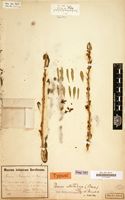
Name
Identification
Boscia pechuelii Kuntze [family CAPPARACEAE ] Verified by Not on sheet., Boscia albitrunca Gilg & Benedict [family CAPPARACEAE ] (stored under name); Verified by Not on sheet.,
Related name
- Boscia albitrunca
- Boscia pechuelii
Flora
Entry for Boscia albitrunca Burch. Gilg & Bened. [family CAPPARIDACEAE]
Herbarium
Royal Botanic Gardens, Kew (K)
Collection
Flora Zambesiaca
Resource Type
Reference Sources
Entry From
FZ, Vol 1, Part 1, page 194, (1960) Author: H. Wild
Names
Boscia albitrunca Burch. Gilg & Bened. [family CAPPARIDACEAE], in Engl., Bot. Jahrb. 53: 212 (1915). — Burtt Davy, F.P.F.T. 1: 123 (1926). — O. B. Mill. in Journ. S. Afr. Bot. 18: 14 (1952). Type from Cape Province (Griqualand West).
Capparis albitrunca Burch. [family CAPPARIDACEAE], Trav. Int. S. Afr. 1: 343 (1822). — Harv. in Harv. & Sond., F.C. 1: 63 (1860). — Sim, For. Fl. Port. E. Afr.: 10 (1909). Type as above.
Boscia pechuelii Kuntze [family CAPPARIDACEAE], in Jahrb. Berl. Bot. Gart. 4: 261 (1886). — Passarge, Die Kalahari: 789 (1904). Type from SW. Africa (Hereroland).
Information
Much-branched tree up to 10 m. tall; crown dense and rounded; bark smooth and whitish; trunk stout. Leaves alternate or fascicled 2–4 together on very reduced side-shoots; lamina 3–5 x 0.7–1.2 cm., coriaceous, oblanceolate or narrowly oblong, apex rounded or retuse or very rarely acute, mucronate, narrowed to a cuneate or narrowly rounded base, puberulous on both sides or glabrescent, midrib prominent beneath, nervation scarcely visible; petiole 1–3 mm. long, puberulous. Inflorescence of very short, dense, axillary racemes; peduncle almost 0, rachis pubescent; bracteoles 1.5 mm. long, filamentous, pubescent, trifid with the middle lobe longest; pedicels up to 5 mm. long, pubescent. Sepals 4 x 2.5–3 mm., ovate-oblong, apex subacute, very minutely puberulous outside, pubescent within, densely so at the margins; receptacle disk-like, papillose-fimbriate. Stamens 6–14, on glabrous filaments c. 5 mm. long. Gynophore c. 3 mm. long, glabrous; ovary ovoid, glabrous, with c. 10 ovules on 2 placentas; style 0.5 mm. long, glabrous; stigma subcapitate, scarcely wider than the style. Fruit up to 1 cm. in diam., globose, yellowish, glabrous, smooth. Seed usually single, c. 0.7 cm. in diam., subglobose, rugose.
Habitat
In drier woodlands and bush, sometimes on termite mounds.
Distribution
Zimbabwe S Gwanda, Beit Bridge, fr. xi.1952. Davies 378 (SRGH).Zimbabwe E Melsetter Distr., Birchenough Bridge, fl. 12.ix.1949, Chase 1751 (SRGH).Zambia S Livingstone Distr., fl. 24.viii.1947, Brenan 7742 (FHO; K).Botswana SE Lobatsi, fl. x.1913, Rogers 6211 (PRE; SRGH).Botswana SW 435 km. NW. of Molepole, 23° E, 22° 20’ S., st. 3.vii.1955, Story 4998 (PRE).Mozambique M between Santaca and Catuane, fr. 13.iv.1949, Myre & Balsinhas 593 (LM; SRGH); Goba, fl. 23.viii.1944, Mendonça 1822 (BM; LISC).Zimbabwe W Gwaai Res., fr. 29.ix.1947, West 2426 (SRGH).Zambia B Sesheke, Malabwe Forest, fl. Brenan & Keay 7669 (FHO).Botswana N Ngamiland, fl. ix.1949, Pole Evans 4626 (PRE).Caprivi Strip Katima Molilo, fr. 23.x.1954, West 3251 (K; SRGH).
Distribution (external)
Cape
Transvaal
Natal
Orange Free State
SW. Africa
Notes
The leaves and young branches of this species are often browsed and the root is used as a food by Africans in time of famine.