JSTOR Global Plants Home
  • Home
  • Browse
  • About
  • Access
  • Account
    • Saved Items
    • Profile
  • Log in

Global Plants

Skip to Main Content
  • JSTOR Global Plants Home
  • Global Plants

    • Browse
    • About
    • Access
    • Account
      • Saved Items
      • Profile
Log in
  • Browse
  • About
  • Access
  • Account
    • Saved Items
    • Profile
Advanced Search

Compilation
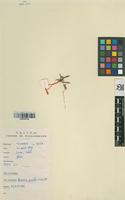
Borreria pusilla

5 Images see all

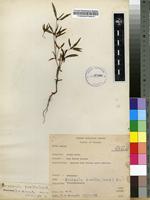
Filed as Borreria pusilla (Wall) DC. [family RUBIACEAE]
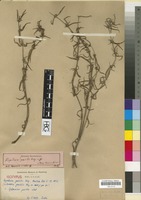
Isotype of Bigelowia gracilis Miq. [family RUBIACEAE]
Filed as Spermacoce pusilla Wall. [family RUBIACEAE]
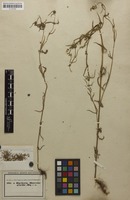
Type of Borreria pusilla (Wall.) DC. [family RUBIACEAE]
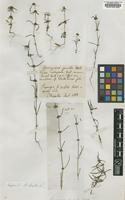
Filed as Borreria pusilla (Wall.) DC. [family RUBIACEAE]
Previous
Next

Name

Identification
Spermacoce pusilla Wall. [family ASTERACEAE ] (stored under name); Borreria pusilla (Wall.) DC. [family RUBIACEAE ]
Related name
  • Borreria pusilla
  • Spermacoce pusilla
Common name
  • a-εnt-ε-ro-bat (NWT) (SIERRA LEONE, TEMNE), Burkill, H.M. 1985. The useful plants of west tropical Africa, Vol. 4
  • lσgbε (NWT) pεnyε (NWT) (SIERRA LEONE, MENDE), Burkill, H.M. 1985. The useful plants of west tropical Africa, Vol. 4

Flora

Entry for SPERMACOCE pusilla Wall. [family RUBIACEAE]
Herbarium
Royal Botanic Gardens, Kew (K)
Collection
Flora of Tropical East Africa
Resource Type
Reference Sources
Entry From
Flora of Tropical East Africa, page 1, (1976) Author: B. VERDCOURT
Names
SPERMACOCE pusilla Wall. [family RUBIACEAE], in Roxb., Fl. Indica, ed. Carey & Wall. 1: 379 (1820). Type: “Nepala Valley”, Gardner (ubi?)
Borreria pusilla (Wall.) DC. [family RUBIACEAE], Prodr. 4: 543 (1830); F.P.S. 2: 427 (1952); Hepper, F.W.T.A., ed. 2, 2: 220 (1963)
Borreria stricta [family RUBIACEAE], [sensu F.W.T.A. 2: 135 (1931); U.K.W.F. 409, fig. (1974) et auct. mult. non (L.f.) K. Schum., nec G.F.W. Mey.]
Borreria hebecarpa [family RUBIACEAE], [sensu F.W.T.A. 2: 135 (1931), non A. Rich.]
Information
Erect or rarely prostrate annual usually branched herb (2–)7.5–60 cm. tall, with grooved ± glabrous or slightly papillate-puberulous often reddish stems. Leaf-blades linear-lanceolate to narrowly lanceolate, 1–5.3 cm. long, 2–5.5 mm. wide, acute at the apex, narrowed to the base, minutely scabrid above, glabrous beneath; true petiole absent; stipule-sheath 1.5–2 mm. long, glabrous or pubescent, 1.5–2 mm. long, bearing 7 setae 2–4 mm. Flowers in dense very compact spherical clusters at most nodes, 0.6–1(–1.5) cm. in diameter; bracteoles filiform, numerous, 2 mm. long. Calyx-tube ovoid, 1 mm. long, pubescent; teeth 4, equal or slightly unequal, subulate, 0.6–1.2 mm. long, scabrid. Corolla white or pink; tube narrowly funnel-shaped, 1.3 mm. long; lobes 0.8–1.1 mm. long, 0.4 mm. wide, with some long flattened hairs at the apex. Filaments exserted ± 1 mm. Style exserted 0.5 mm. Capsule ellipsoid, 1.5 mm. long, glabrous or ± sparsely pubescent. Seeds chestnut-brown, shiny, oblong-ellipsoid or narrowly oblong, 1.3 mm. long, 0.55 mm. wide, 0.4 mm. thick, with a wide ventral groove. Fig. 50/13, p. 342.
Range
DISTR. U1–4; K3, 4–6; T1, 3, 4, 6–8 widespread in tropical Africa, Madagascar and tropical Asia to Japan and Philippines
Altitude range
(150–)450–1920 m.
Distribution
KENYA Trans-Nzoia District Kitale, 5 Oct. 1962, Bogdan 5558!KENYA Uasin Gishu District ? Kipkarren, Brodhurst Hill 136!KENYA Masai District Chyulu North, 24 Apr. 1938, Bally 354! & 725!TANZANIA Musoma District Lupa, Nyambono, 4 June 1959, Tanner 4321!TANZANIA Buha District Gombe Stream Reserve, Kasakela stream valley, 13 Apr. 1964, Pirozynski P. 683!TANZANIA Morogoro, May 1930, Haarer 1916!UGANDA Kigezi District Kinkizi, Nyakinomi, Mar. 1951, Purseglove 3589!UGANDA Mbale District West Bugwe Local Forest Reserve, 0.8 km. NE. of Lugombe Hill, 28 May 1951, G. H. Wood 236!UGANDA Masaka District Sese Is., Kalangala, 28 June 1935, A. S. Thomas 1339!
Notes
Drummond (annot. in herb.) treats B. hebecarpa as a synonym of this species but I think Hepper is probably correct in treating it as a variety of B. chaetocephala (p. 355).

Related Materials

  • Terms and Conditions
  • Privacy Policy
  • Cookie Policy
  • Cookie Settings
  • Accessibility
  • Help
  • Contact Us
  • Facebook
  • Twitter
ITHAKA

JSTOR is part of ITHAKA, a not-for-profit organization helping the academic community use digital technologies to preserve the scholarly record and to advance research and teaching in sustainable ways.

©2000-2026 ITHAKA. All Rights Reserved. JSTOR®, the JSTOR logo, JPASS®, Aluka®, and ITHAKA® are registered trademarks of ITHAKA.

╳