JSTOR Global Plants Home
  • Home
  • Browse
  • About
  • Access
  • Account
    • Saved Items
    • Profile
  • Log in

Global Plants

Skip to Main Content
  • JSTOR Global Plants Home
  • Global Plants

    • Browse
    • About
    • Access
    • Account
      • Saved Items
      • Profile
Log in
  • Browse
  • About
  • Access
  • Account
    • Saved Items
    • Profile
Advanced Search

Compilation
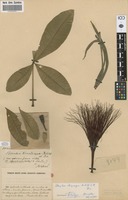
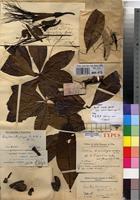
Bombax kimuenzae

2 Images see all

Filed as Bombax kimuenzae De Wild. & T.Durand [family BOMBACACEAE]
Holotype of Bombax kimuenzae De Wild. & T.Durand [family BOMBACACEAE]
Previous
Next

Name

Identification
Bombax kimuenzae De Wild. & T.Durand [family BOMBACACEAE ] Verified by Not on sheet, Bombacopsis glabra (Pasq.) A.Robyns [family BOMBACACEAE ] (stored under name); Verified by Not on sheet,
Related name
  • Bombacopsis glabra
  • Bombax kimuenzae

Flora

Entry for Bombax oleagineum Decne. A. Robyns [family BOMBACACEAE]
Herbarium
Royal Botanic Gardens, Kew (K)
Collection
Flora Zambesiaca
Resource Type
Reference Sources
Entry From
FZ, Vol 1, Part 2, page 511, (1961) Author: H. Wild
Names
Bombax sessile [family BOMBACACEAE], sensu Keay, F.W.T.A. ed. 2, 1, 2: 335 (1958).
Bombax affine [family BOMBACACEAE], sensu Ducke in Arch. Jard. Bot. Rio de Jan. 5: 162 (1930) pro parte quoad descr.
Pachira affinis [family BOMBACACEAE], sensu Bakh., tom. cit.: 171 (1924) pro parte quoad syn. P. kimuenzae.
Bombax kimuenzae De Wild. & Dur. [family BOMBACACEAE], in Bull. Herb. Boiss., Sér. 2, 1: 740 (1901). — Ulbr. in Engl., Bot. Jahrb. 49: 545 (1913). — Exell & Mendonça, C.F.A. 1, 1: 145 (1937). — A. Robyns in Bull. Jard. Bot. Brux. 27: 666 (1957). Type a cultivated or introduced plant from the Belgian Congo.
Pachira oleaginea Decne. [family BOMBACACEAE], in Fl. des Serres 23: 49 (1880) (\"oleagina\"). — Bakh. in Bull. Jard. Bot. Buitenz., Sér. 3, 6: 173 (1924). Type as above.
Bombax oleagineum Decne. A. Robyns [family BOMBACACEAE], in Bull. Jard. Bot. Brux. 29: 26 (1959). Type a specimen cultivated in the Jardin du Hamma, Algiers, origin unknown (P, holotype).
Information
Small tree c. 3–5 m. tall; branches sparsely stellate-puberulous when young, soon glabrescent. Leaves 5–7-foliolate; petiole up to c. 15 cm. long, stellate-puberulous or glabrescent; leaflet-lamina up to c. 19 × 8 cm., elliptic-oblong or slightly obovate-elliptic-oblong, apex acute, often mucronate, base cuneate, minutely and sparsely stellate-puberulous especially below or glabrescent, nerves in 14–20 pairs, slightly raised above, strongly raised below, looping within the margin; petiolules 0–5 mm. long. Flowers usually solitary in the axils; peduncle up to c. 2 cm. long, stellate-puberulous. Calyx c. 1·7 × 1·3 cm., campanulate, very shallowly lobed, sparsely stellate-puberulous. Petals pale green or greenish-white, 14–17 × c. 0·7 cm., linear, apex subacute, recurved in full flower, very finely tomentellous on both sides. Staminal tube 3·5–4·7 cm. long; filaments-many, c. 11 cm. long, attached just above the anther-base; thecae c. 2·5 mm. long, linear. Ovary globose, tomentellous; style c. 15 cm. long, pubescent at the base; stigma 5-lobed. Capsule c. 9 × 8 cm., ovoid, smooth; wool whitish, not very copious. Seeds many, c. 2·3 × 2 cm.; testa greyish or greyish-brown with c. 8 pale striations.
Range
Cultivated widely in tropical America, throughout Africa and in Asia. Widely recorded as an escape in parts of tropical Africa but not so far in our area.
Distribution
Zimbabwe C Salisbury, cult., fl. 16.x.1953, McGregor in GHS 44154 (BM; SRGH).Zambia N Abercorn, Chilongowelo, cult., fr. vi.1953, Gamwell (K)
Notes
The nuts are very oily and are edible.The nomenclature of this species has caused considerable trouble in the past, due largely to the fact that, although K. Schumann in Mart., Fl. Bras. 12, 3: 232 (1886) reduced Carolinea affinis Mart. to synonymy with Pachira insignis (Sw.) Sav., this was not taken up by Bakhuizen (tom. cit.: 171), who retained the former taxon as a distinct species, Pachira affinis (Mart.) Decne. Re-examination of the type of Carolinea affinis shows that Schumann was right and also that it has nothing to do with our plant. Moreover, it is evident from Bakhuizen’s key to the genus Pachira (tom. cit.: 170) in which he describes P. affinis as “calyx . . . pilis stellatis sparse obductus” that he is not referring to P.affinis in the true sense but to our species, as the type of P. affinis has a tomentellous calyx. The type of P. oleaginea has been examined and it is evident that here we have the earliest known name for our material although it is unfortunate that, like the type of Bombax kimuenzae, it is a cultivated or introduced specimen whose country of origin is unknown. In the absence of reliable evidence it is impossible to say more than that this species may be of tropical American origin.

Related Materials

  • Terms and Conditions
  • Privacy Policy
  • Cookie Policy
  • Cookie Settings
  • Accessibility
  • Help
  • Contact Us
  • Facebook
  • Twitter
ITHAKA

JSTOR is part of ITHAKA, a not-for-profit organization helping the academic community use digital technologies to preserve the scholarly record and to advance research and teaching in sustainable ways.

©2000-2026 ITHAKA. All Rights Reserved. JSTOR®, the JSTOR logo, JPASS®, Aluka®, and ITHAKA® are registered trademarks of ITHAKA.

╳