JSTOR Global Plants Home
  • Home
  • Browse
  • About
  • Access
  • Account
    • Saved Items
    • Profile
  • Log in

Global Plants

Skip to Main Content
  • JSTOR Global Plants Home
  • Global Plants

    • Browse
    • About
    • Access
    • Account
      • Saved Items
      • Profile
Log in
  • Browse
  • About
  • Access
  • Account
    • Saved Items
    • Profile
Advanced Search

Compilation
Boerhavia gracillima

9 Images see all

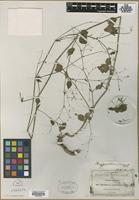
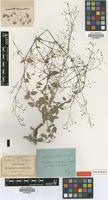
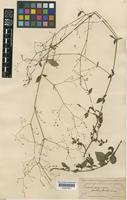
Type? of Boerhavia gracillima Heimerl [family NYCTAGINACEAE]
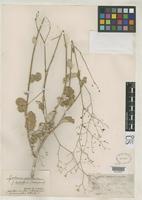
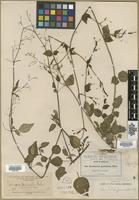
Holotype of Boerhavia gracillima subsp. decalvata Heimerl, A. 1909 [family NYCTAGINACEAE]
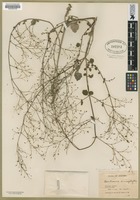
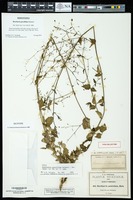
Isolectotype of Boerhavia gracillima Heimerl [family NYCTAGINACEAE]
Filed as Boerhavia paniculata Rich. [family NYCTAGINACEAE]
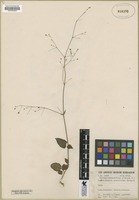
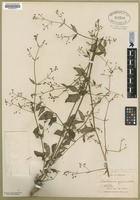
Isosyntype of Boerhavia gracillima Heimerl [family NYCTAGINACEAE]
Filed as Boerhavia gracillima Heimerl [family NYCTAGINACEAE]
Boerhavia gracillima Heimerl [family NYCTAGINACEAE]
Previous
Next

Name

Identification
Boerhavia gracillima Heimerl [family NYCTAGINACEAE ] (stored under name); Verified by Heimerl, A., Boerhavia paniculata Rich. [family NYCTAGINACEAE ] Verified by Pringle, C.G., Boerhavia gracillima Heimerl [family NYCTAGINACEAE ] Verified by Not on sheet,
Related name
  • Boerhavia gracillima
  • Boerhavia paniculata
Common name
  • Slimstalk spiderling, Flora of North America Vol. 4

Flora

Entry for Boerhavia gracillima Heimerl [family NYCTAGINACEAE]
Herbarium
Flora of North America (FNA)
Collection
Flora of North America
Resource Type
Reference Sources
Entry From
Flora of North America, Vol 4,
Names
Boerhavia gracillima Heimerl [family NYCTAGINACEAE], Bot. Jahrb. Syst., 11: 86, plate 2, fig. 1. 1889
Boerhavia gracillima subsp. decalvata Heimerl ex Standley [family NYCTAGINACEAE]
Boerhavia organensis Standley [family NYCTAGINACEAE]
Treatment Author(s)
Richard W. Spellenberg
Information
Herbs, perennial, often woody at base; taproot long and ropelike, woody. Stems decumbent to erect, usually profusely branched throughout, 2–15 dm, usually minutely pubescent, rarely glabrous basally, usually glabrous, rarely sparsely and minutely pubescent distally. Leaves mostly in basal 1/2 of plant; larger leaves with petiole 3–25 mm, blade broadly rhombic to elliptic-oblong, broadly to narrowly ovate, occasionally wider than long, 18–45 × 13–50 mm (distal leaves smaller, proportionately narrower), adaxial surface glabrous, abaxial surface much paler than adaxial surface, glabrous or with hairs on veins, neither surface punctate, base usually obtuse to round, sometimes shallowly cordate, margins entire or sinuate, often undulate, apex acute, obtuse, or round. Inflorescences axillary or terminal, forked ca. 6–8 times unequally, diffuse, without sticky internodal bands; branches divergent, terminating in 1(–3) flowers. Flowers: pedicel slender, 3–13 mm; bracts at base of perianth quickly deciduous, 2–3, linear-lanceolate to broadly lanceolate, 0.3–1.5 mm, quickly deciduous; perianth wine red to brick red, widely funnelform distal to constriction, 2–4.5 mm; stamens (4–)5(–6), well exserted. Fruits usually borne singly, gray-brown to brown, oblong-clavate, 2.8–4.2 × 1–1.5 mm (l/w: [2–]2.2–3.5[–3.8]), apex round to rounded-conic, minutely puberulent, sometimes minutely glandular, rarely glabrous; ribs 5, rounded, smooth or slightly rugose near sulci; sulci 1–2.5 times as wide as base of ribs, not rugose, smooth or minutely papillate.
Phenology
jun-aug (summer), sep-nov (fall)
Altitude range
[100–]600–2000 m;
Distribution
Mexico.USA Ariz.USA N.Mex.USA Tex.
Discussion
The phase Boerhavia gracillima subsp. decalvata from low elevations in the Big Bend region of Texas and adjacent Mexico differs from the remainder of B. gracillima in that it is usually erect or strongly ascending, has glabrous fruits, and has flowers with purple to brick red perianths; the flowers are also in the upper half of the size range for the species. It is highly local and completely intergradient with surrounding populations of B. gracillima in the strict sense. In fruit and flower features the phase resembles B. anisophylla; in its diffuse inflorescence with slender branches (0.15 mm diam. proximal to the flower versus 0.25 mm in B. anisophylla) and in its deciduous bracts it is more similar to B. gracillima. Some populations of B. gracillima also have glabrous fruits, and a local endemic in Durango, B. chrysantha Barneby, differs primarily in its yellow perianths similar in size to those of B. gracillima subsp. decalvata. The complex is in need of careful study.

Related Materials

  • Terms and Conditions
  • Privacy Policy
  • Cookie Policy
  • Cookie Settings
  • Accessibility
  • Help
  • Contact Us
  • Facebook
  • Twitter
ITHAKA

JSTOR is part of ITHAKA, a not-for-profit organization helping the academic community use digital technologies to preserve the scholarly record and to advance research and teaching in sustainable ways.

©2000-2026 ITHAKA. All Rights Reserved. JSTOR®, the JSTOR logo, JPASS®, Aluka®, and ITHAKA® are registered trademarks of ITHAKA.

╳