

Compilation
Bistella digyna
1 Images see all
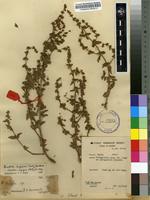
Name
Identification
Bistella digyna (Retz.) Bullock [family VAHLIACEAE ] (stored under name); Verified by Daramola,B.O., 1970
Related name
- Bistella digyna
Flora
Entry for VAHLIA digyna (Retz.) Kuntze [family VAHLIACEAE]
Herbarium
Royal Botanic Gardens, Kew (K)
Collection
Flora of Tropical East Africa
Resource Type
Reference Sources
Entry From
Flora of Tropical East Africa, page 1, (1975) Author: M. Bridson
Names
VAHLIA digyna (Retz.) Kuntze [family VAHLIACEAE], Rev. Gen. Pl.: 227 (1891); G.E.C. Fischer in K.B. 1932: 56 (1932), pro parte; F.P.S.: 79 (1950), pro parte; F.W.T.A., ed. 2, 1: 120 (1954), pro parte; E.P.A.: 172 (1954), pro parte; Schonbeck-Temesy in Rechinger, Fl. Iran. 23: 4 (1966); Rampi in Adum. Fl. Aeth. 25, Webbia 28: 528, fig. 2/A, 3/A, D, 4 (1973); Bridson in K.B. 30: 177, fig. 1/ A–H (1975). Type: India, E. Tranquebar, Koenig (LD, holo., ?K, iso.!)
Oldenlandia digyna Retz. [family RUBIACEAE], Obs. Bot. 4: 23 (1786)
Oldenlandia decumbens Spreng. [family RUBIACEAE], Pl. Min. Cog. Pugil. Prim. 2: 36 (1815), nom. superfl. Type as for species
Vahlia ramosissima DC. [family VAHLIACEAE], Prodr. 4: 54 (1830); Hook., Niger FL: 374 (1849); Oliv., F.T.A. 2: 383 (1871). Type: Senegal, Walo, Perrottet & Leprieur (P, holo.)
Vahlia sessiliflora DC. [family VAHLIACEAE], Prodr. 4: 54 (1830), nom. superfl. Type as for species
Vahlia viscosa Roxb. [family VAHLIACEAE], Fl. Indica, ed. Carey, 2: 89 (1832); Wight, Ic. Pl. Ind. Or. 2, t: 563 (1843); Hook. f. & Thomson in J.L.S. 2: 74 (1857), pro parte; Oliv., F.T.A. 2: 383 (1871), pro parte; Engl., P.O.A. C: 189 (1895) & V.E. 3(1): 286 (1915), pro parte; F.W.T.A. 1: 106 (1927), pro parte; E. & P. Pf., ed. 2, 18a: 166 (1930), pro parte; A. Chev., Fl. Afr. Occ. Franç. 1: 283 (1938), pro parte, nom. superfl. Type as for species
Vahlia menyharthii Schinz [family VAHLIACEAE], in Bull. Herb. Boiss., sér. 2, 2: 944 (1902). Type: Mozambique, Tete, Boroma, Menyharth 1069 (Z, holo., K, iso.!)
Bistella digyna (Retz.) Bullock [family VAHLIACEAE], in Acta Bot. Neerl. 15: 85 (1966) & Med. Bot. Mus. Herb. Rijksuniv. Utrecht 229: 85 (1966), pro parte
Information
Erect sparsely to much-branched annual herb 5–35 cm. tall; stems covered with patent or crisped, often glandular, hairs. Leaves ovate to ovate-lanceolate, 0.5–2.5(–4.8) cm. long, 0.2–0.6(–0.9) cm. wide, acute at apex, tapering or rounded at base, usually with only a few hairs but occasionally pubescent. Flowers sessile or subsessile (peduncles and pedicels up to 1 mm.). Calyx-tube 1.1–2 mm. long, sparsely covered in patent or shorter crisped hairs; lobes ovate, 1.3–2 mm. long, 0.6–1.2 mm. wide, acute, glabrous or sparsely pubescent outside. Petals yellow, fading to white, always shorter than sepals, round to ovate, l–l.3(–l.6) mm. long, 0.55–1 mm. wide, usually distinctly apiculate, narrowed to base, entire to finely or irregularly crenate towards apex, with midvein alone distinct. Filaments 0.3–1.1 mm. long, translucent with vein apparent, with a small membranous hairy scale-like appendage at the base; anthers 0.15–0.4 mm. long. Style-bases distinctly thickened, not separating for 0.15–0.3 mm. above the disc; styles 0.7–1.3 mm. long, glabrous. Capsule 1.4–2.2 mm. long, sparsely pubescent. Seeds straw-coloured, ovoid-cylindrical, 0.15–0.27 mm. long, with indistinct longitudinal ridges. Fig. 1/1–8.
Range
DISTR. K1, 4, 7; T1, 3, 5, 7, 6/8 south of the Sahara from Senegal to Somalia, Mozambique, Zambia, Rhodesia and Botswana;
Altitude range
450–1127 m.
Distribution
KENYA Northern Frontier Province Ayangyangi swamp, 12 June 1970, Mathew & Gwynne 6767 !KENYA S. Nyeri District Mwea-Tebere Irrigation Station, 12 Aug. 1958, Bogdan 4613 !KENYA Tana River District W. of Galole, Makin !TANZANIA Lushoto District 8 km. SE. of Mkomazi, 2 May 1953, Drummond & Hemsley 2390 !TANZANIA Dodoma District 15 km. SW. of Logi, 26 Aug. 1970, Thulin & Mhoro 791 !TANZANIA Iringa District Great Ruaha R., Mtera, 18 Apr. 1962, Polhill & Paulo 2064 !
Distribution (external)
Egypt
India
Pakistan
Notes
V. digyna has frequently been treated in a broad sense to include V. geminiflora and V. somalensis. The differences are clear and constant.