JSTOR Global Plants Home
  • Home
  • Browse
  • About
  • Access
  • Account
    • Saved Items
    • Profile
  • Log in

Global Plants

Skip to Main Content
  • JSTOR Global Plants Home
  • Global Plants

    • Browse
    • About
    • Access
    • Account
      • Saved Items
      • Profile
Log in
  • Browse
  • About
  • Access
  • Account
    • Saved Items
    • Profile
Advanced Search

Compilation
Betula verrucosa

6 Images see all

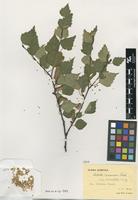
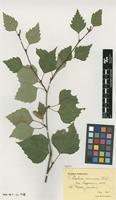
Type of Betula verrucosa Ehrh. var. saxatilis Lindq. [family BETULACEAE]
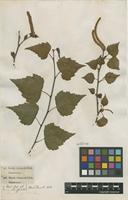
Type? of Betula verrucosa Ehrh. [family BETULACEAE]
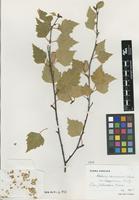
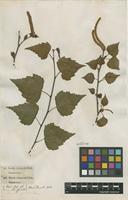
Type of Betula verrucosa Ehrh. var. lapponica Lindq. [family BETULACEAE]
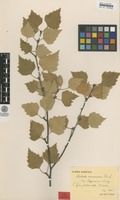
Type? of Betula verrucosa Ehrh. [family BETULACEAE]
Previous
Next

Name

Identification
Betula verrucosa Ehrh. [family BETULACEAE ] (stored under name); Verified by Not on sheet,
Related name
  • Betula verrucosa
Common name
  • European white birch, Flora of North America Vol. 3
  • silver birch, Flora of North America Vol. 3
  • bouleau pleureur, Flora of North America Vol. 3
  • Weeping birch, Flora of North America Vol. 3

Flora

Entry for Betula pendula Roth [family BETULACEAE]
Herbarium
Flora of North America (FNA)
Collection
Flora of North America
Resource Type
Reference Sources
Entry From
Flora of North America, Vol 3,
Names
Betula pendula Roth [family BETULACEAE], Tent. Fl. Germ., 1: 405. 1788
Betula verrucosa Ehrhart [family BETULACEAE]
Information
Trees, to 25 m; trunks usually several, crowns spreading. Bark of mature trunks and branches creamy to silvery white, smooth, exfoliating as long strands; lenticels dark, horizontally expanded. Branches pendulous; twigs glabrous, usually dotted with small resinous glands. Leaf blade broadly ovate to rhombic with 5--18 pairs of lateral veins, 3--7 × 2.5--5 cm, base cuneate, rarely truncate, margins coarsely and sharply doubly serrate, apex acuminate; surfaces abaxially glabrous to sparsely pubescent, covered with minute, resinous glands. Infructescences erect to nearly pendulous, cylindric, 2--3.5 × 0.6--1 cm, shattering with fruits in fall; scales adaxially sparsely pubescent, lobes diverging at middle, central lobe obtuse, much shorter than lateral lobes, lateral lobes broad, rounded, extended. Samaras with wings much broader than body, broadest near center, extended beyond body apically. 2n = 28, 56.
Phenology
Flowering late spring
Altitude range
0--350 m
Distribution
EuropeAsia.USA Conn.USA Mass.USA N.H.USA N.Y.USA OhioUSA Pa.USA Vt.USA Wash.Canada B.C.Canada Man.Canada Ont.
Discussion
The Eurasian weeping birch (Betula pendula) is extensively cultivated throughout the temperate range of the flora, and it has been known to persist or to become locally naturalized in several areas, particularly in the Northeast. In vegetative features it resembles B. populifolia Marshall, to which it is closely allied; it can easily be distinguished from the latter by its peeling bark, as well as by its mostly pubescent leaves with somewhat shorter, acuminate apices.

Related Materials

  • Terms and Conditions
  • Privacy Policy
  • Cookie Policy
  • Cookie Settings
  • Accessibility
  • Help
  • Contact Us
  • Facebook
  • Twitter
ITHAKA

JSTOR is part of ITHAKA, a not-for-profit organization helping the academic community use digital technologies to preserve the scholarly record and to advance research and teaching in sustainable ways.

©2000-2026 ITHAKA. All Rights Reserved. JSTOR®, the JSTOR logo, JPASS®, Aluka®, and ITHAKA® are registered trademarks of ITHAKA.

╳