JSTOR Global Plants Home
  • Home
  • Browse
  • About
  • Access
  • Account
    • Saved Items
    • Profile
  • Log in

Global Plants

Skip to Main Content
  • JSTOR Global Plants Home
  • Global Plants

    • Browse
    • About
    • Access
    • Account
      • Saved Items
      • Profile
Log in
  • Browse
  • About
  • Access
  • Account
    • Saved Items
    • Profile
Advanced Search

Compilation
Berberis nervosa

8 Images see all

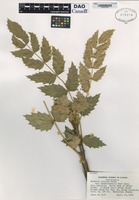
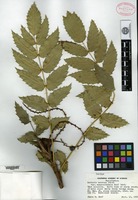
Isotype of Berberis nervosa Pursh variety mendocinensis Roof [family BERBERIDACEAE]
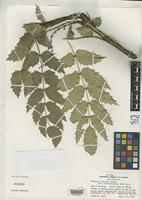
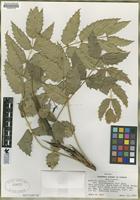
Isotype of Berberis nervosa var. mendocinensis Roof, J.B. 1969 [family BERBERIDACEAE]
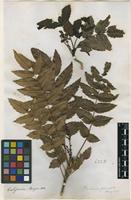
Filed as Berberis pinnata Lag. [family BERBERIDACEAE]
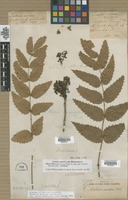
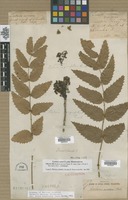
Lectotype of Berberis nervosa Pursh [family BERBERIDACEAE]
Isotype of Berberis nervosa Pursh var. mendocinensis Roof [family BERBERIDACEAE]
Isotype of Berberis nervosa Pursh var. mendocinensis Roof Ined. [family BERBERIDACEAE]
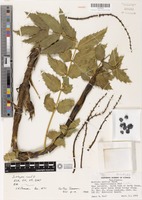
Holotype of Berberis nervosa Pursh var. mendocinensis J.B. Roof [family BERBERIDACEAE]
Filed as Berberis nervosa Pursh [family BERBERIDACEAE]
Previous
Next

Name

Identification
Berberis nervosa Pursh [family BERBERIDACEAE ] (stored under name); Verified by Roof, James B.,
Related name
  • Berberis nervosa

Flora

Entry for Berberis nervosa Pursh [family BERBERIDACEAE]
Herbarium
Flora of North America (FNA)
Collection
Flora of North America
Resource Type
Reference Sources
Entry From
Flora of North America, Vol 3,
Names
Berberis nervosa Pursh [family BERBERIDACEAE], Fl. Amer. Sept., 219. 1814
Berberis nervosa Pursh var. mendocinensis Roof [family BERBERIDACEAE]
Mahonia nervosa (Pursh) Nuttall [family BERBERIDACEAE]
Mahonia nervosa var. mendocinensis (Roof) Roof [family BERBERIDACEAE]
Information
Shrubs, evergreen, 0.1-0.8(-2) m. Stems monomorphic, without short axillary shoots. Bark of 2d-year stems brown or yellow-brown, glabrous. Bud scales (13-)20-44 mm, persistent. Spines absent. Leaves 9-21-foliolate; petioles 2-11 cm. Leaflet blades thin and ± flexible; surfaces abaxially rather dull, smooth, adaxially dull, somewhat glaucous; terminal leaflet stalked, blade 2.9-8.4 × 1.2-4.8 cm, 1.8-3.2 times as long as wide; lateral leaflet blades lance-ovate to ovate, 4-6-veined from base, base rounded to cordate, margins plane, toothed, each with 6-13 teeth 1-2(-3) mm tipped with spines to 1-2.4 × 0.1-0.2 mm, apex acute or broadly acuminate. Inflorescences racemose, dense, 30-70-flowered, 6-17 cm; bracteoles membranous, apex acute, obtuse, or rounded. Flowers: anther filaments without distal pair of recurved lateral teeth. Berries blue, glaucous, oblong-ovoid or globose, 8-11 mm, juicy, solid. 2n = 56.
Phenology
Flowering winter-spring (Mar-Jun)
Altitude range
0-1800 m
Distribution
USA Calif.USA IdahoUSA Oreg.USA Wash.Canada B.C.
Discussion
Plants of Berberis nervosa are usually very low (commonly 0.1-0.3 m), but occasional plants may be considerably taller (to 2 m). One such population from north of Westport, California, has been separated as B. nervosa var. mendocinensis. Similar populations occur sporadically throughout the range of B. nervosa, so the form should not be recognized taxonomically.
Berberis nervosa is resistant to infection by Puccinia graminis.
The Skagit tribe used Berberis nervosa medicinally in a root preparation to treat venereal disease (D. E. Moermann 1986).

Related Materials

  • Terms and Conditions
  • Privacy Policy
  • Cookie Policy
  • Cookie Settings
  • Accessibility
  • Help
  • Contact Us
  • Facebook
  • Twitter
ITHAKA

JSTOR is part of ITHAKA, a not-for-profit organization helping the academic community use digital technologies to preserve the scholarly record and to advance research and teaching in sustainable ways.

©2000-2026 ITHAKA. All Rights Reserved. JSTOR®, the JSTOR logo, JPASS®, Aluka®, and ITHAKA® are registered trademarks of ITHAKA.

╳