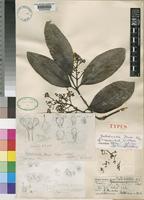
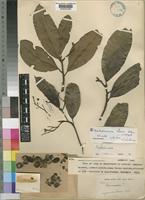
Stuhlmann 1231 (Uganda, Masaka District, Sese Is., 15 Dec. 1890) is by far the earliest specimen collected and bears an epithet commemorating Emin Pasha but the name appears never to have been published. It is in rather immature flower and had at first been placed in Dovyalis and ? Homalium .West Nile District is included in the distribution in I.T.U. but the gathering seen - Otzi [Otze] Reserve, 15 Dec. 1952, Leggat 96 - has rather larger leaves 15-23× 4.7-7.8 cm. and, although some fruits are 3.2-3.5 × 1.3-1.5 cm., a proportion are only 0.9-1 cm. wide, one distinctly sausage-shaped 4.3 × 0.9 cm. and the wall is woody. I.T.U. also gives Madi (Zoka Forest) but I have seen no material. Only complete material would remove doubts concerning the identification but it is likely these northern populations are no longer extant.B.daweihas exactly the same facies as B. ugandensisand comes from within its distribution; the differences given are densely pubescent not glabrous ovary, longer pedicels and less densely pubescent inflorescences. I believe it is no more than a form of B. ugandensis. Stapf (certainly no ‘ lumper’ !) annotated Dawe 964 as this SPECIES and it bears a drawing by Matilda Smith. In F.T.A. Stapf states ovary glabrous but in Hook., Ic. Pl. he states ovary glabrous or pubescent. In the same account he gives the fruit size as 6 × 1.7 cm. but the figure, said to be natural size, shows it about 3.2 × 2 cm.Robyns & R. Wilczek (B.J.B.B. 19: 473 (1949)) describe a var. katangensis (Type: Zaire, Katanga, Lubumbashi [Elisabethville], Keyberg, Kisanga Forest, Schmitz 2013 (BR, holo.)), differing in small characters: puberulous inflorescence-axes, larger flowers 3-4.2 mm. wide, outer anthers slightly larger and drupes 2 × 1.6 cm. (see also F.C.B. 2: 422, photo. 3 (1951)). It seems reasonable that so isolated a population should be a separate taxon. Material reported from Zambia under the varietal name is only partly correct, large fruited specimens obviously belonging to a different SPECIES.Five sheets from Tanzania, Kigoma District are puzzling but four are sterile — Kasakati, 5 Mar. 1964, Itani 158; Milanga, 17 Feb. 1967, Kano 209; Firabanga R., 11 Mar. 1967, Kano 232 & 224. At least one leaf has a distinctly acuminate apex. A fifth has all the leaves blunt or rounded at the apex but the fruits are ellipsoid, 2 × 1.4 - 1.6 cm.; the seeds are loose but this may not be certain evidence they are mature. The largest leaves attain 23 × 8.8 cm. It is impossible to deal adequately with this genus with such inadequate material but theT4 material is probably best treated as B. ugandensis until fuller material is available. It seems worth citing the localities to show where further material might be found.