

Name
Identification
Bauhinia mombassae Vatke [family LEGUMINOSAE ]
Related name
- Bauhinia mombassae
Flora
Entry for BAUHINIA mombassae Vatke [family LEGUMINOSAE-CAESALPINIOIDEAE]
Herbarium
Royal Botanic Gardens, Kew (K)
Collection
Flora of Tropical East Africa
Resource Type
Reference Sources
Entry From
Flora of Tropical East Africa, page 1, (1967) Author: J. P. M. Brenan
Names
BAUHINIA mombassae Vatke [family LEGUMINOSAE-CAESALPINIOIDEAE], in Oesterr. Bot. Zeitschr. 30: 279 (1880); L.T.A.: 655 (1930); K.T.S.: 96 (1961). Type: Kenya, Mombasa, Hildebrandt 2006 (? B, holo. †, BM, K, iso.!)
Information
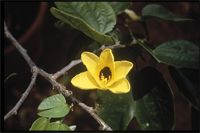
Shrub (Kelly 1230). Young branchlets ± densely brownish-pubescent. Leaves ± 3.5–12.5 cm. long, 4–10 cm. wide, mostly larger than in B. tomentosa, bilobed at apex to about one-third to half way down with lobes ± tapering to an obtuse or rounded point and usually ± divergent, cordate at base, densely and softly pubescent beneath. Flowers in lateral and terminal several- to many-flowered panicles, whose lateral branches are sometimes few and short. Braeteoles broad and conspicuous, enfolding the flower-buds. Pedicels short, up to ± 7 mm. long. Flower-buds: upper part (i.e. sepals) lanceolate in outline, ± 1.9–2.2 cm. long before anthesis, pubescent outside; hypanthium ± 3–4 mm. long, slightly sulcate. Petals apparently obovate to suborbicular, ± 3–5 cm. long, not clawed, 4 of them yellow with bright orange bases, the fifth with a deep crimson patch at base. Fertile stamens 10. Stigma apparently peltate and terminal. Pods thinly woody, 7–12 cm. long, 1.4–2 cm. wide. Seeds unknown.
Range
DISTR. K7 not so far known with certainty from elsewhere, but see note below
Distribution
KENYA Without precise locality, comm. May 1880, Wakefield !KENYA Mombasa, June 1876, Hildebrandt 2006 !KENYA Kwale/Kilifi District banks of Saponi R. near Mazeras, Kelly 1230! & in C.M. 13911!
Notes
Much allowance should be made for imperfections and errors in the description of this species, of which I have only seen the four gatherings cited above, none of them good. Although clearly related to B. tomentosa, B. mombassae in my opinion is beyond question a good species, distinguished by its rather large leaves with cordate bases and divergent tapering lobes, by the paniculate inflorescences, short pedicels, and especially by the broad boat-shaped convex braeteoles enfolding the unopened flower-buds.A fruiting gathering similar to B. mombassae but with rounded-subtruncate, not at all cordate leaf-bases was made in Tanganyika, Morogoro District, Nguru Mts., Koruhamba, Nov. 1953, Paulo 216 ! More material is needed of this, as it is of typical B. mombassae. A flowering isotype of B. loeseneriana Harms in E.J. 33: 158 (1902); L.T.A.: 655 (1930); T.T.C.L.: 88 (1949) [Type: SE. Tanganyika, Kwa-Mkopo on the Ruvuma R., Busse 1027 (B, holo. †, iso. (fragment)!, EA, iso.!)] exactly, matches Paulo 216, as far as they can be compared. At present I would consider the non-cordate leaf-bases and the (in B. loeseneriana) 5–6 mm. long points to the sepals of little taxonomic importance and B. loeseneriana to be thus only a minor variation of B. mombassae.