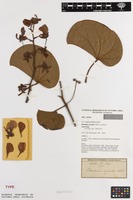
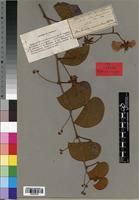
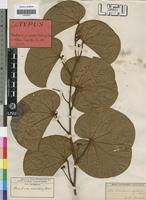
A climbing rusty-tomentose or pubescent shrub; extremities sulcate or obtusely angular, the ridges occasionally at length glabrate. Leaves firmly membranous, suborbicular or transversely dilated, 3–7 in. broad, basal sinus usually narrow (segments sometimes overlap), extending about one-third the length of leaf, apical sinus very broad and shallow or apex entire; leaflets broadly rounded above and below each with 5–7 strong divaricately forking nervures beneath, glabrous sometimes glaucous above, tomentose or tomentose-pilose on the under surface and petioles which vary from 2–6 in. in length. Racemes pedunculate, laxly 6–18-flowered, clothed with ferruginous tomentum, with the peduncle 1/2–1 ft. long. Bracts narrow, 1/4– 1/2 in. long, usually present at flowering. Pedicels ascending, or at length patent, sometimes slightly recurved towards the apex, 1–2 in. long. Buds ellipsoidal, rather obtuse, 3/4 in. long. Calyx-tube campanulate, about 1/3– 1/2 as long as the linear segments, which are more or less distinctly dorsally carinate towards the apex. Anterior petals yellow or orange, pilose externally, rotundate, clawed, 2–4 times longer than the calyx; posterior petal with a prominent erect narrow bifid callus, nearly 2 lines in length. Fertile stamens usually 2. Ovules 2. Legume flat at right angles to the gynophore of 1/2 in. in length, obliquely obovate or rotundate, rounded or apiculate at the apex, 2-valved, valves hard, smooth, or faintly ridged transversely, the ventral suture but inconspicuously thickened; valves consolidated towards the apex and dorsal suture, 3 1/2–4 in. long, 2 1/2 in. broad. Seeds not examined.