JSTOR Global Plants Home
  • Home
  • Browse
  • About
  • Access
  • Account
    • Saved Items
    • Profile
  • Log in

Global Plants

Skip to Main Content
  • JSTOR Global Plants Home
  • Global Plants

    • Browse
    • About
    • Access
    • Account
      • Saved Items
      • Profile
Log in
  • Browse
  • About
  • Access
  • Account
    • Saved Items
    • Profile
Advanced Search

Compilation
Basananthe pedata

4 Images see all

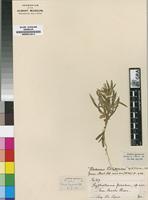
Isotype of Tryphostemma pedatum Baker f. [family PASSIFLORACEAE]
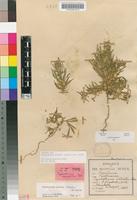
Holotype of Tryphostemma arenophilum Pott [family PASSIFLORACEAE]
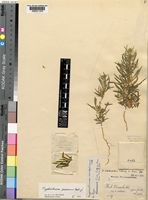
Basananthe pedata (Baker f.) W.J.de Wilde [family PASSIFLORACEAE]
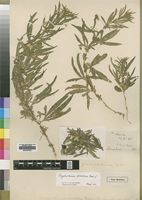
Type of Tryphostemma pedatum Baker f. [family PASSIFLORACEAE]
Previous
Next

Name

Identification
Basananthe pedata (Baker f.) W.J.deWilde [family PASSIFLORACEAE ] (stored under name); Tryphostemma pedatum Baker f. [family PASSIFLORACEAE ] Verified by deWilde,W.J.,
Related name
  • Tryphostemma pedatum
  • Tryphostemma arenophilum
  • Basananthe pedata

Flora

Entry for Basananthe pedata [family PASSIFLORACEAE]
Herbarium
South African National Biodiversity Institute, Compton Herbarium, Cape Town (SAM)
Collection
Flora of Southern Africa
Resource Type
Reference Sources
Entry From
Flora of South Africa, (2003) Author: Dr J.P. Roux
Names
Basananthe pedata [family PASSIFLORACEAE]
Common names
Tryphostemma pedatum Bak.f. in J. Bot. Lond. 37: 436 (1899); Hutch. & Pearce in Kew Bull. 1921: 263 (1921). T. schlechteri Schinz in Vjschr. Naturf. Ges. Zurich 55: 243 (1911); Schreiber in F.S.W.A. 89: 2 (1968). Type: Trans­vaal, Schlechter 4596 (B, hole!; HBG). T. arenophilum Pott in Ann. Transv. Mus. 5: 234 (1915). Type: Transvaal, Leendertz 2062 (PRE, holo.!; K). T. harmsianum Dinter in Feddes Rep. 24: 304 (1928). Type: S.W. Africa, Dinter 872 (Bt, holo.;M).
Information
Erect annual or biennial herb up to 50 cm, glabrous or slightly scabrous, often with some spreading-erect branches from the base; tendrils absent. Leaves deeply pedately 3-7 (-9)-lobed, the lobes elliptic to linear, (0,5-) 1-8 cm, obtuse to acute-acuminate, margin remote- to densely dentate-mucronate (serrate) up to 1,5 mm; leaf-base subcordate to long-cuneate, de-current in the alate petiole 0,2-1,5 cm. Stipules 2-6 mm; false stipules foliaceous, asymmetri­cal, 0,5-2 cm, acute-acuminate, mucronate. Inflorescences 1- or 2-flowered; peduncle up to 2 cm; bracts 2—4 mm. Flowers glabrous; stipe 1,5-3,5 mm; hypanthium 1-2 mm wide. Sepals 2,5-4,5 mm, with (2-) 3-keeled or winged green nerves. Petals 2-4,5 mm. Outer corona-tube (0,5-) 0,7-1,3 mm, threads (0,5-) 0,7-1 mm. Disc 0,1-0,2 mm. Inner corona cup-shaped, 0,3-0,8 mm. Stamens 5; filaments 1-1,5 mm; anthers 0,5-1 mm. Ovary 0,5-1,5 mm; styles free, 0,6-2,3 mm. Fruit subsessile, (0,7-) 1 cm, containing 1 seed c. 7 mm. Fig. 38: 4.
Use
1. Basananthe pedata (Bak.f.) De Wilde in Blumea 21: 333, fig. la, 5 (1974). Type: Rhodesia, Rand 67 (BM).
Range
Growing mostly in sandy soil of riverbeds or dunes, or in gravelly, or sometimes rocky soil; 400-1 200 m; occurs locally in Transvaal and in north-eastern South West Africa; also in Zambia, Rhodesia and Botswana.

Related Materials

  • Terms and Conditions
  • Privacy Policy
  • Cookie Policy
  • Cookie Settings
  • Accessibility
  • Help
  • Contact Us
  • Facebook
  • Twitter
ITHAKA

JSTOR is part of ITHAKA, a not-for-profit organization helping the academic community use digital technologies to preserve the scholarly record and to advance research and teaching in sustainable ways.

©2000-2026 ITHAKA. All Rights Reserved. JSTOR®, the JSTOR logo, JPASS®, Aluka®, and ITHAKA® are registered trademarks of ITHAKA.

╳