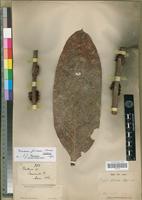
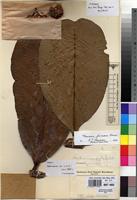
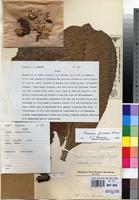
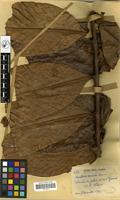
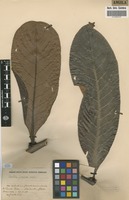
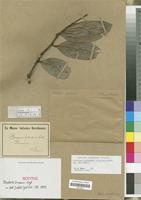
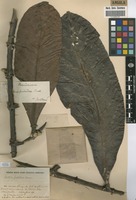
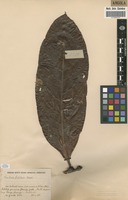
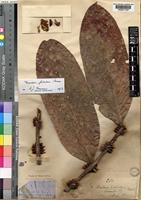
Barteria fistulosaMast. [family PASSIFLORACEAE ] Verified by Not on sheet, Barteria fistulosaMast. [family PASSIFLORACEAE ] (stored under name); Verified by Breteler F.J., 1993
Related name
Barteria erosula
Barteria fistulosa
Barteria braunii
Barteria nigritana
Common name
ngibe (ZOG) (NIGERIA, HAUSA), Burkill, H.M. 1985. The useful plants of west tropical Africa, Vol. 4
arbre à fourmis (= ant tree) (Gabon, Walker)., Burkill, H.M. 1985. The useful plants of west tropical Africa, Vol. 4
òko (KO&S) (NIGERIA, YORUBA), Burkill, H.M. 1985. The useful plants of west tropical Africa, Vol. 4
ogeimi (JMD; KO&S) (NIGERIA, EDO), Burkill, H.M. 1985. The useful plants of west tropical Africa, Vol. 4
ọje (KO&S) (NIGERIA, IGBO), Burkill, H.M. 1985. The useful plants of west tropical Africa, Vol. 4
(Kolokuma) ịgbangị́tarịghá (KW&T) (NIGERIA, IJO-IZON), Burkill, H.M. 1985. The useful plants of west tropical Africa, Vol. 4
Flora
Entry for BARTERIA fistulosa Mast. [family PASSIFLORACEAE]
Herbarium
Royal Botanic Gardens, Kew (K)
Collection
Flora of Tropical Africa
Resource Type
Reference Sources
Entry From
Flora of Tropical Africa, Vol 2, page 503, (1871) Author: (By Mr. J. G. Baker.)
Names
BARTERIA fistulosaMast. [family PASSIFLORACEAE]
Information
A small tree with angular, smooth or lenticellate, fistular branches. Leaves leathery, 10–12 in. long, 3–4 in. wide, oblong, obtuse, glabrous, 1-nerved, somewhat narrower at the base which is decurrent along the branch. Stipules 0. Flowers sessile, in linear clusters emerging from the stem between it and the decurrent edges of the leaf, each encircled at the base by numerous overlapping leathery shining chestnut-coloured oblong obtuse or boat-shaped bracts increasing in size from below upwards. Flowers smaller than those of B. nigritiana. Sepals and petals downy on the outside, lanceolate, wavy at the margins. Corona and inner organs of the flower as in the last-named species but smaller. Anthers apiculate.
Distribution
Fernando Po Upper Guinea Mann!
Notes
The so-called decurrent leaves would probably be more correctly described as congenitally adnate to the branch for some distance. The manner in which the flowers emerge from between the sides of the base of the leaf and the stem is very curious.