

Compilation
Balanites australis
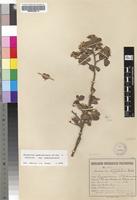
1 Images see all
Name
Identification
Balanites australis Bremek. [family BALANITACEAE ] Verified by Not on sheet, Balanites pedicellaris Mildbr. & Schltr. [family BALANITACEAE ] (stored under name); Verified by Martin J.S.Sands,
Related name
- Balanites pedicellaris
- Balanites australis
Flora
Entry for Balanites pedicellaris Mildbr. & Schlechter [family BALANITACEAE]
Herbarium
Royal Botanic Gardens, Kew (K)
Collection
Flora Zambesiaca
Resource Type
Reference Sources
Entry From
FZ, Vol 2, Part 1, page 221, (1963) Author: E. Launert
Names
Balanites pedicellaris Mildbr. & Schlechter [family BALANITACEAE], in Engl., Bot. Jahrb. 51: 162 (1913). — Engl. in Engl. & Prantl, Nat. Pflanzenfam. ed. 2, 19a: 182 (1931). — Brenan, T.T.C.L.: 571 (1949); in Mem. N.Y. Bot. Gard. 8, 3: 233 (1953). Type from Kenya.
Balanites australis Bremek. [family BALANITACEAE], in Ann. Transv. Mus. 15: 244 (1933). — Brenan, tom. cit.: 234 (1953). Type from the Transvaal.
Information
Much-branched shrub or small tree with pendulous branches, up to 6 m. or more high, variable in shape and size. Branches yellowish or greyish-green or grey, rather stiff, usually spiny, younger parts densely puberulous, glabrous when older; spines rather stout, simple. Leaves shortly petiolate; leaflets sessile, 1–3 (4) × 0·5–2·3 (3) cm., obovate, broadly obovate, obcuneate or rarely obovate-elliptic, apex rounded, rarely subtruncate, entire or slightly retuse, base always narrowly cuneate, subsucculent, very shortly and densely puberulous to subtomentose when young, later glabrescent; secondary nerves 3–5 pairs, not very prominent beneath; petiole 1·5–4 (6) mm. long, rather stout, ± densely pubescent at first, later glabrescent. Flowers c. 1·4 cm. in diam., in few- to many-flowered sessile or rarely shortly pedunculate fascicles; pedicels up to 2 cm. long, fairly stout, ± densely puberulous, very rarely glabrous. Sepals 6·5–7·5 × 3·2–5 mm., ovate to ovate-lanceolate, coriaceous, densely tomentellous outside, with long whitish silky hairs inside, acute, caducous. Petals 6·7–9 × (2·5) 2·8–3·4 mm., narrowly elliptic with an acutish apex, glabrous on both surfaces. Stamens with oblong anthers 2–2·8 mm. long; filaments c. 3·75 mm. long. Ovary densely covered with whitish silky hairs. Drupe orange, subglobose or broadly ellipsoid, usually somewhat flattened on both ends, 1·2–2·5 × 1·5–2 cm., finely puberulous when young, later usually glabrescent.
Habitat
In dry bushy or open woodland, on alluvial flood plains, amongst scattered trees.
Distribution
Mozambique M Maputo, Catuane, fl. 29.iv.1948, Torre 7744 (LISC).Mozambique GI Musamane, fl. 25.vi.1947, Pedro & Pedrógão 2061 (PRE).Malawi S Chikwawa, 200 m., 2.x.1946, Brass 17906 (K; PRE; SRGH).Zimbabwe S Beitbridge, fl. 22.iii.1959, Drummond 5937 (BM; K; PRE; SRGH).
Distribution (external)
Kenya
Tanganyika
Natal
N. Transvaal