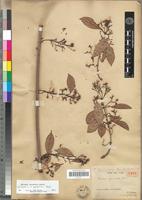
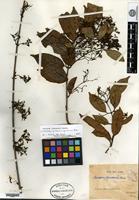
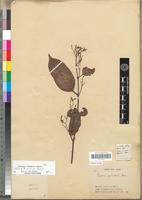
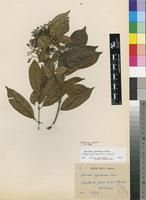
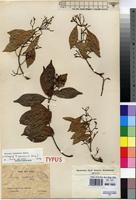
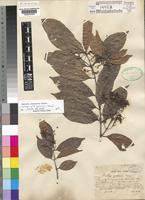
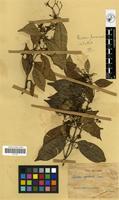
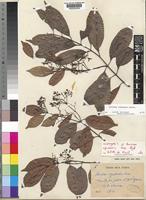
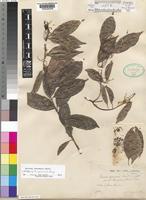
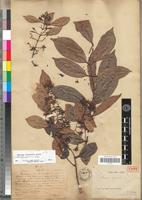
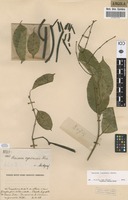
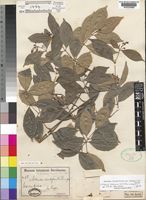
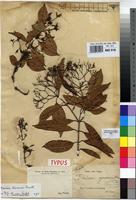
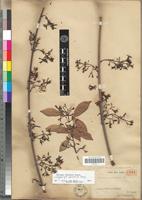
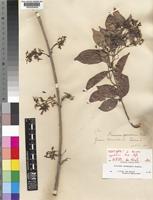
A powerful climbing shrub, quite glabrous except the inflorescences and nerve-axils; young branches compressed near the tips, soon terete, blackish when dry. Leaves oblong, acuminate (acumen rather broad subacute or obtuse, 2–4 lin. long), acute at the base, 2 1/2–3 1/2 in. long, 1 1/4–1 1/2 in. broad, papery, with small tufts of rust-coloured hairs in the nerve-axils below; secondary nerves 10–12 on each side, with almost parallel tertiary ones between them and the transverse veins, subhorizontal; nervation and reticulation slightly raised on both sides, faint; petioles slender, 4–9 lin. long. Cymes few- or many-flowered, in axillary or terminal usually ovoid or obovoid panicles, very minutely furfuraceous, blackish; peduncles very slender, 4–9 lin. long; bracts minute; pedicels filiform, up to 1 1/2 lin. long. Calyx globose-ovoid, 2/3 lin. long; sepals ovate, subacute, with a scanty extremely delicate tomentum like that of the pedicels; intracalycular glands 5, minute. Corolla white with crimson streaks in the throat, funnel-shaped; tube subcampanulate, not quite 1 1/2 lin. long, minutely papillose without, glabrous in the throat, calli transversely linear, more or less united into a ring; lobes linear, obtuse, over 2 lin. long. Anthers not quite 1 lin. long, minutely papillose on the back. Disc shallow, sinuate. Ovary-top pubescent; style obconical, rather slender, puberulous; stigma campanulate, with a long bifid subulate apex.