JSTOR Global Plants Home
  • Home
  • Browse
  • About
  • Access
  • Account
    • Saved Items
    • Profile
  • Log in

Global Plants

Skip to Main Content
  • JSTOR Global Plants Home
  • Global Plants

    • Browse
    • About
    • Access
    • Account
      • Saved Items
      • Profile
Log in
  • Browse
  • About
  • Access
  • Account
    • Saved Items
    • Profile
Advanced Search

Compilation
Baccharis pteronioides

8 Images see all

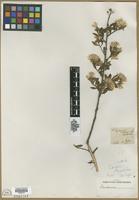
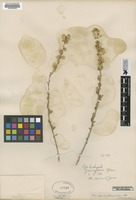
Type? of Corynia pteronioides Nutt. [family PAPAVERACEAE]
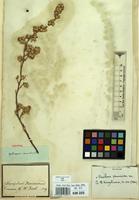
Isotype of Aplopappus ramulosus DC. [family COMPOSITAE]
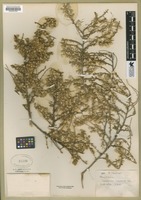
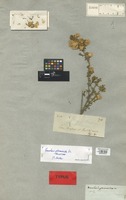
Filed as Baccharis pteronioides DC. [family ASTERACEAE]
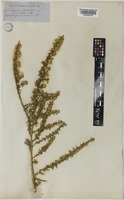
Baccharis pteronioides DC. [family COMPOSITAE]
Filed as Baccharis pteronioides [family ASTERACEAE]
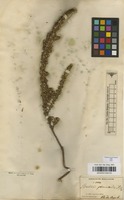
Holotype of Baccharis pteronioides DC. [family COMPOSITAE]
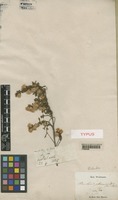
Filed as Baccharis pteronioides DC. [family COMPOSITAE]
Type of Baccharis pteronioides DC. [family COMPOSITAE]
Previous
Next

Name

Identification
Isotype of Aplopappus ramulosus DC. [family COMPOSITAE ] Verified by Not on sheet, Baccharis pteronioides DC. [family COMPOSITAE ] (stored under name); Verified by Not on sheet,
Related name
  • Baccharis pteronioides
  • Aplopappus ramulosus
Common name
  • Yerba de pasmo, Flora of North America Vol. 20

Flora

Entry for Baccharis pteronioides de Candolle [family COMPOSITAE]
Herbarium
Flora of North America (FNA)
Collection
Flora of North America
Resource Type
Reference Sources
Entry From
Flora of North America, Vol 20,
Names
Baccharis pteronioides de Candolle [family COMPOSITAE], in A. P. de Candolle and A. L. P. P. de Candolle, Prodr., 5: 410. 1836
Baccharis ramulosa (de Candolle) A. Gray [family COMPOSITAE]
Treatment Author(s)
Scott D. Sundberg†
David J. Bogler
Information
Shrubs, 30–100 cm (diffusely and evenly branched with thick woody crowns). Stems erect, terete, brittle, slightly striate, scabrous, stipitate-glandular, papillose-roughened. Leaves cauline (proximal withering before flowering, distal crowded in gascicles); sessile; blades linear to lanceolate or spatulate, 5–25 × 1–6 mm (stiff, coriaceous to fleshy), bases attenuate, margins sharply serrate (teeth 1–5 pairs, distal leaves often entire), faces glabrous, gland-dotted, resinous. Heads (10–20+ on densely leafy lateral branchlets) in spreading racemiform arrays. Involucres campanulate; staminate 4–5 mm, pistillate 5–6(–7) mm. Phyllaries ovate to lanceolate, 1–5 mm, margins scarious, medians green, apices acute to acuminate, glabrous. Staminate florets 15–20; corollas 4–5 mm. Pistillate florets 15–20; corollas 4–5 mm. Cypselae 1.8–3 mm, 8–10-nerved, minutely papillose-glandular; pappi 8–10 mm (bristles rigid).
Phenology
apr-may (spring), jun (summer)
Altitude range
300–2000 m;
Distribution
Mexico.USA Ariz.USA N.Mex.USA Tex.
Discussion
Baccharis pteronioides is characterized by its shrubby stiff habit, rough gray bark, branches that are evenly spaced and often at 45° angles, fascicles of narrow sessile leaves, and heads in racemiform arrays on short leafy branches. The Mexican common name yerba de pasmo refers to an infusion of the leaves used to treat chills (pasmo) and sores; the plants are also said to be poisonous to cattle and sheep.

Related Materials

  • Terms and Conditions
  • Privacy Policy
  • Cookie Policy
  • Cookie Settings
  • Accessibility
  • Help
  • Contact Us
  • Facebook
  • Twitter
ITHAKA

JSTOR is part of ITHAKA, a not-for-profit organization helping the academic community use digital technologies to preserve the scholarly record and to advance research and teaching in sustainable ways.

©2000-2026 ITHAKA. All Rights Reserved. JSTOR®, the JSTOR logo, JPASS®, Aluka®, and ITHAKA® are registered trademarks of ITHAKA.

╳