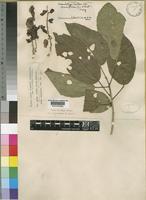
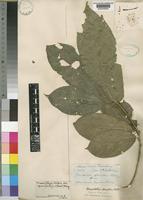
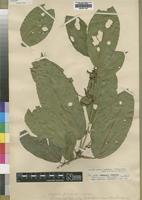
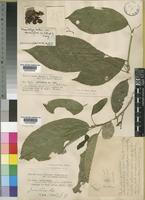
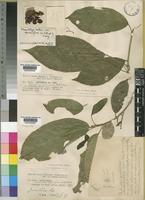
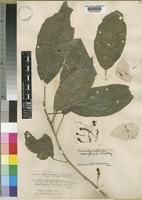
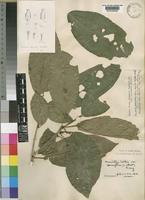
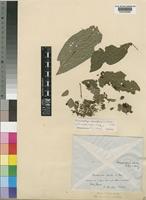
A climbing shrub or small tree; young branchlets sparingly setulose, older ones glabrous. Leaves elliptic or oblong-elliptic, rather acutely and somewhat abruptly acuminate, rounded at the base or rarely slightly cuneate, very variable in size, 3–8 in. long, 1 1/4–3 1/2 in. broad, membranous, margin distinctly repand-denticulate, glabrous on both surfaces except on the sparingly setulose midrib and lateral nerves below; lateral nerves 6–8 on each side, looped near the margin, prominent on the lower surface; tertiary nerves distinct, somewhat distant, subparallel or branched; veins slender, slightly conspicuous below; petiole 1–2 in. long, rather slender, slightly swollen at the apex, more or less setulose-pubescent, at length glabrous or nearly so; stipules subulate as in M. floribunda, but very soon deciduous and not at all persistent. Male racemes solitary when borne in the leaf-axils of the young shoots, two or three in a cluster when produced in the axils of the lower leaves, 1–1 1/2 in. long when young, at length elongating to 3 in.; axis rather shortly pubescent when young, becoming nearly glabrous when older; bracts ovate, subacute, slightly pubescent; pedicels scarcely 1/2 lin. long. Calyx-lobes 4–5, ovate, slightly pubescent or glabrous at maturity. Stamens 4–5, when 4, then one of the filaments much thicker than the others. Disk-glands large and fleshy, contiguous, more or less pubescent. Rudimentary ovary columnar, terete, pubescent. Female inflorescences subsolitary or few together on the second-year wood; bracts, pedicels and calyx as in the male. Disk cupular, short, very shortly ciliolate, otherwise glabrous. Ovary oblong-ellipsoid, glabrous; styles 2, very short, bifid, the lobes recurved. Infructescences 2 1/2–3 1/2 in. long, bearing not more than 15 fruits. Fruits ellipsoid, 4 lin. long, 3 lin. in diam., covered with a fine glaucous bloom. Mature seeds not seen.