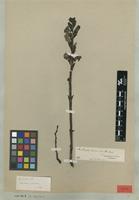
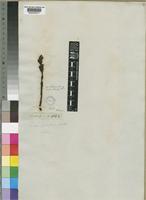
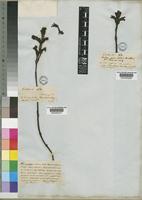
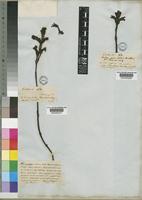
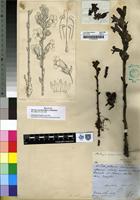
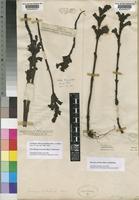
a root-parasite, viscid-pubescent, turning black in drying; stem, bracts and scales dull crimson; stem erect or ascending, ribbed and furrowed, rigid, 6–18 in. high, simple and usually straight above, thickened and sometimes shortly branched at or near the base; leaves scale-like, scattered or opposite, ovate or oval, obtuse, broad and somewhat amplexicaul at the base, concave, entire, 1/6– 1/2 in. long, 1/12– 1/6 in. broad; raceme terminal, rather loosely 2–24-flowered, 1–12 in. long; pedicels opposite or alternate, suberect, 1/8– 1/2 in. long, from the axils of bracts or leaves, 1-flowered, bibracteolate at or near the apex, the lower the longer; bracts similar to the leaves, about as long as the pedicels or longer in the case of the upper ones; bracteoles oblong or sublinear, 1/6– 1/5 in. long; calyx campanulate, nearly rounded at the base, 1/8– 3/5 in. long, shortly 5-lobed; lobes deltoid or subovate, obtuse, 1/8– 1/6 in. long, erect; corolla membranous, yellow on the tube, pink on the limb, when fully expanded inclining to white, 3/4–1 in. long; tube funnel-shaped, inflated upwards, curved, 10-nerved, glabrous inside, glandular-puberulous outside, 1/4– 1/3 in. broad about the middle, 3/8– 1/2 in. broad at the top; mouth oval or round, 1/6– 1/3 in. in diam. inside; limb spreading or somewhat reflexed, 3/4–1 1/8 in. in diam.; lobes 5, rounded, wavy, 3/8– 1/2 in. broad, glabrous above or nearly so, veined; filaments minutely glandular; anthers glabrous, alike, each of the cells beaked at the tip; style minutely glandular, exceeding the stamens, bent about the apex over the anthers, not exserted; stigma clavate-capitate. null