JSTOR Global Plants Home
  • Home
  • Browse
  • About
  • Access
  • Account
    • Saved Items
    • Profile
  • Log in

Global Plants

Skip to Main Content
  • JSTOR Global Plants Home
  • Global Plants

    • Browse
    • About
    • Access
    • Account
      • Saved Items
      • Profile
Log in
  • Browse
  • About
  • Access
  • Account
    • Saved Items
    • Profile
Advanced Search

Compilation
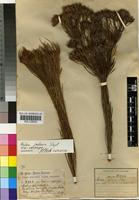
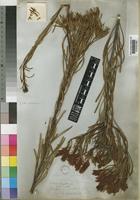
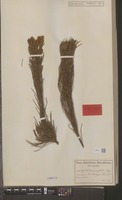
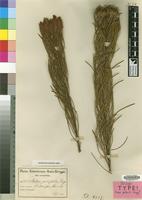
Aulax pallasia

6 Images see all

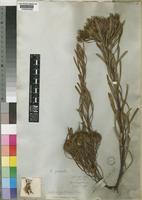
Aulax pallasia Stapf [family PROTEACEAE]
Isosyntype of Aulax pallasia Stapf [family PROTEACEAE]
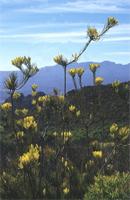
Aulax pallasia Stapf [family PROTEACEAE]
Aulax pallasia Stapf
Isolectotype of Aulax pallasia Stapf [family PROTEACEAE]
Previous
Next

Name

Identification
Aulax pallasia Stapf [family PROTEACEAE ]
Related name
  • Aulax pallasia

Flora

Entry for AULAX pallasia Stapf [family PROTEACEAE]
Herbarium
Royal Botanic Gardens, Kew (K)
Collection
Flora Capensis
Resource Type
Reference Sources
Entry From
Flora Capensis, Vol 5, page 502, (1912) Author: By J. HUTCHINSON, E. P. PHILLIPS and O. STAPF.
Names
AULAX pallasia Stapf [family PROTEACEAE]
AULAX umbellata E. Meyer [family PROTEACEAE], in Drège, Zwei Pfl. Documente, 85, 97 (and 167 partly), not of R. Br.
Information
a shrub, up to 4 ft. high; leaves intermediate in shape between those of the two preceding species from linear-filiform to linear with a long attenuated base, acute to obtuse, 2–5 in. long, 1/2–2 (rarely 3) lin. wide, rather straight, flat or the narrowest semiterete and channelled above; male racemes 1–1 1/2 in. long; bracts up to 2 lin. long, exceeding or the upper equalling the pedicels; perianth 3–4 lin. long, including the 2 1/2 lin.-long limb; anthers over 1 lin. long, usually at length recurved; style 3 lin. long, very slender; female heads 1/2– 3/4 in. long and 3/4–1 in. across; involucral branches bearing 1 flower at or above the lower 1/3, narrow, not fused at the base into a receptacle at length hard and woody, usually sparingly and minutely puberulous, particularly below, often deeply divided, the lateral divisions without flowers and pectinate-bracteate, pectination throughout looser than in the preceding species; dorsal leaves few, mostly needle-shaped, acute, incurved, rarely flat, linear to oblanceolate-linear and obtuse, 1/2–1 in. long, forming with the uppermost leaves a dense outer involucre, central axis rather slender, including the terminal barren bracts over 1/2 in. long, usually bearing flowers to more than 1/2 way; bracts subulate, 2–1 lin. long; perianth 3 1/2 lin. long, including the slightly finely filiform more than 1 lin.-long spreading or recurved segments; style 2 1/2 lin. long; nut ellipsoid, shortly contracted at the base, elliptic in cross-section, with 4 rather broad primary and 4 slender secondary ribs, more or less fulvous-villous all over, the hairs on the ribs, and particularly those of the lateral, longer than the rest. null
Distribution
COAST REGION Tulbagh Div.; Witsen Berg, Burchell, 8695, ♀! 8731, ♀! Winterhoeks Berg, Bolus, 5226, ♀! Worcester Div.; Dutoits Kloof, Drège, ♀!  hills near Worcester, Rehmann, 2510, ♀! Paarl Div.; Paarl Mountain, Drège, ♀! Ecklon & Zeyher, ♂, ♀! Stellenbosch Div.; Lowrys Pass, Drège, ♂! Burchell, 8239, ♂, ♀! Schlechter, 7254, ♂, ♀! Caledon Div.; Houw Hoek Mountains, Burchell, 8020, ♀! Knoflooks Kraal and Little Houw Hoek, Zeyher, 3634, ♂, ♀! Bavians Kloof, near Genadendaal, Burchell, 7784, ♂, ♀! Bot River, Burchell, 930, ♀! Swellendam Div.; Mountain peak near Swellendam, Burchell, 7319, ♂! Riversdale Div.; Platte Kloof (?) Thunberg, ♂.SOUTH AFRICA without locality, Thunberg, ♀! Thom, 331, ♀! 469, ♂! Forster, ♂! Gueinzius, ♂! without locality, Ludwig, ♂, ♀! Caledon Div.: Houw Hoek Mountains, MacOwan, 2978!
Notes
Male specimens of Aulax are only distinguishable by their foliage, and as the leaves of A. pallasia approach sometimes to one or the other of the two remaining species the determination of some of the males referred here to A. pallasia is perhaps open to doubt. These doubtful males are nearly all specimens without definite localisation. Burchell 8239 and 930 approach more than any others to A. cneorifolia so far as the leaves (including those of the involucres) are concerned, but the structure of the involucral branches is clearly that of A. pallasia. One or the other of the lower marginal bracts of the involucral branches of A. pallasia may have a more or less perfect male flower in its axil.

Related Materials

  • Terms and Conditions
  • Privacy Policy
  • Cookie Policy
  • Cookie Settings
  • Accessibility
  • Help
  • Contact Us
  • Facebook
  • Twitter
ITHAKA

JSTOR is part of ITHAKA, a not-for-profit organization helping the academic community use digital technologies to preserve the scholarly record and to advance research and teaching in sustainable ways.

©2000-2026 ITHAKA. All Rights Reserved. JSTOR®, the JSTOR logo, JPASS®, Aluka®, and ITHAKA® are registered trademarks of ITHAKA.

╳