JSTOR Global Plants Home
  • Home
  • Browse
  • About
  • Access
  • Account
    • Saved Items
    • Profile
  • Log in

Global Plants

Skip to Main Content
  • JSTOR Global Plants Home
  • Global Plants

    • Browse
    • About
    • Access
    • Account
      • Saved Items
      • Profile
Log in
  • Browse
  • About
  • Access
  • Account
    • Saved Items
    • Profile
Advanced Search

Compilation
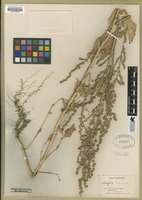
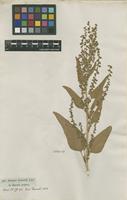
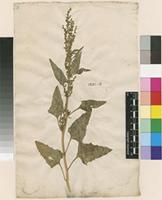
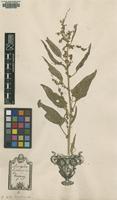
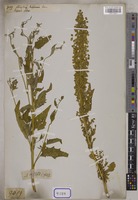
Atriplex hortensis

9 Images see all

Filed as Atriplex hortensis L. [family AMARANTHACEAE]
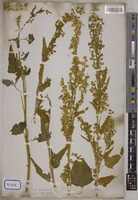
Original material of Atriplex hortensis L. [family CHENOPODIACEAE]
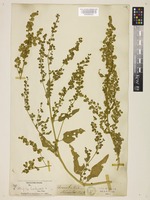
Atriplex hortensis L. [family CHENOPODIACEAE]
Atriplex hortensis L. [family AMARANTHACEAE]
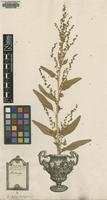
Type of Atriplex hortensis L. [family CHENOPODIACEAE]
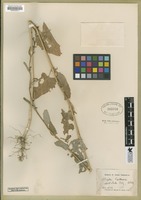
Filed as Atriplex hortensis L. [family AMARANTHACEAE]
Atriplex hortensis L. [family CHENOPODIACEAE]
Previous
Next

Name

Identification
Atriplex hortensis L. [family CHENOPODIACEAE ] (stored under name);
Related name
  • Atriplex hortensis
Common name
  • Garden orach, Flora of North America Vol. 4

Flora

Entry for Atriplex hortensis Linnaeus [family CHENOPODIACEAE]
Herbarium
Flora of North America (FNA)
Collection
Flora of North America
Resource Type
Reference Sources
Entry From
Flora of North America, Vol 4,
Names
Atriplex hortensis Linnaeus [family CHENOPODIACEAE], Sp. Pl., 2: 1053. 1753
Atriplex nitens Schkuhr [family CHENOPODIACEAE]
Treatment Author(s)
Stanley L. Welsh
Information
Herbs, green to yellowish or reddish, 5–15(–25) dm, glabrous. Stems erect, mostly branched. Leaves mostly opposite or mostly alternate; petiole 0.3–4+ cm; blade green on both sides, ovate or ovate-lanceolate to cordate-hastate at base, 15–180 × 8–135 mm, margin entire or more rarely irregularly toothed or lobed, apex attenuate to acuminate or rounded. Inflorescences of spikes disposed in leafless panicles. Staminate flowers 5-merous. Pistillate flowers dimorphic, some ebracteolate and with 5-parted perianth, others without perianth enclosed by a pair of sessile or very shortly stipitate bracteoles. Fruiting bracteoles samaralike, orbicular to oval or ovate, compressed, 5–18 mm, united only at base, entire, faces smooth. Seeds of ebracteate flowers black, horizontal, convex, 1–2 mm wide, lustrous; those of bracteolate flowers olivaceous brown, vertical, flat, 3–4.5 mm wide, dull. 2n = 18.
Phenology
jun-aug (summer), sep-nov (fall)
Altitude range
0–2200 m;
Distribution
Asia.USA AlaskaUSA Calif.USA Colo.USA Conn.USA IdahoUSA Ill.USA Ind.USA IowaUSA Mass.USA Minn.USA Mont.USA Nebr.USA Nev.USA N.J.USA N.Y.USA N.Dak.USA Oreg.USA S.Dak.USA UtahUSA Wash.USA Wis.USA Wyo.Canada Alta.Canada B.C.Canada Man.Canada Ont.Canada Que.Canada Sask.Canada Yukon
Discussion
Atriplex hortensis has been widely grown as a potherb, has escaped from cultivation, and is now established especially in moist ruderal sites. It is easily distinguished by its rounded, samaralike, entire, and smooth fruiting bracteoles, and the presence of two kinds of pistillate flowers, the one enclosed by bracteoles and lacking sepals, the other without bracteoles but subtended by sepals.
Atriplex nitens (see list of excluded taxa) is distinguished from A. hortensis in Flora Europea (P. Aellen 1964b) by having leaf blades densely white scurfy beneath, the distal surface lustrous, as opposed to green and dull for A. hortensis. Occasional specimens, treated here as A. hortensis, have leaves somewhat scurfy.
Native/Introduced
introduced;

Related Materials

  • Terms and Conditions
  • Privacy Policy
  • Cookie Policy
  • Cookie Settings
  • Accessibility
  • Help
  • Contact Us
  • Facebook
  • Twitter
ITHAKA

JSTOR is part of ITHAKA, a not-for-profit organization helping the academic community use digital technologies to preserve the scholarly record and to advance research and teaching in sustainable ways.

©2000-2026 ITHAKA. All Rights Reserved. JSTOR®, the JSTOR logo, JPASS®, Aluka®, and ITHAKA® are registered trademarks of ITHAKA.

╳