JSTOR Global Plants Home
  • Home
  • Browse
  • About
  • Access
  • Account
    • Saved Items
    • Profile
  • Log in

Global Plants

Skip to Main Content
  • JSTOR Global Plants Home
  • Global Plants

    • Browse
    • About
    • Access
    • Account
      • Saved Items
      • Profile
Log in
  • Browse
  • About
  • Access
  • Account
    • Saved Items
    • Profile
Advanced Search

Compilation
Atriplex fruticulosa

6 Images see all

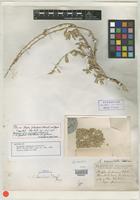
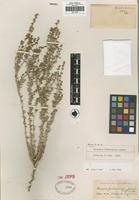
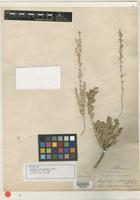
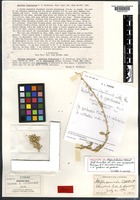
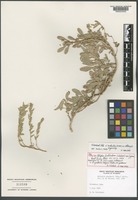
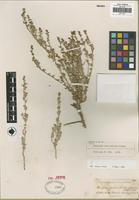
Isotype of Atriplex fruticulosa Osterh. [family CHENOPODIACEAE]
Holotype of Atriplex fruticulosa Jeps. [family CHENOPODIACEAE]
Isotype of Atriplex fruticulosa Jeps. [family CHENOPODIACEAE]
Holotype of Atriplex fruticulosa Osterh. [family AMARANTHACEAE]
Isotype of Atriplex fruticulosa Osterh. [family AMARANTHACEAE]
Holotype of Atriplex fruticulosa Jeps. [family CHENOPODIACEAE]
Previous
Next

Name

Identification
Atriplex fruticulosa Jeps. [family CHENOPODIACEAE ] (stored under name); Verified by Not on Sheet,
Related name
  • Atriplex fruticulosa
Common name
  • Little oak orach, Flora of North America Vol. 4

Flora

Entry for Atriplex fruticulosa Jepson [family CHENOPODIACEAE]
Herbarium
Flora of North America (FNA)
Collection
Flora of North America
Resource Type
Reference Sources
Entry From
Flora of North America, Vol 4,
Names
Atriplex fruticulosa Jepson [family CHENOPODIACEAE], Pittonia, 2: 306. 1892
Treatment Author(s)
Stanley L. Welsh
Information
Herbs, perennial, decumbent-spreading to erect, fruticose at base, 0.5–3(–5) dm. Stems simple or much branched, scurfy, finally glabrate. Leaves numerous, proximal ones mostly short petiolate, distal ones sessile; blade narrowly lanceolate to elliptic, 5–15(–20) × 2–4 mm, mostly acute at both ends, margin entire, densely gray scurfy. Staminate flowers in short, dense, interrupted terminal spikes. Pistillate flowers in small, axillary clusters. Fruiting bracteoles sessile or subsessile, broadly obovate to suborbicular in profile, slightly if at all compressed, 3–5 mm and almost as wide, united to middle, narrowly margined and acutely dentate beyond middle, sides tooth-crested or muricate, ± indurate. Seeds dark brown, 1.4–1.7 mm.
Phenology
jun-aug (summer), sep-nov (fall)
Altitude range
700+ m;
Distribution
USA Calif.
Discussion
H. M. Hall and F. E. Clements (1923) indicated a close relationship between Atriplex fruticulosa and A. coulteri. Both species are described as being perennial by D. Taylor and D. H. Wilken (1993), wherein A. coulteri was inadvertently left out of the key. Perhaps the size of the fruiting bracteoles, 3–5 mm in A. fruticulosa and 2–3 mm in A. coulteri, is diagnostic. Hall and Clements pointed to differences in habit of the plant, which vary from the erect woody forms represented by the type collection (and known only from them?) to the evidently more common phase in which the leafy stems are spreading or prostrate, and herbaceous throughout except at the very base, where they are attached to a more or less woody root crown.
In some fruiting bracteoles the faces are bicristate as in the thornberi phase of Atriplex elegans, in which the teeth radiate around much of the bracteole margin, not mainly from above the middle as in the present species.

Related Materials

  • Terms and Conditions
  • Privacy Policy
  • Cookie Policy
  • Cookie Settings
  • Accessibility
  • Help
  • Contact Us
  • Facebook
  • Twitter
ITHAKA

JSTOR is part of ITHAKA, a not-for-profit organization helping the academic community use digital technologies to preserve the scholarly record and to advance research and teaching in sustainable ways.

©2000-2026 ITHAKA. All Rights Reserved. JSTOR®, the JSTOR logo, JPASS®, Aluka®, and ITHAKA® are registered trademarks of ITHAKA.

╳