JSTOR Global Plants Home
  • Home
  • Browse
  • About
  • Access
  • Account
    • Saved Items
    • Profile
  • Log in

Global Plants

Skip to Main Content
  • JSTOR Global Plants Home
  • Global Plants

    • Browse
    • About
    • Access
    • Account
      • Saved Items
      • Profile
Log in
  • Browse
  • About
  • Access
  • Account
    • Saved Items
    • Profile
Advanced Search

Compilation
Atriplex endolepis

6 Images see all

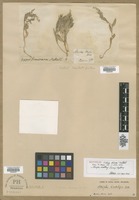
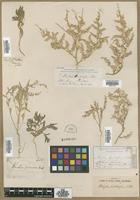
Filed as Atriplex endolepis S.Watson [family AMARANTHACEAE]
Type? of Endolepis dioica Standl. [family CHENOPODIACEAE]
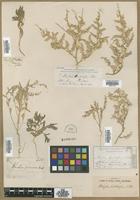
Filed as Atriplex endolepis S.Watson [family AMARANTHACEAE]
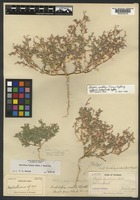
Syntype of Atriplex endolepis S.Watson [family AMARANTHACEAE]
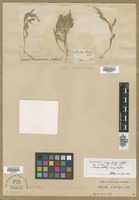
Type? of Atriplex endolepis S.Watson [family CHENOPODIACEAE]
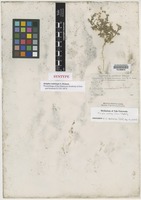
Paratype of Endolepis ovata Rydb. [family CHENOPODIACEAE]
Previous
Next

Name

Identification
Phyllotheca dioica Nutt. [family CHENOPODIACEAE ] (stored under name); Verified by Not on Sheet, Endolepis dioica Standl. [family CHENOPODIACEAE ] Verified by Standley, P.C., Atriplex endolepis S.Watson [family CHENOPODIACEAE ] Verified by Not on Sheet,
Related name
  • Endolepis dioica
  • Phyllotheca dioica
  • Atriplex endolepis
Common name
  • Suckley’s orach, Flora of North America Vol. 4

Flora

Entry for Atriplex suckleyi (Torrey) Rydberg [family CHENOPODIACEAE]
Herbarium
Flora of North America (FNA)
Collection
Flora of North America
Resource Type
Reference Sources
Entry From
Flora of North America, Vol 4,
Names
Atriplex suckleyi (Torrey) Rydberg [family CHENOPODIACEAE], Mem. New York Bot. Gard., 1: 134. 1900
Endolepis suckleyi Torrey [family ], in War Department [U.S.], Pacif. Railr. Rep., 12(2): 47. 1860 Atriplex dioica (Nuttall) J. F. Macbride, 1918
Atriplex endolepis S. Watson [family CHENOPODIACEAE]
Atriplex ovata (Rydberg) F. E. Clements & E. G. Clements [family CHENOPODIACEAE]
Endolepis dioica (Nuttall) Standley [family ]
Endolepis ovata Rydberg [family ]
Kochia dioica Nuttall [family CHENOPODIACEAE]
Salsola dioica (Nuttall) Sprengel [family CHENOPODIACEAE]
Past names
suckleyana
Treatment Author(s)
Stanley L. Welsh
Information
Herbs, spreading, branching from base, (0.3–)0.5–3(–4) dm and as broad. Stems terete, often tinged with red, sparsely mealy or glabrous. Leaves numerous, alternate, sessile; blade lanceolate to elliptic or less commonly ovate, 7–35 × (2–)4–10(–11) mm, thick and succulent, base acute, margin entire, apex acute or acuminate, glaucous, sparsely farinose when young. Staminate flowers in small glomerules, these in distal axils or in short, dense or interrupted, mostly simple, terminal spikes, perianth cup-shaped, frequently pinkish, lobes each with fleshy crest. Pistillate flowers solitary or few in leaf axils, calyx within bracteoles of 3 or 4, entire or lobed, distinct, obtuse, hyaline sepals. Fruiting bracteoles small and difficult to find, sessile, ovate, 2 × 1.5 mm, membranous, united to apex, without appendages, scurfy, each pistil subtended by a perianth. Seeds brown, 1.5 × 1.2 mm.
Phenology
jun-aug (summer), sep-nov (fall)
Altitude range
(400–)1200–2200 m;
Distribution
USA Colo.USA Mont.USA N.Dak.USA S.Dak.USA Wyo.Canada Alta.Canada Sask.
Discussion
At specific rank, the epithet suckleyi clearly has priority. Stutz et al. (1993) resurrected Endolepis Torrey and placed within it two completely disparate species, E. dioica and E. covillei Standley [Atriplex covillei (Standley) J. F. Macbride]. The interpretation of the genus by Stutz et al. stands on the presence of perianth segments subtending the ovary within the fruiting bracteoles, lack of Kranz leaf anatomy, and other more equivocal characteristics. The shared features hardly indicate near affinity, however. The two taxa are otherwise grossly dissimilar. Fundamentally, the genus Endolepis as resurrected by H. C. Stutz et al. stands on the basis of a single character: the presence of perianth segments. Kranz anatomy rises and falls, both within subg. Atriplex and subg. Obione. Thus, coincidence of the non-Kranz criterion is subject to interpretation. Perianth segments subtending the ovary within the enclosing bracteoles, per se, appear to be of independent origin. And, the peculiar nature of the staminate calyx in A. suckleyi (a major determining condition in establishment of the genus Endolepis by Torrey) is not present in A. covillei. Certainly the two species included within Endolepis appear to be as closely allied to other species of Atriplex as they are to each other.

Related Materials

  • Terms and Conditions
  • Privacy Policy
  • Cookie Policy
  • Cookie Settings
  • Accessibility
  • Help
  • Contact Us
  • Facebook
  • Twitter
ITHAKA

JSTOR is part of ITHAKA, a not-for-profit organization helping the academic community use digital technologies to preserve the scholarly record and to advance research and teaching in sustainable ways.

©2000-2026 ITHAKA. All Rights Reserved. JSTOR®, the JSTOR logo, JPASS®, Aluka®, and ITHAKA® are registered trademarks of ITHAKA.

╳