JSTOR Global Plants Home
  • Home
  • Browse
  • About
  • Access
  • Account
    • Saved Items
    • Profile
  • Log in

Global Plants

Skip to Main Content
  • JSTOR Global Plants Home
  • Global Plants

    • Browse
    • About
    • Access
    • Account
      • Saved Items
      • Profile
Log in
  • Browse
  • About
  • Access
  • Account
    • Saved Items
    • Profile
Advanced Search

Compilation
Atriplex cristata

9 Images see all

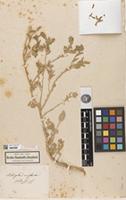
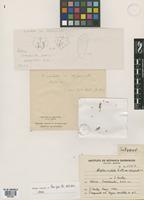
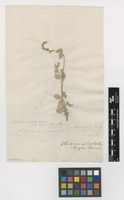
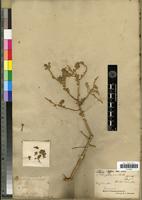
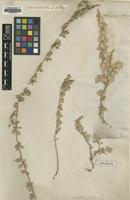
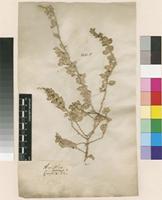
Syntype of Atriplex cristata Willd. [family CHENOPODIACEAE]
Type of Atriplex cristata Humb. & Bonpl. ex Willd. [family CHENOPODIACEAE]
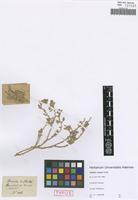
Isotype of Atriplex cristata Humb. & Bonpl. ex Willd. var. pulvinata Kuntze [family CHENOPODIACEAE]
Syntype of Atriplex cristata Willd. [family CHENOPODIACEAE]
Isotype of Atriplex cristata Humb. & Bonpl. ex Willd. var. depauperata Kuntze [family CHENOPODIACEAE]
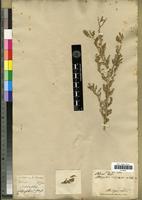
Filed as Atriplex cristata B.Heyne ex Moq. [family CHENOPODIACEAE]
Holotype of Atriplex cristata Willd. [family CHENOPODIACEAE]
Type of Atriplex cristata Koenig [family CHENOPODIACEAE]
Filed as Atriplex cristata Humb. & Bonpl. ex Willd. [family AMARANTHACEAE]
Previous
Next

Name

Identification
Atriplex cristata Koenig [family CHENOPODIACEAE ] Atriplex repens Roth [family CHENOPODIACEAE ] (stored under name);
Related name
  • Atriplex koenigii
  • Atriplex cristata
  • Atriplex repens
  • Obione cristata
Common name
  • Quelite, Flora of North America Vol. 4

Flora

Entry for Atriplex mucronata Rafinesque [family CHENOPODIACEAE]
Herbarium
Flora of North America (FNA)
Collection
Flora of North America
Resource Type
Reference Sources
Entry From
Flora of North America, Vol 4,
Names
Atriplex mucronata Rafinesque [family CHENOPODIACEAE], Amer. Monthly Mag. & Crit. Rev., 2(2): 119. 1817
Atriplex arenaria Nuttall [family CHENOPODIACEAE]
Atriplex cristata Humboldt & Bonpland ex Willdenow var. arenaria (Nuttall) Kuntze [family CHENOPODIACEAE]
Atriplex pentandra (Jacquin) Standley subsp. arenaria (Nuttall) H. M. Hall & Clements [family CHENOPODIACEAE]
Treatment Author(s)
Stanley L. Welsh
Information
Herbs, annual. Stems erect, ascending, or procumbent, much branched, obtusely angled, 1–6 dm, stout, scurfy when young. Leaves alternate or proximalmost opposite or subopposite; petiole to 1.5 cm or sessile; blade paler abaxially, oblong or oval, lanceolate, or elliptic to broadly obovate or narrowly oblong, 10–40(–60) × (2–)4–20 mm, base rounded to cuneate, margin entire or undulate, rarely with 1–2 teeth, apex rounded to acute, mucronate, thin, often densely white scurfy beneath, grayish green and glabrate above. Staminate glomerules terminal or in dense or interrupted, terminal or axillary, naked spikes or shortly branched panicles. Pistillate flowers fascicled in axils. Fruiting bracteoles subsessile or with stipes to 1 mm, cuneate-orbiculate, compressed, 4.5–7 × 3.5–5.6 mm, typically longer than wide, united to middle, apex rounded, 3–5-toothed, teeth subequal, sides irregularly tuberculate or with 2 lateral dentate crests, rarely not appendaged. Seeds reddish brown, 2 mm. 2n = 18.
Phenology
jun-aug (summer), sep-nov (fall)
Altitude range
0 m;
Distribution
USA Ala.USA Fla.USA La.USA Md.USA Mass.USA Miss.USA N.H.USA N.J.USA N.C.USA Tex.USA Va.
Discussion
Problems with prior applications of the name Atriplex mucronata lie in the mistaken determination of the place of publication as Amer. Monthly Mag. & Crit. Rev. 2: 176. 1818 (where the name is only mentioned), instead of 2: 119. 1817 (where accompanied by a description and notes). H. M. Hall and F. E. Clements (1923) evidently relied on P. C. Standley’s (1916) interpretation, which indicated the wrong citation (see also A. dioica Rafinesque as an identical example). Hall and Clements applied the name mucronata to their interpretation of A. patula subsp. hastata or to A. hastata (i.e., to A. prostrata according to this treatment).
The treatment of Obione by C. H. B. A. Moquin-Tandon (1849) included “A. mucronata Rafin.!” as a synonym of O. arenaria. Possibly a sheet in the Prodromus herbarium at Geneva was the basis for that decision. It has two mounted specimens, one labeled A. arenaria Nuttall, collected by Nuttall in “N. Jersey, 1826,” and a second labeled “Atriplex mucronata Rafinesque (A. arenaria Nuttall, N. Jersey) Maritime NY, Rafinesque 1819.” From that information (although the year is 1819, not 1817), and from the description of the taxon, it seems clear that A. arenaria Nuttall is a later synonym of A. mucronata Rafinesque by at least half a year.
H. A. Gleason and A. Cronquist (1991) indicated that this taxon, by whatever name, is “perhaps better treated as a variety of the more tropical Atriplex pentandra (Jacquin) Standley, but the proper nomenclatural combination not yet made.” The present writer agrees with that conclusion, but such subjugation might indicate further contraction into the species of additional closely related taxa, e.g., A. wrightii, which is clearly closely allied as well.
Plants from the coastal states from New England south to New Jersey are much alike and seldom, if ever, display prominent, terminal, naked spikes or panicles with beadlike glomerules of staminate flowers. Plants from Florida westward sometimes have such staminate spikes or panicles.
Specimens from Florida and some from Texas can be distinguished from Atriplex pentandra only with difficulty, especially those individuals with entire leaves. However, the fruiting bracteole length-width ratio and overall shape, with some allowance for overlap, can serve to distinguish most specimens; those of A. mucronata are proportionately longer than broad and, on average, larger.

Related Materials

  • Terms and Conditions
  • Privacy Policy
  • Cookie Policy
  • Cookie Settings
  • Accessibility
  • Help
  • Contact Us
  • Facebook
  • Twitter
ITHAKA

JSTOR is part of ITHAKA, a not-for-profit organization helping the academic community use digital technologies to preserve the scholarly record and to advance research and teaching in sustainable ways.

©2000-2026 ITHAKA. All Rights Reserved. JSTOR®, the JSTOR logo, JPASS®, Aluka®, and ITHAKA® are registered trademarks of ITHAKA.

╳