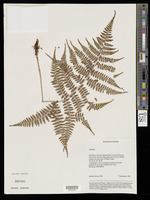
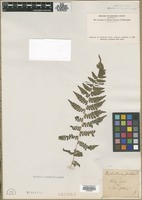
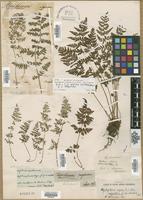
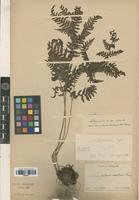
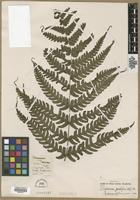
Athyrium sp.Not on sheet [family PTERIDOPHYTA ] (stored under name); Verified by Christ, 1907
Related name
Athyrium sp.
Aspidium alpinum
Cystopteris alpina
Flora
Entry for ATHYRIUM sp. [family WOODSIACEAE]
Herbarium
Royal Botanic Gardens, Kew (K)
Collection
Flora of Tropical East Africa
Resource Type
Reference Sources
Entry From
Flora of Tropical East Africa, page 1, (2003) Author: BERNARD VERDCOURT
Names
ATHYRIUM sp. [family WOODSIACEAE]
Information
Rhizome erect with spreading roots; scales chestnut, lanceolate, 3 mm long, 1 mm wide, attenuate. Fronds tufted, 16–20 cm tall; stipe 5–6 cm long, scaly at base. Lamina oblong-lanceolate in outline, 9–12 cm long, 4–5 cm wide with 10–15 pairs of pinnae; pinnae oblong in outline, 1–2.5 cm long, 0.3–1.3 cm wide, subacute and not attenuate at apex, with 4–5 pairs of pinnules and short apical lobed part; pinnules oblong-ovate, up to about 7 mm long, 5 mm wide, 3–5-lobed and ± crenate, with sparse flattened trichomes beneath. Sori one per pinnule, about 1 mm long; indusia deeply fimbriate.
Range
DISTR. T 7
Altitude range
2300 m
Distribution
TANZANIA Iringa District Luhomero Massif, South Msisimwana ridge, 19 Aug. 1985, Rodgers & Hall 4558!
Notes
It was suggested that this was a young plant of A. scandicinum but it is fertile. No other material has been seen which resembles it and until more is collected in the same area its status is uncertain.