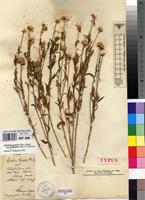
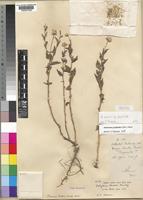
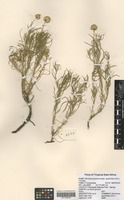
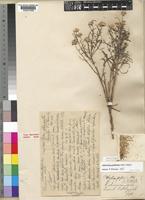
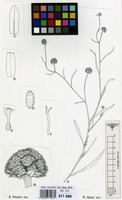
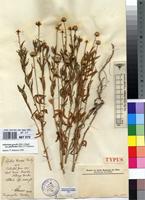
Athroisma gracile(Oliv.) Mattf. [family COMPOSITAE ] (stored under name); Verified by Eriksson T., 1993
Related name
Athroisma haareri
Athroisma gracile
Polycline haareri
Athroisma psyllioides
Flora
Entry for Athroisma gracile (Oliv.) Mattf. [family ]
Herbarium
Royal Botanic Gardens, Kew (K)
Collection
Flora of Tropical East Africa
Resource Type
Reference Sources
Entry From
Flora of Tropical East Africa, Part Part 3, page 547, (2005) Author: H. Beentje, C. Jeffrey & D.J.N. Hind
Names
Athroisma gracile(Oliv.) Mattf. [family ], in N.B.G.B. 13: 302 (1936); T. Eriksson in J.L.S. 119: 165, t. 36 (1995). Type: Tanzania/Kenya, Kapté country, Thompson s.n. (K!, holo.)
Information
Perennial or rarely annual herb 0.1–1 m high, usually much branched; base of stem woody; young branches glabrous. Leaves linear to elliptic or obovate, 2–12 cm long, 0.1–2.5 cm wide, base attenuate, margins entire to dentate or serrate, apex acute to acuminate, glabrous; basal veins 1–3. Glomerules solitary and terminal, 9–16 mm in diameter, with 20–50 capitula; phyllaries absent; paleae 2.5–4 mm long. Florets white, pink or purple, female florets absent; disc florets 8–22, 1.5–2.5 mm long, glandular. Achenes ellipsoid, obovoid or almost globose, 1–1.5 mm long, slightly hairy, without glands; pappus absent or of short hairs. Fig. 146 (page 717).
Notes
Eriksson states the capitula occur in groups of 1–5(–7), but I believe that is a matter of interpretation. I see them as solitary on small leafy branches, and because the plant is densely branched the heads look close together. Eriksson sees them as branched, leafy synflorescences. Of course, the whole upper part of the plant acts as a large inflorescence!