JSTOR Global Plants Home
  • Home
  • Browse
  • About
  • Access
  • Account
    • Saved Items
    • Profile
  • Log in

Global Plants

Skip to Main Content
  • JSTOR Global Plants Home
  • Global Plants

    • Browse
    • About
    • Access
    • Account
      • Saved Items
      • Profile
Log in
  • Browse
  • About
  • Access
  • Account
    • Saved Items
    • Profile
Advanced Search

Compilation
Astripomoea grantii

4 Images see all

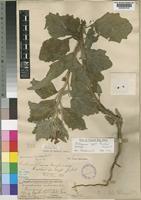
Lectotype of Astripomoea grantii (Rendle) Verdc. [family CONVOLVULACEAE]
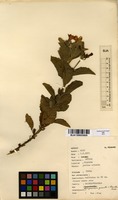
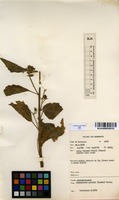
Filed as Astripomoea grantii (Rendle) Verdc. [family CONVOLVULACEAE]
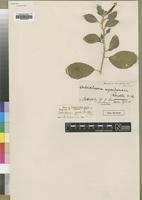
Type of Astrochlaena ugandensis Rendle [family CONVOLVULACEAE]
Previous
Next

Name

Identification
Astripomoea grantii (Rendle) Verdc. [family CONVOLVULACEAE ] (stored under name); Verified by Verdcourt,B., Astrochlaena ugandensis Rendle [family CONVOLVULACEAE ]
Related name
  • Astripomoea grantii
  • Astrochlaena malvacea
  • Astrochlaena ugandensis
  • Convolvulus malvaceus
  • Breweria malvacea
  • Astrochlaena grantii

Flora

Entry for ASTRIPOMOEA grantii (Rendle) Verdc. [family CONVOLVULACEAE]
Herbarium
Royal Botanic Gardens, Kew (K)
Collection
Flora of Tropical East Africa
Resource Type
Reference Sources
Entry From
Flora of Tropical East Africa, page 1, (1963) Author: B. VERDCOURT (East African Herbarium)
Names
ASTRIPOMOEA grantii (Rendle) Verdc. [family CONVOLVULACEAE], in K.B. 13 : 196 (1958). Type : Tanganyika, Usui, Speke & Grant 202 (K, lecto.!)
Convolvulus malvaceus [family CONVOLVULACEAE], [sensu Oliv. in T.L.S. 29 : 117 (1873), non Breweria malvacea Klotzsch]
Astrochlaena grantii Rendle [family CONVOLVULACEAE], in F.T.A. 4 (2) : 123 (1905)
Astrochlaena ugandensis Rendle [family CONVOLVULACEAE], in F.T.A. 4 (2) : 124 (1905). Type : a plant grown at Kew in 1905 originally from Uganda, coll. Dawe (BM, holo. !, K, iso. !)
Information
Short-lived perennial up to 1.2 m. tall; stems erect, or rarely decumbent, unbranched or sparsely branched just above the ground, up to 2 cm. in diameter at point of junction with the root, densely stellately subferruginously tomentose. Leaf-blade broadly elliptic or obovate, 6.3–10 cm. long, 3.8–6 cm. wide, blunt but mucronate at the apex, narrowly cuneate at the base; margins coarsely wavy or lobed above, rarely entire; sparsely stellately hairy above, beset with ± dense grey granular tomentum beneath; petiole about 2.5 cm. long. Peduncle 1–9 cm. long, usually long; inflorescence a subcapitate (1–)6-flowered cyme; pedicels about 6 mm. long. Sepals ovate-lanceolate to lanceolate, 1–1.4 cm. long, acute. Corolla purple with lighter limb or white with a purple eye, (2–)2.5–3.5 cm. long. Capsule ovoid, 6–8 mm. tall.
Range
DISTR. U2–4; K3, 5; T1, 4, ?7
Altitude range
1200–1920 m.; intermediates with A. hyoscyamoïdes down to 720 m.
Distribution
KENYA Trans-Nzoia District Kitale, 6 Nov. 1955, Irwin 145 !KENYA North Kavirondo/Nandi Districts Kaimosi Farm, 15 June 1953, G. R. Williams 574!KENYA South Kavirondo District Kisii, July 1934, Napier 3412 in C.M. 6653 !TANGANYIKA Mwanza District Ukerewe I., 14 Apr. 1929, Conrads 944 ! ;TANGANYIKA Biharamulo District Usui, Speke & Grant 202 ! ;TANGANYIKA Ufipa District Chapota, 10 Mar. 1957, Richards 8615 !UGANDA Ankole District Igara, Mar. 1939, Purseglove 633! ;UGANDA Busoga District 21 km. SSE. of Bugiri, 17 Dec. 1952, G. H. S. Wood 545 ! (leaves not typical) ;UGANDA Mengo District Entebbe, Mahon !
Distribution (external)
; eastern Congo Republic
Notes
A. ugandensis is a depauperate cultivated form with mostly 1-flowered inflorescences and almost entire leaves, slightly different in shape from those of A. hyoscyamoïdes. Napier 6106 is almost identical with the type of A. ugandensis. This species is closely allied to A. hyoscyamoïdes and replaces it at higher altitudes. It is possibly only an ecotypical condition, or a subspecies. A few complete intermediates are known from lower altitudes e.g. Jex Blake 5173 (Ol Lorgasailic), Beaton 26 (Mtito Andei), Scheffler 74 (Kibwezi) and Lea 39 (Rukwa) which have markedly lobed leaves but a finer indumentum.

Related Materials

  • Terms and Conditions
  • Privacy Policy
  • Cookie Policy
  • Cookie Settings
  • Accessibility
  • Help
  • Contact Us
  • Facebook
  • Twitter
ITHAKA

JSTOR is part of ITHAKA, a not-for-profit organization helping the academic community use digital technologies to preserve the scholarly record and to advance research and teaching in sustainable ways.

©2000-2026 ITHAKA. All Rights Reserved. JSTOR®, the JSTOR logo, JPASS®, Aluka®, and ITHAKA® are registered trademarks of ITHAKA.

╳