JSTOR Global Plants Home
  • Home
  • Browse
  • About
  • Access
  • Account
    • Saved Items
    • Profile
  • Log in

Global Plants

Skip to Main Content
  • JSTOR Global Plants Home
  • Global Plants

    • Browse
    • About
    • Access
    • Account
      • Saved Items
      • Profile
Log in
  • Browse
  • About
  • Access
  • Account
    • Saved Items
    • Profile
Advanced Search

Compilation
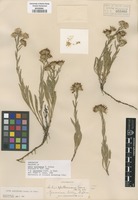
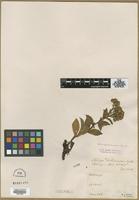
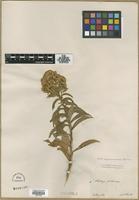
Aster spithamaeus

3 Images see all

Original material of Aster spithamaeus (M.A. Curtis ex A. Gray) Kuntze [family ASTERACEAE]
Filed as Solidago spithamaea Curtis [family ASTERACEAE]
Previous
Next

Name

Identification
Solidago spithamaea Curtis [family ASTERACEAE ] (stored under name); Verified by Not on Sheet, Solidago spithamaea Curtis [family ASTERACEAE ] Verified by Not on Sheet, Aster spithamaeus Greene [family ASTERACEAE ] Verified by Not on Sheet,
Related name
  • Aster spithamaeus
  • Solidago spithamaea
Common name
  • Skunk or Blue Ridge goldenrod, Flora of North America Vol. 20

Flora

Entry for Solidago spithamaea M. A. Curtis ex A. Gray [family COMPOSITAE]
Herbarium
Flora of North America (FNA)
Collection
Flora of North America
Resource Type
Reference Sources
Entry From
Flora of North America, Vol 20,
Names
Solidago spithamaea M. A. Curtis ex A. Gray [family COMPOSITAE], Amer. J. Sci. Arts, 42: 42. 1842
Aster spithamaeus (M. A. Curtis ex A. Gray) Kuntze [family COMPOSITAE]
Treatment Author(s)
John C. Semple
Rachel E. Cook
Information
Plants 10–40 cm (with somewhat noxious odor); rhizomes short, stout, or branched caudices. Stems 1–10+, erect (usually simple), rough-puberulent or shortly spreading hirsute, or proximally glabrate. Leaves: basal petioles 1.5–7 mm, blades spatulate to lanceolate or subrhombic, mostly 50–109 × 15–40 mm, bases tapering, glabrous, margins sharply serrate, ciliate, apices acuminate; mid and distal sessile, blades lanceolate to subrhombic, much reduced distally, margins serrulate becoming entire distally, glabrous. Heads 15–50+ in compactly rounded corymbiform arrays, becoming paniculiform in robust plants. Peduncles 1–7, short-strigose; bracts leaflike, 5–15 mm. Involucres campanulate, 5–6 mm. Phyllaries (in 3–4 series) lanceolate, unequal (midnerves swollen), acute to acuminate (tips dark green). Ray florets 8–10(–15); laminae 2–3.5 mm. Disc florets 20–60; corollas 3.5–4.5 mm, lobes 1.5–2 mm. Cypselae 2–3 mm, sparsely strigose to glabrate; pappi (of 12–22 bristles) about 3 mm. 2n = 54.
Conservation Status
of conservation concern;
Phenology
sep-oct (fall)
Altitude range
1600–2000 m;
Distribution
USA N.C.USA Tenn.
Discussion
Solidago spithamaea is listed as threatened by the U.S. Fish and Wildlife Service. The species is extant at only three locations; all other known populations were extirpated. It is in the Center for Plant Conservation’s National Collection of Endangered Plants.

Related Materials

  • Terms and Conditions
  • Privacy Policy
  • Cookie Policy
  • Cookie Settings
  • Accessibility
  • Help
  • Contact Us
  • Facebook
  • Twitter
ITHAKA

JSTOR is part of ITHAKA, a not-for-profit organization helping the academic community use digital technologies to preserve the scholarly record and to advance research and teaching in sustainable ways.

©2000-2026 ITHAKA. All Rights Reserved. JSTOR®, the JSTOR logo, JPASS®, Aluka®, and ITHAKA® are registered trademarks of ITHAKA.

╳