JSTOR Global Plants Home
  • Home
  • Browse
  • About
  • Access
  • Account
    • Saved Items
    • Profile
  • Log in

Global Plants

Skip to Main Content
  • JSTOR Global Plants Home
  • Global Plants

    • Browse
    • About
    • Access
    • Account
      • Saved Items
      • Profile
Log in
  • Browse
  • About
  • Access
  • Account
    • Saved Items
    • Profile
Advanced Search

Compilation
Aster spathulatus

5 Images see all

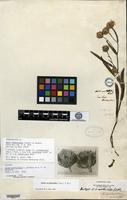
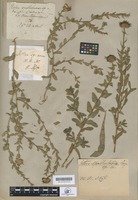
Isotype of Aster spathulatus Lindley ex de Candolle [family ASTERACEAE]
Aster andinus Nutt. [family COMPOSITAE]
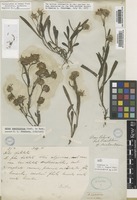
Symphyotrichum spathulatum (Lindl.) G.L.Nesom [family ASTERACEAE]
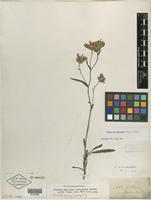
Type? of Aster spathulatus Lindl. [family ASTERACEAE]
Type of Demetria sphatulata Lag. [family COMPOSITAE]
Previous
Next

Name

Identification
Isotype of Aster spathulatus Lindley ex de Candolle [family ASTERACEAE ] (stored under name); Verified by Lindl. ex. DC., 1836
Related name
  • Aster spathulatus
  • Demetria sphatulata
Common name
  • Western mountain aster, Flora of North America Vol. 20

Flora

Entry for Symphyotrichum spathulatum (Lindley) G. L. Nesom [family ]
Herbarium
Flora of North America (FNA)
Collection
Flora of North America
Resource Type
Reference Sources
Entry From
Flora of North America, Vol 20,
Names
Symphyotrichum spathulatum (Lindley) G. L. Nesom [family ], Phytologia, 77: 291. 1995
Aster spathulatus Lindley [family COMPOSITAE], in W. J. Hooker, Fl. Bor.-Amer., 2: 8. 1834
Treatment Author(s)
Luc Brouillet
John C. Semple
Geraldine A. Allen
Kenton L. Chambers
Scott D. Sundberg†
Information
Perennials, 20–80 cm, colonial; long-rhizomatous. Stems 1–5+, ascending to erect, glabrous or sparsely puberulent. Leaves thin, margins entire, apices acute, faces glabrous or sparsely puberulent; basal persistent, petiolate, blades narrowly elliptic to obovate, 50–150 × 3–15 mm, attenuate, margins entire; proximal cauline sessile or subpetiolate, blades linear to narrowly elliptic, 50–150 × 2–15 mm, bases attenuate or cuneate; distal sessile, blades 30–60 × 2–10 mm, reduced distally, bases cuneate to rounded. Heads in corymbiform to paniculiform arrays, branches usually few. Peduncles sparsely hairy, bracts 0–3+. Involucres campanulate, 5–10 mm. Phyllaries in 3–5 series, narrowly oblong or linear (outer) to linear (inner), unequal, bases indurate, margins entire, green zones elliptic to lanceolate, apices usually acute, sometimes obtuse, faces glabrous or ± puberulent. Ray florets 15–40; corollas violet, laminae 9–15 × 1–2 mm. Disc florets 30-80(–100); corollas yellow, sometimes becoming reddish, 4.5–6 mm, lobes triangular, 0.5–1 mm. Cypselae brown, cylindric to obovoid, not compressed, 2.5–3.5 mm, ± 4-nerved, faces hairy; pappi whitish, 5–7 mm.
Distribution
w North Americanw Mexico.
Discussion
Symphyotrichum spathulatum is a variable species, widespread in montane regions of western North America. It hybridizes with S. eatonii, S. foliaceum, and S. hendersonii.

Related Materials

  • Terms and Conditions
  • Privacy Policy
  • Cookie Policy
  • Cookie Settings
  • Accessibility
  • Help
  • Contact Us
  • Facebook
  • Twitter
ITHAKA

JSTOR is part of ITHAKA, a not-for-profit organization helping the academic community use digital technologies to preserve the scholarly record and to advance research and teaching in sustainable ways.

©2000-2026 ITHAKA. All Rights Reserved. JSTOR®, the JSTOR logo, JPASS®, Aluka®, and ITHAKA® are registered trademarks of ITHAKA.

╳