JSTOR Global Plants Home
  • Home
  • Browse
  • About
  • Access
  • Account
    • Saved Items
    • Profile
  • Log in

Global Plants

Skip to Main Content
  • JSTOR Global Plants Home
  • Global Plants

    • Browse
    • About
    • Access
    • Account
      • Saved Items
      • Profile
Log in
  • Browse
  • About
  • Access
  • Account
    • Saved Items
    • Profile
Advanced Search

Compilation
Aster meritus

13 Images see all

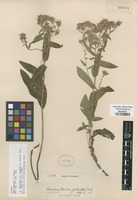
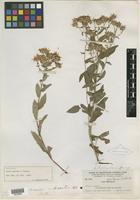
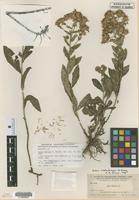
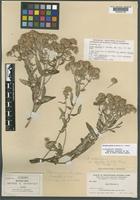
Isotype of Aster meritus A. Nelson [family ASTERACEAE]
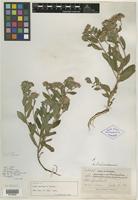
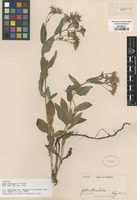
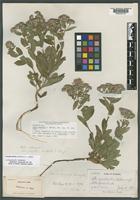
Syntype of Aster meritus A. Nelson [family ASTERACEAE]
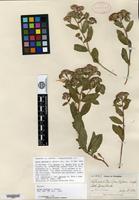
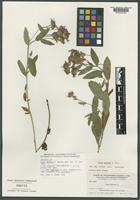
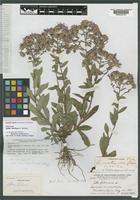
Paratype of Aster meritus A. Nelson [family ASTERACEAE]
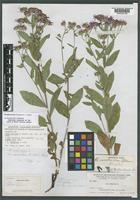
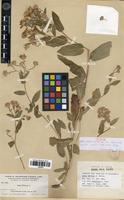
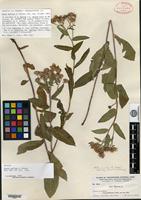
Syntype of Aster meritus A.Nelson [family ASTERACEAE]
Syntype of Aster meritus A. Nelson [family ASTERACEAE]
Paratype of Aster meritus A. Nelson [family ASTERACEAE]
Holotype of Aster meritus A. Nelson [family ASTERACEAE]
Syntype of Aster meritus A. Nelson [family ASTERACEAE]
Paratype of Aster meritus A. Nelson [family ASTERACEAE]
Previous
Next

Name

Identification
Aster sibiricus Linnaeus [family ASTERACEAE ] (stored under name); Verified by A. G. Jones, Aster meritus A. Nelson [family ASTERACEAE ] Verified by A. Nelson, 1904
Related name
  • Eurybia merita
  • Aster meritus
  • Aster richardsonii
  • Aster radulinus
  • Aster sibiricus
Common name
  • Subalpine aster, Flora of North America Vol. 20

Flora

Entry for Eurybia merita (A. Nelson) G. L. Nesom [family ]
Herbarium
Flora of North America (FNA)
Collection
Flora of North America
Resource Type
Reference Sources
Entry From
Flora of North America, Vol 20,
Names
Eurybia merita (A. Nelson) G. L. Nesom [family ], Phytologia, 77: 260. 1995
Aster meritus A. Nelson [family COMPOSITAE], Bot. Gaz., 37: 268. 1904
Aster richardsonii Sprengel var. meritus (A. Nelson) Raup [family COMPOSITAE]
Aster sibiricus Linnaeus var. meritus (A. Nelson) Raup [family COMPOSITAE]
Treatment Author(s)
Luc Brouillet
Information
Plants (2–)10–50 cm, clonal and clumped, eglandular; rhizomes creeping to ascending, long or short, scaly, woody with age. Stems 1–3+, usually ascending, sometimes decumbent, purplish, occasionally branched basally, sparsely villosulous, densely so distally. Leaves cauline (dark green abaxially, paler bluish green adaxially) firm, ± markedly veined, margins entire or serrulate, scabrous to strigoso-ciliate, teeth mucronate, slightly indurate, apices obtuse to acute, mucronate, abaxial faces glabrescent to sparsely villous along veins, adaxial glabrescent or sparsely (proximal) to ± densely (distal) villoso-strigose or strigose; proximalmost withering by flowering; proximal narrowly winged-petiolate or sessile, petiole bases sheathing, blades spatulate to obovate or oblanceolate, 10–43 × 2–16 mm, smaller than mid, bases attenuate to cuneate, subclasping (if sessile); mid sessile, blades lanceolate or oblong-lanceolate to oblanceolate, narrowly obovate, or spatulate, 20–80 × 4–35 mm, gradually reduced distally, bases rounded or subauriculate to widely attenuate or cuneate; distal (arrays) sessile, lanceolate to lance-ovate or elliptic to oblanceolate, 6–52 × 1–17 mm, rapidly reduced distally, margins often slightly purplish. Heads (1–)5–50, usually in open to compact, corymbiform arrays, rarely borne singly. Peduncles villosulous; bracts 0–3, lanceolate to spatulate, leaflike to distally phyllary-like (bases indurate, margins purplish), mostly foliaceous. Involucres campanulate, 6–9 mm, shorter than pappi. Phyllaries 30–65 in 4–5 series, often purplish, oblong or lance-oblong (outer) to lance-linear or linear (inner), unequal, membranous, bases indurate, rounded, dark green zones diffusely diamond-shaped to lanceolate in distal 1/3–2/3 (outer, seldom foliaceous) to 1/5 or none (inner), margins ± dark purple, narrowly scarious, erose, densely villoso-ciliate, apices appressed or sometimes loose and ± squarrose, acute to obtuse, often apiculate, faces usually villous, rarely glabrous. Ray florets (10–)14–32; corollas purple to violet, 7–12(–15) × 1–1.7 mm. Disc florets 30–60; corollas pale to cream-yellow, lobes pink-tinged, 5–7.6 mm, slightly ampliate, tubes equaling or slightly longer than funnelform throats, lobes erect, triangular, 0.6–1.3 mm. Cypselae brownish, fusiform-obconic, slightly compressed, ca. 3.4 mm, ribs 8–10 (pale, strong), strigillose; pappi of cinnamon to yellowish bristles 5–6 mm, longer than disc corollas. 2n = 36.
Phenology
late summer
Altitude range
100–3200 m;
Distribution
B.CUSA Calif.USA IdahoUSA Mont.USA Oreg.USA S.Dak.USA UtahUSA Wash.USA Wyo.
Discussion
Eurybia merita occurs mainly from the Interior Mountains and Plateaus system to the Rocky Mountains, and is disjunct to the Black Hills of South Dakota. It reaches California in Siskyou County; the species has been overlooked in this state (e.g., G. A. Allen 1993) because of misidentification with E. radulina. S. L. Welsh et al. (1987) reported E. sibirica from the Uinta Mountains of Utah (Summit County), which A. Cronquist (1994) attributed to var. merita.

Related Materials

  • Terms and Conditions
  • Privacy Policy
  • Cookie Policy
  • Cookie Settings
  • Accessibility
  • Help
  • Contact Us
  • Facebook
  • Twitter
ITHAKA

JSTOR is part of ITHAKA, a not-for-profit organization helping the academic community use digital technologies to preserve the scholarly record and to advance research and teaching in sustainable ways.

©2000-2026 ITHAKA. All Rights Reserved. JSTOR®, the JSTOR logo, JPASS®, Aluka®, and ITHAKA® are registered trademarks of ITHAKA.

╳