

Compilation
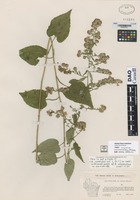
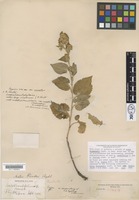
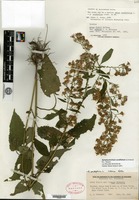
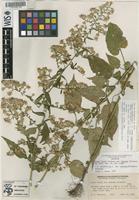
Aster finkii
4 Images see all
Name
Identification
Aster cordifolius L. [family ASTERACEAE ] (stored under name); Verified by Judziewicz, Emmet J., 1999 Aster finkii Rydb. [family ASTERACEAE ] Verified by Jones, Alumt G., 1979 Aster cordifolius L. [family ASTERACEAE ] Verified by Jones, Almut G., 1979 Aster cordifolius L. [family ASTERACEAE ] Verified by Jones, Almut G., 1988
Related name
- Aster cordifolius
- Aster finkii
Common name
- aster cordifolié, Flora of North America Vol. 20
- Heartleaf or common blue wood aster, Flora of North America Vol. 20
Flora
Entry for Symphyotrichum cordifolium (Linnaeus) G. L. Nesom [family ]
Herbarium
Flora of North America (FNA)
Collection
Flora of North America
Resource Type
Reference Sources
Entry From
Flora of North America, Vol 20,
Names
Symphyotrichum cordifolium (Linnaeus) G. L. Nesom [family ], Phytologia, 77: 278. 1995
Aster cordifolius Linnaeus [family COMPOSITAE], Sp. Pl., 2: 875. 1753
Aster cordifolius var. alvearius E. S. Burgess [family COMPOSITAE]
Aster cordifolius var. furbishiae Fernald [family COMPOSITAE]
Aster cordifolius var. incisus Britton [family COMPOSITAE]
Aster cordifolius subsp. laevigatus (Porter) A. G. Jones [family COMPOSITAE]
Aster cordifolius var. laevigatus Porter [family COMPOSITAE]
Aster cordifolius var. lanceolatus Porter [family COMPOSITAE]
Aster cordifolius var. moratus (Shinners) Shinners [family COMPOSITAE]
Aster cordifolius var. polycephalus Porter [family COMPOSITAE]
Aster cordifolius var. racemiflorus Fernald [family COMPOSITAE]
Aster cordifolius subsp. sagittifolius (Wedemeyer ex Willdenow) A. G. Jones [family COMPOSITAE]
Aster cordifolius var. sagittifolius (Wedemeyer ex Willdenow) A. G. Jones [family COMPOSITAE]
Aster finkii Rydberg var. moratus Shinners [family COMPOSITAE]
Aster leiophyllus Porter [family COMPOSITAE]
Aster lowrieanus Porter [family COMPOSITAE]
Aster lowrieanus var. incisus (Britton) Porter [family COMPOSITAE]
Aster lowrieanus var. lanceolatus (Porter) Porter [family COMPOSITAE]
Aster sagittifolius Wedemeyer ex Willdenow [family COMPOSITAE]
Symphyotrichum cordifolium var. furbishiae (Fernald) G. L. Nesom [family ]
Symphyotrichum cordifolium var. lanceolatum (Porter) G. L. Nesom [family ]
Symphyotrichum cordifolium var. moratum (Shinners) G. L. Nesom [family ]
Symphyotrichum cordifolium var. polycephalum (Porter) G. L. Nesom [family ]
Symphyotrichum cordifolium var. racemiflorum (Fernald) G. L. Nesom [family ]
Symphyotrichum lowrieanum (Porter) G. L. Nesom [family ]
Symphyotrichum sagittifolium (Wedemeyer ex Willdenow) G. L. Nesom [family ]
Treatment Author(s)
Luc Brouillet
John C. Semple
Geraldine A. Allen
Kenton L. Chambers
Scott D. Sundberg†
Information
Perennials, 20–120 cm, colonial or cespitose; branched rhizomatous, or with branched caudices, becoming ± woody. Stems 1–5+, erect (straight to ± flexuous distally, often reddish, sometimes brown), usually glabrous, sometimes ± pilose, particularly distally. Leaves thin, margins serrate (often sharply, teeth acuminate, mucronulate) to serrate-crenate or subentire, strigose, apices acuminate to acute, mucronulate, abaxial faces glabrous or sparsely to densely strigose-pilose, often pilose on midveins, sometimes on other veins also, adaxial glabrous or sparsely to densely strigose, sometimes ± scabrous; basal withering by flowering, new vernal rosettes often present, long-petiolate (petioles ± narrowly winged, bases dilated, sheathing, ciliate), blades ovate to elliptic or suborbiculate, (10–)35–150 × (10–)25–75 mm, bases usually deeply cordate, sometimes rounded, margins coarsely, often irregularly serrate, apices sometimes obtuse or rounded; proximal cauline often withering by flowering, winged-petiolate (becoming shorter and more widely winged distally, petiole bases clasping), blades widely to narrowly ovate, 40–100(–140) × 20–40(–70) mm, reduced distally, bases ± deeply cordate to rounded, margins sharply serrate, apices acuminate; distal usually sessile or subsessile, rarely short-petiolate, blades ovate to lanceolate, 5–105 × 2–45 mm, bases cordate or rounded to attenuate or cuneate, margins serrate or entire (distalmost), apices acuminate. Heads [(5–)20–300+] in ± densely paniculiform arrays, branches divaricate to ascending, paniculiform, sometimes ± long-arching, leafy. Peduncles 0.3–2 cm, ± pilose, bracts linear-oblanceolate or -lanceolate to linear, foliaceous, distally grading into phyllaries, margins sparsely ciliolate, glabrous. Involucres cylindro-campanulate to cylindric, (3–)4.5–5(–6) mm. Phyllaries in (3–)4–6 series, linear-lanceolate to oblong-lanceolate, unequal, bases indurate 1/2–3/4, margins scarious, erose, hyaline, sparsely ciliolate, green zones lanceolate to ± diamond-shaped, apical, apices (often red-tipped) acute to obtuse-acuminate or acuminate, mucronulate, faces glabrous or sparsely strigillose. Ray florets (8–)10–16(–20); corollas usually blue to purple, seldom whitish or pink, laminae (5–)6–8(–10) × 1.4–1.8 mm. Disc florets (8–)10–15(–20); corollas cream-color or light yellow becoming purple, (3–)4–4.5(–5) mm, tubes slightly shorter than funnelform throats, lobes sometimes ± spreading, narrowly triangular to lanceolate, 0.6–0.9 mm. Cypselae dull purple or light brown, obovoid, ± compressed, 2–2.5 mm, 4–5-nerved, faces glabrous; pappi white or ± rose-tinged, 2.5–4.5 mm. 2n = 16, 32.
Phenology
aug (summer), sep-oct (fall)
Altitude range
0–1200 m;
Distribution
USA Ala.USA Ark.USA Conn.USA D.C.USA Ga.USA Ill.USA Ind.USA IowaUSA Ky.USA MaineUSA Md.USA Mass.USA Mich.USA Minn.USA Mo.USA Nebr.USA N.H.USA N.J.USA N.Y.USA N.C.USA OhioUSA Okla.USA Pa.USA R.I.USA S.C.USA S.Dak.USA Tenn.USA Vt.USA Va.USA W.Va.USA Wis.Canada Man.Canada N.B.Canada N.S.Canada Ont.Canada P.E.I.Canada Que.
Discussion
Symphyotrichum cordifolium has been introduced in British Columbia but has not persisted. In a morphometric analysis of infraspecific variation in the northeastern part of the range, A. Legault (1986) showed that the varieties described are not distinct and mostly represent phenotypic variants caused by growing conditions; likewise, diploid and tetraploid races could not be distinguished morphologically.
The type of Aster cordifolius var. laevigatus is conspecific with that of Symphyotrichum cordifolium. This name is the basionym of S. lowrieanum; therefore the latter cannot be considered distinct from S. cordifolium and is not recognized here. Most specimens initially identified as S. lowrieanum in herbaria have been re-determined as S. cordifolium. Some of the specimens, however, appear to correspond to the hybrid between S. cordifolium and S. laeve var. laeve, called S. ×schistosum (Steele) G. L. Nesom (syn. Aster schistosus Steele).
Symphyotrichum ×tardiflorum (Linnaeus) Greuter, Aghababian & Wagenitz [syn. Aster tardiflorus Linnaeus, A. novi-belgii Linnaeus subsp. tardiflorus (Linnaeus) A. G. Jones, A. novi-belgii var. tardiflorus (Linnaeus) A. G. Jones, Symphyotrichum novi-belgii (Linnaeus) G. L. Nesom var. tardiflorum (Linnaeus) G. L. Nesom] is the F1 hybrid between S. cordifolium and S. puniceum (J. Labrecque & Brouillet 1996; G. L. Nesom 1997; W. Greuter et al. 2005). Aster tardiflorus forma vestitus (Fernald) Fernald or var. vestitus Fernald is a hairy variant of the hybrid and is not recognized here; hairiness may be related to whichever species is the maternal parent. A. G. Jones (1989) reported hybrids with S. drummondii and S. urophyllum. She believed that var. moratum may be a hybrid with or an introgressant from S. drummondii, but this is not accepted by all authors. Symphyotrichum ×finkii (Rydberg) G. L. Nesom (syn. Aster finkii Rydberg), may be the hybrid of S. cordifolium and S. shortii. All such putative hybrids need to be confirmed.