JSTOR Global Plants Home
  • Home
  • Browse
  • About
  • Access
  • Account
    • Saved Items
    • Profile
  • Log in

Global Plants

Skip to Main Content
  • JSTOR Global Plants Home
  • Global Plants

    • Browse
    • About
    • Access
    • Account
      • Saved Items
      • Profile
Log in
  • Browse
  • About
  • Access
  • Account
    • Saved Items
    • Profile
Advanced Search

Compilation
Aster claviger

4 Images see all

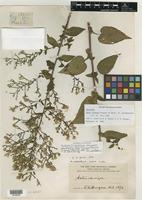
Lectotype of Aster claviger E. S. Burgess [family ASTERACEAE]
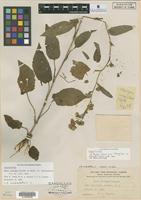
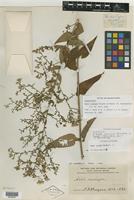
Isolectotype of Aster claviger E. S. Burgess [family ASTERACEAE]
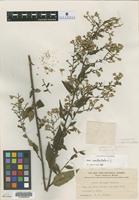
Filed as Aster claviger E. S. Burgess [family ASTERACEAE]
Previous
Next

Name

Identification
Aster claviger E. S. Burgess [family ASTERACEAE ] (stored under name); Verified by Jones, A. G.; Wetter, M. A.; Grimes, J. W., 1982 Aster claviger E. S. Burgess [family ASTERACEAE ] Verified by Jones, A. G., 1979 Aster claviger E. S. Burgess [family ASTERACEAE ] Verified by Burgess, E. S., 1898
Related name
  • Aster claviger
  • Aster undulatus
Common name
  • Wavyleaf aster, Flora of North America Vol. 20

Flora

Entry for Symphyotrichum undulatum (Linnaeus) G. L. Nesom [family ]
Herbarium
Flora of North America (FNA)
Collection
Flora of North America
Resource Type
Reference Sources
Entry From
Flora of North America, Vol 20,
Names
Symphyotrichum undulatum (Linnaeus) G. L. Nesom [family ], Phytologia, 77: 293. 1995
Aster undulatus Linnaeus [family COMPOSITAE], Sp. Pl., 2: 875. 1753
Aster asperifolius E. S. Burgess [family COMPOSITAE]
Aster baldwinii Torrey & A. Gray [family COMPOSITAE]
Aster claviger E. S. Burgess [family COMPOSITAE]
Aster corrigiatus E. S. Burgess [family COMPOSITAE]
Aster gracilescens E. S. Burgess [family COMPOSITAE]
Aster linguiformis E. S. Burgess [family COMPOSITAE]
Aster loriformis E. S. Burgess [family COMPOSITAE]
Aster mohrii E. S. Burgess [family COMPOSITAE]
Aster proteus E. S. Burgess [family COMPOSITAE]
Aster sylvestris E. S. Burgess [family COMPOSITAE]
Aster triangularis E. S. Burgess [family COMPOSITAE]
Aster truellius E. S. Burgess [family COMPOSITAE]
Aster undulatus var. diversifolius (Michaux) A. Gray [family COMPOSITAE]
Aster undulatus var. loriformis E. S. Burgess [family COMPOSITAE]
Treatment Author(s)
Luc Brouillet
John C. Semple
Geraldine A. Allen
Kenton L. Chambers
Scott D. Sundberg†
Information
Perennials, 30–160 cm, cespitose; short-rhizomatous or with branched, woody caudices. Stems 1–3+, erect (straight, brittle), hirtellous to glabrescent proximally to densely hirtellous distally. Leaves thin, margins scabrous, abaxial faces hirtellous, densely so on midveins, adaxial usually scabrous, sometimes strigose or hirsute, rarely glabrate; basal withering by flowering (sometimes new winter rosette developing), petiolate (petioles purplish, narrowly winged, bases dilated and sheathing, hirsute), blades oblong-ovate or ovate to widely ovate, (10–)35–60(–140) × (10–)15–70 mm, bases usually cordate or subcordate to rounded, sometimes attenuate, margins shallowly crenate-serrate to subentire, apices obtuse or rounded, mucronulate; proximalmost cauline withering by flowering, proximal persistent, winged-petiolate, distally more widely winged or ± sessile, wings widening abruptly at strongly auriculate-clasping petiolar bases, blades ovate to lanceolate, 30–120(–140) × (10–)20–50 mm, reduced distally, bases cordate- or auriculate-clasping (sessile), margins crenate-serrate or entire, apices acute or acuminate, mucronate; distal sessile, blades lance-ovate to oblong or lanceolate to linear-lanceolate, sometimes pandurate (branch leaves ovate to lanceolate, sharply smaller), 4–100 × 0.5–26 mm, reduced distally, bases ± clasping, sheathing, margins serrulate or entire, apices acute or acuminate to long-acuminate. Heads in open, narrow to wide paniculiform arrays, branches widely spreading, divaricate to ascending, sometimes secund, ± densely leafy. Peduncles well developed, 0.3–3(–5) cm, branches to 10 cm, spreading, bracteate, densely hirtellous to strigillose, bracts 3–10+, firm, appressed, subulate (2–3 mm), grading into phyllaries. Involucres campanulate to cylindro-campanulate, 3.8–5.5 mm. Phyllaries in 4–5(–6) series, appressed or outer spreading, oblong-lanceolate (outer) to linear-oblanceolate (inner) or linear (innermost), strongly unequal, bases indurate 1/2–2/3, margins scarious, erose, hyaline, ciliolate, green zones diamond-shaped to lanceolate, apices acute to acuminate or obtuse, often ± involute, often mucronulate, sometimes tips purplish, abaxial faces hirsutulous, adaxial sparsely so distally. Ray florets 12–16(–25); corollas usually blue to purple, sometimes lilac, laminae 6–12 × 1.4–2.5 mm. Disc florets 15–22(–25); corollas cream or light yellow becoming purple, 4–5.8 mm, tubes slightly shorter than funnelform throats, lobes lanceolate, 0.5–0.9 mm. Cypselae dull purple to light brown or tan, oblong-obovoid, compressed, 1.7–2.2 mm, 3–4-nerved, faces strigillose; pappi cream or rose-tinged, 3.5–5 mm. 2n = 16, 32.
Phenology
aug (summer), sep-oct (fall)
Altitude range
200–1500 m;
Distribution
USA Ala.USA Conn.USA Del.USA D.C.USA Fla.USA Ga.USA Ill.USA Ind.USA Ky.USA La.USA MaineUSA Md.USA Mass.USA Miss.USA N.H.USA N.J.USA N.Y.USA N.C.USA OhioUSA Pa.USA R.I.USA S.C.USA Tenn.USA Vt.USA Va.USA W.Va.Canada N.S.Canada Ont.
Discussion
Symphyotrichum undulatum is of conservation concern in Illinois and Nova Scotia. Hybridization with S. drummondii and S. oolentangiense has been by reported by A. G. Jones (1989), but some specimens so annotated represent phenotypic variation of S. undulatum. Symphyotrichum undulatum is sometimes confused with members of the S. patens complex due to its auriculate-clasping, more or less pandurifom cauline leaves.

Related Materials

  • Terms and Conditions
  • Privacy Policy
  • Cookie Policy
  • Cookie Settings
  • Accessibility
  • Help
  • Contact Us
  • Facebook
  • Twitter
ITHAKA

JSTOR is part of ITHAKA, a not-for-profit organization helping the academic community use digital technologies to preserve the scholarly record and to advance research and teaching in sustainable ways.

©2000-2026 ITHAKA. All Rights Reserved. JSTOR®, the JSTOR logo, JPASS®, Aluka®, and ITHAKA® are registered trademarks of ITHAKA.

╳