JSTOR Global Plants Home
  • Home
  • Browse
  • About
  • Access
  • Account
    • Saved Items
    • Profile
  • Log in

Global Plants

Skip to Main Content
  • JSTOR Global Plants Home
  • Global Plants

    • Browse
    • About
    • Access
    • Account
      • Saved Items
      • Profile
Log in
  • Browse
  • About
  • Access
  • Account
    • Saved Items
    • Profile
Advanced Search

Compilation
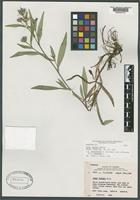
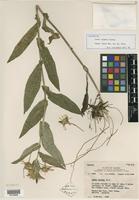
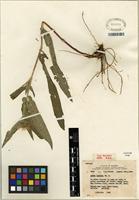
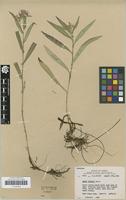
Aster calderi

7 Images see all

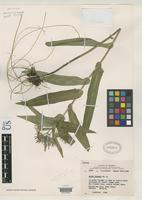
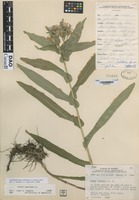
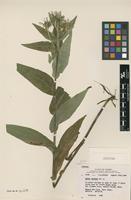
Paratype of Aster calderi Boivin [family ASTERACEAE]
Isotype of Aster calderi B. Boivin [family ASTERACEAE]
Isotype of Aster puniceus var. calderi (B. Boivin) Lepage [family ASTERACEAE]
Paratype of Aster calderi B.Boivin 1951 [family ASTERACEAE]
Isotype of Aster calderi Boivin, B. 1951 [family ASTERACEAE]
Type of Aster calderi Boivin [family ASTERACEAE]
Isotype of Aster calderi B.Boivin [family ASTERACEAE]
Previous
Next

Name

Identification
Aster calderi B.Boivin 1951 [family ASTERACEAE ] (stored under name); Verified by B. Boivin, 1948
Related name
  • Aster calderi
  • Aster puniceus

Flora

Entry for Symphyotrichum puniceum (Linnaeus) Á. Löve & D. Löve var. puniceum [family ]
Herbarium
Flora of North America (FNA)
Collection
Flora of North America
Resource Type
Reference Sources
Entry From
Flora of North America, Vol 20,
Names
Symphyotrichum puniceum (Linnaeus) Á. Löve & D. Löve var. puniceum [family ]
Aster calderi B. Boivin [family COMPOSITAE]
Aster puniceus Linnaeus var. calderi (B. Boivin) Lepage [family COMPOSITAE]
Aster puniceus var. compactus Fernald [family COMPOSITAE]
Aster puniceus var. oligocephalus Fernald [family COMPOSITAE]
Aster puniceus var. perlongus Fernald [family COMPOSITAE]
Symphyotrichum puniceum var. calderi (B. Boivin) G. L. Nesom [family ]
Treatment Author(s)
Luc Brouillet
John C. Semple
Geraldine A. Allen
Kenton L. Chambers
Scott D. Sundberg†
Information
Plants 7–200+ cm. Stems usually sparsely to ± densely hirsute, often glabrescent, sometimes glabrate proximally, sometimes entirely so (hirsute in lines in arrays). Leaves: abaxial faces paler than adaxial, with a dark, distinct reticulum, adaxial without impressed main veins; array leaves usually equal to mid cauline. 2n = 16, 32.
Phenology
aug (summer), sep-oct (fall)
Altitude range
0–2000 m;
Distribution
St. Pierre and Miquelonintroduced in Europe.USA Ala.USA Conn.USA Del.USA Ga.USA Ill.USA Ind.USA IowaUSA MaineUSA Md.USA Mich.USA Minn.USA Mo.USA Nebr.USA N.H.USA N.J.USA N.Y.USA N.C.USA N.Dak.USA OhioUSA Pa.USA R.I.USA S.C.USA S.Dak.USA Tenn.USA Vt.USA Va.USA W.Va.USA Wis.Canada Alta.Canada B.C.Canada Man.Canada N.B.Canada Nfld. and Labr.Canada N.S.Canada Ont.Canada P.E.I.Canada Que.Canada Sask.
Discussion
The following forms that pertain to var. puniceum are not recognized here: Aster puniceus forma blandus (Pursh) Lepage, forma candidus Fernald, forma colbyi Shinners, forma demissus (Lindley) Fernald, forma etiamalbus Venard, and forma rufescens Fassett. Variety calderi is a dwarf morphotype at the northern limit of the range that does not deserve taxonomic recognition. Hybrids of var. puniceum with the following species have been reported: Symphyotrichum lanceolatum (probably A. tardiflorus Linnaeus var. lancifolius Fernald), S. lateriflorum, S. urophyllum, and S. cordifolium.

Related Materials

  • Terms and Conditions
  • Privacy Policy
  • Cookie Policy
  • Cookie Settings
  • Accessibility
  • Help
  • Contact Us
  • Facebook
  • Twitter
ITHAKA

JSTOR is part of ITHAKA, a not-for-profit organization helping the academic community use digital technologies to preserve the scholarly record and to advance research and teaching in sustainable ways.

©2000-2026 ITHAKA. All Rights Reserved. JSTOR®, the JSTOR logo, JPASS®, Aluka®, and ITHAKA® are registered trademarks of ITHAKA.

╳