JSTOR Global Plants Home
  • Home
  • Browse
  • About
  • Access
  • Account
    • Saved Items
    • Profile
  • Log in

Global Plants

Skip to Main Content
  • JSTOR Global Plants Home
  • Global Plants

    • Browse
    • About
    • Access
    • Account
      • Saved Items
      • Profile
Log in
  • Browse
  • About
  • Access
  • Account
    • Saved Items
    • Profile
Advanced Search

Compilation
Asplenium stuhlmannii

4 Images see all

[family ]
[family ]
[family ]
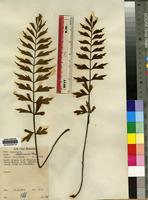
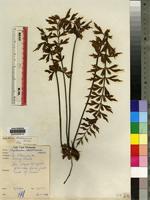
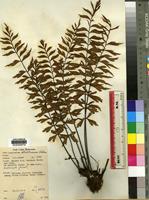
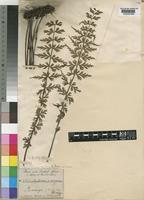
Asplenium stuhlmannii Hieron. [family ASPLENIACEAE]
Previous
Next

Name

Identification
Asplenium stuhlmannii Hieron. [family ASPLENIACEAE ] (stored under name); null
Related name
  • `
  • Asplenium stuhlmannii
  • Asplenium praemorsum

Flora

Entry for Asplenium stuhlmannii Hieron. [family ASPLENIACEAE]
Herbarium
Royal Botanic Gardens, Kew (K)
Collection
Flora of Tropical East Africa
Resource Type
Reference Sources
Entry From
Flora of Tropical East Africa, page 1, (2008) Author: Henk Beentje
Names
Asplenium stuhlmannii Hieron. [family ASPLENIACEAE], P.O.A. C: 83 (1895); Alston, Ferns W.T.A.: 59 (1959); Pic. Serm. in B.J.B.B. 55: 152 (1985); Johns, Pterid. trop. East Africa checklist: 67 (1991); Faden in U.K.W.F. ed. 2: 30, t. 173 (1994). Lectotype: Country unclear, Kanesse, Stuhlmann 936 (B!, lecto., chosen here)
Asplenium stuhlmannii Hieron. var. laciniata [family ASPLENIACEAE], P.O.A. C: 83 (1895). Type: Sudan, Niamniam land, on Gumango (R.), Schweinfurth 3915 (B!, holo.)
Asplenium ramlowii Hieron. [family ASPLENIACEAE], in E.J. 46: 372 (1911); Schelpe, F.Z. Pteridophyta: 180 (1970); Burrows, S. Afr. Ferns: 245, map, figs. (1990). Type: Tanzania, Tanga, Ramlow 16 (B!, holo.), syn. nov.
Information
Epiphyte or lithophyte; rhizome short-creeping or erect, to 5 mm diameter, with dark brown narrowly triangular rhizome scales 2.5–8x0.3–0.5 mm, attenuate at apex, margin paler and entire or with outgrowths. Fronds closely spaced or tufted, to 40 cm long, erect, not proliferous. Stipe dark brown, 6–28 cm long, at first densely set with scales similar to those of the rhizome, later becoming subglabrous except near the base. Lamina narrowly oblong, 6–38x1.6–5(–8.8) cm, 1-pinnate to 2-pinnatifid or 2-pinnatisect (rarely 3-pinnatifid), the lower pinnae slightly reduced, with a terminal pinna similar to lateral ones; pinnae in 8–15 pairs, opposite in mid-frond, narrowly ovate-triangular to ovate in outline, up to 3(–4.5)x1.6(–2.5) cm, subsessile, palmately to pinnately divided into 3–5 serrate lobes to 1 cm long, the central lobe prominent and serrate (rarely to 3.7x1.2 cm, and deeply pinnatisect), with a few minute scales or glabrous. Rachis dark brown at first densely set with shining scales similar to those on the stipe, glabrescent. Sori many, may cover lower pinna surface, linear, (1–)3–10 mm long; indusium linear, membranous, 0.4–0.5 mm wide, entire to slightly erose. Fig. 5: 12–13, p. 30.
Range
DISTR. U 2; K 3?, 4, 7; T 1, 3, 7
Altitude range
1200–1700 m but type presumably from much lower altitude
Distribution
KENYA Kitui District Galunka, May 1902, Kassner 793!KENYA Teita District Msau–Mbololo road, near Mwambirwa Forest Station, Sep. 1970, Faden et al. 70/520!TANZANIA Bukoba District Ilomera Mission, Sep. 1974, Balslev 11!TANZANIA Lushoto District Lushoto, June 1961, Braithwaite 316!TANZANIA Iringa District Ruaha National Park, Magangwe Hill, May 1972, Bjørnstad 1799! & 1800!UGANDA Ankole District Nyakatokye–Bunyenye, Kashari, Mar. 1986, Rwaburindore 2235!
Distribution (external)
Burundi
Zambia
Mozambique
Zimbabwe
Notes
CONSERVATION Widespread; least concern (LC). When one compares the types and protologues of A. stuhlmannii and A. ramlowii hardly any differences are apparent. The size range of rhizome scales in ramlowii is slightly greater, and pinnae number is slightly smaller in ramlowii. The type of A. ramlowii is a minimalist bunch of scraps, but probably really the same as the rest of the taxon so named. Var. laciniatum looks quite different, much more incised, but Uhlig 106 has a single frond divided in the same way as the type of laciniatum, while the other fronds are as in the typical variety. The dimensions are indicated in brackets in the above description. The pinnae look quite like uppermost few pinnae of A. albersii (now in A. aethiopicum). The Kenyan Kassner specimen and T 1, Moru Kopjes, Apr. 1961, Greenway & Miles Turner 10033! are the only ones that have the pinnae divided into discrete pinnules, which in turn are lobed. Another Kenyan specimen, K 3, Uasin Gishu District: Kipkarren, Aug. 1931, Brodhurst-Hill 49! is sterile, but looks very much like this species. Information received after the text was completed: Dr A Braithwaite informs me re Braithwaite 316, that there is a clear cytological difference between this material and A. stuhlmannii. It has the same chromosome number as material of A. simii Dr Braithwaite collected from Knysna, South Africa. i. e. n = 144, while A. stuhlmannii is tetraploid withn = 72. A. simii is recorded as ‘excluded species’ (page 69) but this will obviously have to be revisited during follow-up treatments!

Related Materials

  • Terms and Conditions
  • Privacy Policy
  • Cookie Policy
  • Cookie Settings
  • Accessibility
  • Help
  • Contact Us
  • Facebook
  • Twitter
ITHAKA

JSTOR is part of ITHAKA, a not-for-profit organization helping the academic community use digital technologies to preserve the scholarly record and to advance research and teaching in sustainable ways.

©2000-2026 ITHAKA. All Rights Reserved. JSTOR®, the JSTOR logo, JPASS®, Aluka®, and ITHAKA® are registered trademarks of ITHAKA.

╳