JSTOR Global Plants Home
  • Home
  • Browse
  • About
  • Access
  • Account
    • Saved Items
    • Profile
  • Log in

Global Plants

Skip to Main Content
  • JSTOR Global Plants Home
  • Global Plants

    • Browse
    • About
    • Access
    • Account
      • Saved Items
      • Profile
Log in
  • Browse
  • About
  • Access
  • Account
    • Saved Items
    • Profile
Advanced Search

Compilation
Asplenium rutifolium

6 Images see all

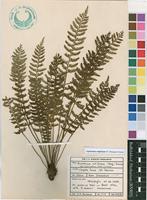
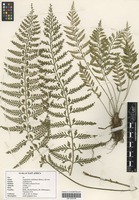
Syntype of Asplenium stans Bory [family PTERIDOPHYTA]
Filed as Asplenium rutifolium (Willd.) Kunze [family ASPLENIACEAE]
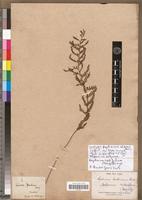
Holotype of Lonchitis bipinnata Forssk. [family DENNSTAEDTIACEAE]
Filed as Asplenium rutifolium (P.J.Bergius) Kunze [family ASPLENIACEAE]
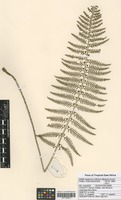
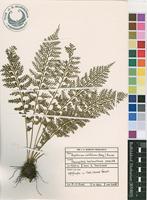
Filed as Asplenium rutifolium (Willd.) Kunze [family ASPLENIACEAE]
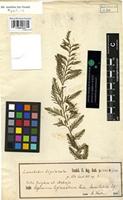
Filed as Asplenium rutifolium (P.J.Bergius) Kunze [family ASPLENIACEAE]
Previous
Next

Name

Identification
Asplenium rutifolium (P.J.Bergius) Kunze [family ASPLENIACEAE ] (stored under name); Verified by Burrows, J.E.,
Related name
  • Asplenium bipinnatum
  • Asplenium stans
  • Lonchitis bipinnata
  • Asplenium rutifolium
  • Caenopteris furcata

Flora

Entry for Asplenium rutifolium (Bergius) Kunze [family ASPLENIACEAE]
Herbarium
Royal Botanic Gardens, Kew (K)
Collection
Flora of Tropical East Africa
Resource Type
Reference Sources
Entry From
Flora of Tropical East Africa, page 1, (2008) Author: Henk Beentje
Names
Asplenium rutifolium (Bergius) Kunze [family ASPLENIACEAE], in Linnaea, 10: 521 (1836), as rutaefolium; Schelpe, F.Z. Pteridophyta: 185 (1970); Burrows, S. Afr. Ferns: 236, map, figs. (1990); Johns, Pterid. trop. East Africa checklist: 67 (1991). Type: South Africa, Cape of Good Hope, Thunberg s.n. (SBT, holo.)
Lonchitis bipinnata Forssk. [family ], Fl. Aegypt.-Arab.: CXXIV, 184 (1775)
Adiantum achilleifolium Lam. [family ADIANTACEAE], Encycl. Méth., Bot. 1: 43 (1783). Type: South Africa, Cape of Good Hope (no collector indicated)
Caenopteris rutifolium Bergius [family ASPLENIACEAE], in Act. Petropol. 1782, 2: 249, t. 7 fig. 2 (1786), as rutaefolia
Darea disticha Kaulf. [family ASPLENIACEAE], Enum. Fil.: 180 (1824), nom. illegit. Type as for Lonchitis bipinnata
Caenopteris disticha Spreng. [family ASPLENIACEAE], in L., Syst. Nat., ed. 16, 4: 91 (1827)
Asplenium achilleifolium (Lam.) C.Chr. [family ASPLENIACEAE], Ind. Fil.: 99 (1905), non Liebm. (1849)
Asplenium distichum (Kaulf.) Salomon [family ASPLENIACEAE], Nomencl. Gefässkrypt.: 84 (1883)
Asplenium bipinnatum (Forssk.) C.Chr [family ASPLENIACEAE], Index filic.: 99 (1905) & apud Hieron., Z.A.E.: 11 (1910). Type: Yemen, Bolghose, Forsskål 810 (C, holo., B! (fragm.), iso.), non A. bipinnatum Roxb. (1844) nec Hil. (1888)
Asplenium linearilobum Peter [family ASPLENIACEAE], in F.D.O.-A.: 80 (1929) & Descr.: 8, t. 2.7–2.8 (1929);Johns, Pterid. trop. East Africa checklist: 65 (1991). Type: Tanzania, Lushoto District: W Usambara, Manolo–Mtai, Peter 4196c (B, holo., not found). Note: Peter also says this is A. borbonicum Jacq., Collect.: 3 (1789), non Hook.; though he calls 4196 ‘specimen authenticum’, which is his term for type!
Asplenium rutifolium (Forsk.) Schelpe var. bipinnatum [family ASPLENIACEAE], in Journ. S. Afr. Bot.30: 194 (1964); Schelpe, F.Z. Pteridophyta: 180, t. 54c (1970); Johns, Pterid. trop. East Africa checklist: 67 (1991)
Asplenium rutifolium (Peter) Schelpe var. linearilobum [family ASPLENIACEAE], ined.?; Johns, Pterid. trop. East Africa checklist: 67 (1991). Nomen nudum? used on quite a few herbarium sheets. Note: in F.Z. Schelpe puts linearilobum Peter as a synonym of his A. rutifolium var. bipinnatum.
Asplenium strangeanum Pic.Serm. [family ASPLENIACEAE], in Webbia 32 (1): 83, t. 4 (1977) & in B.J.B.B. 55: 152 (1985); Schippers in Fern Gaz. 14, 6: 204 (1993); Faden in U.K.W.F. ed. 2: 29, t. 173 (1994). Type: Kenya, Kiambu District: Kiambu, Chania R., Strange 59 (herb. Pic.Serm., holo.), syn. nov.
Information
Lithophyte, epiphyte or terrestrial; rhizome erect, to 50 mm long and to 25 mm diameter, with dark brown lanceolate to narrowly ovate acute rhizome scales 4–9x0.8–1.2(–2.2) mm with or without narrow pale borders, subentire or sometimes with a few hair-like lobes. Fronds tufted (once described as rhizome shortly creeping, fronds shortly spaced, Faden 69/327), usually stiffly erect, not proliferous. Stipe brown abaxially, green adaxially, 3–20 cm long, either with scattered scales to 3x1.3 mm with dark brown midpart and broad pale margins or glabrous except for scattered minute dark brown ovate acuminate scales, becoming glabrous with age. Lamina ovate to narrowly oblong in outline, 7–40x3–10(–12) cm, thinly to thickly coriaceous, 2-pinnatisect to 3-pinnatisect, with basal pinnae hardly or not reduced, apex gradually decrescent; pinnae 13–28 pairs, oblong and attenuate or obtuse, the largest 3–7x0–7–1.3(–1.7) cm, shortly stalked, deeply pinnatifid into mostly linear or very narrowly spatulate segments set at 45°, 3.5–8x0.6–1.2 mm (up to 2 mm across sori) but with the acroscopic basal segment often 2–9-lobed, often with some of the basal segments 2-fid to 2-lobed, apices obtuse, basiscopic base sub-dimidiate, glabrous on both surfaces except for occasional minute dark narrowly ovate scales. Rachis narrowly winged or ridged laterally, pale brown when dry with occasional minute dark brown ovate scales. Sori 1 per pinna lobe, ellipsoid, borne halfway along the length of the lobe or slightly higher and reaching from the costule to or beyond the margin, facing towards the pinna apex, 1.3–3.5 mm in our area, elsewhere 0.8–5 mm long; indusium oblong, membranous, entire, to 0.8 mm wide. Fig. 9: 5–6, p. 54.
Range
DISTR. U 2, 3; K 1, 3–7; T 1–4, 6–8
Altitude range
750–2100(–2300) m
Distribution
KENYA Northern Frontier District Ndoto Mts, between Nkurnit and Manmanet ridge, Oct. 1995, Bytebier & Kirika 42!KENYA Nairobi, no exact locality, May 1971, Mwangangi & Mukenya 1599!KENYA Teita District road to Bura Mission, Faden et al. 69/327!TANZANIA Musoma District Wogakuria guard post, Dec. 1964, Greenway & Turner 11798!TANZANIA Lushoto District Baga Forest Reserve, May 1987, Kisena 477!TANZANIA Iringa District Mufindi, Luiga tea estate, May 1968, Renvoize & Abdallah 2057!UGANDA Ankole District Ruizi R., Mar. 1951, Jarrett 406!UGANDA Mt Elgon, below Bulambuli, Dec. 1957, Allen 3671!
Distribution (external)
Malawi
Mozambique
Zimbabwe
South Africa
Madagascar
Mascarene Is
Yemen
Notes
CONSERVATION Widespread; least concern (LC). Burrows has re-united var. bipinnatum with the typical variety, due to the presence of intermediates. I am happy to follow him. A. strangeanum agrees completely with A. rutifolium – as does the illustration with the protologue. The only differences seem to be slightly longer rhizome scales. The author did not compare it to rutifolium, but only to A. borbonicum – which does not occur in East Africa. H.D. van Someren102 from Kenya K 7, Shimba Hills, is sterile but looks like this species – it would be a low altitude, but the specific altitude is not given on the label. There are a whole range of problem specimens falling in between rutifolium and loxoscaphoides, with a worrying variability of rhizome scales – narrow ones about 1 mm wide, with a dark brown middle part and a thin pale brown margin are usual for rutifolium; wider ones, up to 2.5 mm wide, with a narrow dark brown central part and a wide pale brown margin, occur in specimens from northern Tanzania and Kenya, e.g. Beesley 10! from Kilimanjaro and Archbold 970! from the same area. This form of rhizome scale is often, but not always, linked to longer stipes, of up to 25 cm. Confusingly, in this same area ‘normal’ rutifolium specimens with the narrower scales are also common. It is possible that specimens with narrow pale margins and a rather broad dark centre are linked to a moist forest habitat. I believe there are some differences, as per the key (rhizome scales being the most clear; plus some relative sizes) but the two taxa are close.

Related Materials

  • Terms and Conditions
  • Privacy Policy
  • Cookie Policy
  • Cookie Settings
  • Accessibility
  • Help
  • Contact Us
  • Facebook
  • Twitter
ITHAKA

JSTOR is part of ITHAKA, a not-for-profit organization helping the academic community use digital technologies to preserve the scholarly record and to advance research and teaching in sustainable ways.

©2000-2026 ITHAKA. All Rights Reserved. JSTOR®, the JSTOR logo, JPASS®, Aluka®, and ITHAKA® are registered trademarks of ITHAKA.

╳