JSTOR Global Plants Home
  • Home
  • Browse
  • About
  • Access
  • Account
    • Saved Items
    • Profile
  • Log in

Global Plants

Skip to Main Content
  • JSTOR Global Plants Home
  • Global Plants

    • Browse
    • About
    • Access
    • Account
      • Saved Items
      • Profile
Log in
  • Browse
  • About
  • Access
  • Account
    • Saved Items
    • Profile
Advanced Search

Compilation
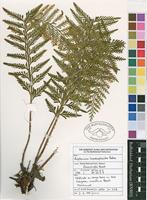
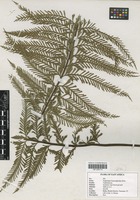
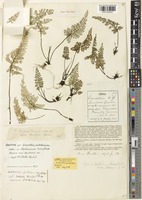
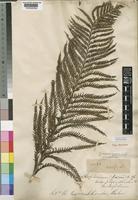
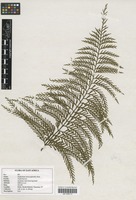
Asplenium loxoscaphoides

5 Images see all

Filed as Asplenium loxoscaphoides Baker [family ASPLENIACEAE]
Type of Asplenium pulcherrimum (Baker) Ching in Blot [family ASPLENIACEAE]
Type of Asplenium loxoscaphoides Baker [family ASPLENIACEAE]
Filed as Asplenium loxoscaphoides Baker [family ASPLENIACEAE]
Previous
Next

Name

Identification
Asplenium loxoscaphoides Baker [family ASPLENIACEAE ] (stored under name); Verified by Burrows, J.E.,
Related name
  • Asplenium loxoscaphoides
  • Asplenium plerioides

Flora

Entry for Asplenium loxoscaphoides Baker [family ASPLENIACEAE]
Herbarium
Royal Botanic Gardens, Kew (K)
Collection
Flora of Tropical East Africa
Resource Type
Reference Sources
Entry From
Flora of Tropical East Africa, page 1, (2008) Author: Henk Beentje
Names
Asplenium loxoscaphoides Baker [family ASPLENIACEAE], in Trans. Linn. Soc. 2: 354 (1887); Johns, Pterid. trop. East Africa checklist: 65 (1991); Faden in U.K.W.F. ed. 2: 29, t. 173 (1994). Type: Tanzania, Kilimanjaro, Johnston 43 (K!, holo.)
Information
Terrestrial, epiphyte or rarely lithophyte; rhizome erect, fleshy, to 60 mm long and 8–50 mm diameter, with pale to mid-brown ovate acute subentire rhizome scales to 9–14x3–3.5 mm. Fronds tufted, erect to arching, not proliferous, thinly to thickly coriaceous. Stipe pale brown to greyish-green when dry (green to black when fresh), 15–48 cm long, glabrous except for some scales near base. Lamina dark green, narrowly ovate in outline, 32–80x13–26 cm, 2-pinnatisect to 3-pinnatifid on the lowermost pinnules, with basal pinnae reduced (rarely not reduced), apex gradually decrescent; pinnae opposite or alternate, 23–44 pairs, oblong and attenuate, the largest (6–)8–13(–16)x1–2.2 cm or up to 4 cm wide with much-lobed basal pinnules, petiolate, deeply pinnatifid into linear or very narrowly spatulate segments set at 45°, 1–2 mm wide, most segments entire or some with bifid apex or many segments bifid, basal acroscopic segment usually more lobed or enlarged to an up to 2.5 cm long deeply lobed pinnule (rarely basiscopic segment also more lobed), apices acute or obtuse; more basal pinnae often shorter and with more widely winged costa and so appearing more pinnatipartite than the pinnatisect upper pinnae; with scattered scales similar to those on rachis. Rachis black and green when fresh, pale brown when dry, with scattered dark brown narrowly lanceolate scales to 3 mm long with hair-like lobes, sometimes becoming glabrous. Sori 1 per pinna lobe, ellipsoid, borne halfway along the length of the lobe but almost on the margin, facing towards the pinna apex, 1.5–5(–6) mm long; indusium very narrowly oblong, membranous, entire, to 1 mm wide. Fig. 9: 7–8, p. 54.
Range
DISTR. K 1, 3–6; T 2, 6, 7
Altitude range
1850–3100(–3650) m
Distribution
KENYA Mt Elgon, E slope above Tweedie’s saw-mill, Feb. 1948, Hedberg 116!KENYA Meru District Ithangune, near Katheri, June 1969, Faden et al. 69/780!KENYA Masai District Chyulu Hills, Oct. 1969, Gillett & Kariuki 18857!TANZANIA Kilimanjaro, above Mandara Hut, Oct. 1993, Grimshaw 93/860!TANZANIA Masai District Embagai crater rim, Dec. 1956, Greenway 9138!TANZANIA Morogoro District Uluguru Mts, Bondwa SE, Sep. 1970, Faden et al. 70/638!
Distribution (external)
north Malawi
Notes
CONSERVATION Fairly widespread in a series of habitats and often locally common; Least Concern (LC). Baker in his protologue said the taxon was close to A. rutifolium; the characters he uses in the description are similar to those of rutifolium, except for ‘lower pinnae 10–12.5 cm long, 10–12 mm wide’ – which is larger than in rutifolium. The type (and only specimen Baker saw) does not have a stipe & rhizome. Baker did not mention how he thought the plant differed from rutifolium. I believe there are some differences, as per the key (rhizome scales being the most clear; plus some relative sizes) but the two taxa are close, and there are some vexing overlap characters/specimens (see under A. rutifolium). Asplenium centrafricanum Pic.Serm. in Webbia 27: 436 (1972 publ. 1973) from Burundi, Zaire is probably the same; the differences enumerated in the protologue do not sound very different to me.

Related Materials

  • Terms and Conditions
  • Privacy Policy
  • Cookie Policy
  • Cookie Settings
  • Accessibility
  • Help
  • Contact Us
  • Facebook
  • Twitter
ITHAKA

JSTOR is part of ITHAKA, a not-for-profit organization helping the academic community use digital technologies to preserve the scholarly record and to advance research and teaching in sustainable ways.

©2000-2026 ITHAKA. All Rights Reserved. JSTOR®, the JSTOR logo, JPASS®, Aluka®, and ITHAKA® are registered trademarks of ITHAKA.

╳