JSTOR Global Plants Home
  • Home
  • Browse
  • About
  • Access
  • Account
    • Saved Items
    • Profile
  • Log in

Global Plants

Skip to Main Content
  • JSTOR Global Plants Home
  • Global Plants

    • Browse
    • About
    • Access
    • Account
      • Saved Items
      • Profile
Log in
  • Browse
  • About
  • Access
  • Account
    • Saved Items
    • Profile
Advanced Search

Compilation
Asplenium elliottii

11 Images see all

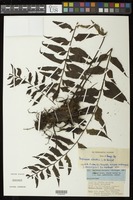
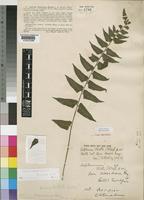
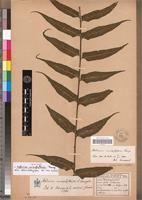
Holotype of Asplenium anisophyllum var. pseudo-plumosa Hieron. [family POLYPODIACEAE]
[family ]
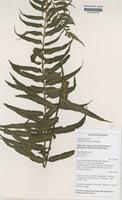
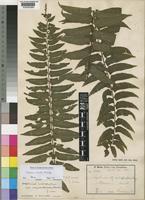
Filed as Asplenium elliottii C. H. Wright [family ASPLENIACEAE]
Asplenium elliottii C.H. Wright [family ASPLENIACEAE]
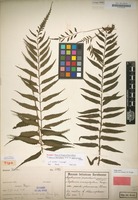
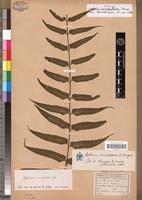
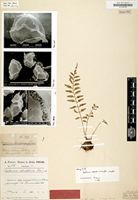
Isotype of Asplenium anisophylloides Bonap. [family PTERIDOPHYTA]
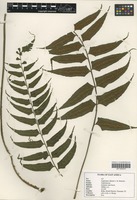
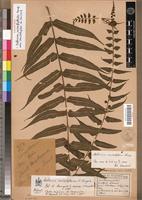
Holotype of Asplenium anisophylloides Bonap. [family PTERIDOPHYTA]
Isotype of Asplenium anisophylloides Bonap. [family PTERIDOPHYTA]
Filed as Asplenium elliottii C.H.Wright [family ASPLENIACEAE]
Asplenium elliottii C.H. Wright [family ASPLENIACEAE]
Previous
Next

Name

Identification
Asplenium elliottii C.H.Wright [family ASPLENIACEAE ] (stored under name); Verified by Viane, R.,
Related name
  • Asplenium aequilaterale
  • Asplenium elliottii
  • `
  • Asplenium anisophylloides
  • Asplenium anisophyllum

Flora

Entry for Asplenium elliottii C.H.Wright [family ASPLENIACEAE]
Herbarium
Royal Botanic Gardens, Kew (K)
Collection
Flora of Tropical East Africa
Resource Type
Reference Sources
Entry From
Flora of Tropical East Africa, page 1, (2008) Author: Henk Beentje
Names
Asplenium elliottii C.H.Wright [family ASPLENIACEAE], in K.B. 1908: 262 (1908); Johns, Pterid. trop. East Africa checklist: 63 (1991); Schippers in Fern Gaz. 14, 6: 200 (1993); Faden in U.K.W.F. ed. 2: 28, t. 172 (1994). Type: Kenya, Aberdare range at ± 2800 m, C.F. Elliott s.n. (K!, holo.)
Asplenium anisophyllum Hieron. var. aequilateralis [family ASPLENIACEAE], in P.O.A. C: 82 (1895). Type: Tanzania, Lushoto District: Usambara, Shagayu Forest near Mbaramu, Holst 2491 (B!, holo.)
Asplenium anisophyllum Hieron. var. pseudo-plumosa [family ASPLENIACEAE], P.O.A. C: 82 (1895). Type: Tanzania, Lushoto District: Usambara Mts, Shagayu forest near Mbaramu, Holst 2492 (B!, holo.), syn. nov.
Asplenium aequilaterale (Hieron.) Viane [family ASPLENIACEAE], in Biol. Jaarb. 59: 157 (1991); Schippers in Fern Gaz. 14, 6: 198 (1993); Johns, Pterid. trop. East Africa checklist: 61 (1991), syn. nov.
Information
Terrestrial or less often a low-level epiphyte, often gregarious, 30–140 cm high; rhizome erect (very rarely shortly creeping), to 8 mm diameter, with concolorous ovate scales 4–10x2.5–4 mm. Stipe straw-colored, 11–30(–80) cm long, thin, glabrous or with sparse subulate clathrate scales to 4 mm long with widened base and occasionally with very thin side-lobes. Fronds tufted. Lamina dark green, lanceolate, 24–60(–100+)x10–22 cm, 1-pinnate, the lowermost pinnae slightly smaller, decrescent towards the apex, proliferous near apex; pinnae in 14–30 pairs, opposite or alternate, rhomboid or narrowly lanceolate, (3–)5–16(–22)x(1.3–)1.6–3.3 cm, base truncate and parallel to rachis on the acroscopic side, oblique on the basiscopic side, minutely crenate-serrate, acuminate; veins forked once; glabrous or occasionally with sparse scattered scales; petiolule 1–4 mm long. Rachis slightly winged in the distal part, with sparse subulate scales to 3.5 mm long with widened base and occasionally with very thin side-lobes. Sori many, from near costa to halfway towards the margin, brown or red-brown, linear to elliptic, 3–4.5(–8) mm long; indusium pale, entire, 0.5–1(–1.3) mm wide. Fig. 3: 5, p. 19.
Range
DISTR. U 2, 3; K 3–7; T 1–7
Altitude range
1050–2800 m
Distribution
KENYA Meru District Nyambeni Hills, Kirima, Oct. 1960, Verdcourt & Polhill 2973!KENYA Kericho District Chemasingi Tea Estate 13 km S of Kericho, Dec. 1967, Perdue & Kibuwa 9304!KENYA Teita District Taita Hills, Ngangao, May 1985, NMK Taita Hills Expedition 272!TANZANIA Lushoto District Baga Forest Reserve, May 1987, Kisena 635!TANZANIA Ufipa District Nsanga forest, Aug. 1960, Richards 12970!TANZANIA Mpwapwa District Sagara [Usagura] Mts, 1884, Kirk s.n.!UGANDA Toro District Ruwenzori, Bjuku valley, Jan. 1951, Osmaston 3662!UGANDA Kigezi District Bwindi forest, Rubanda, Nov. 1989, Rwaburindore 2886!UGANDA Elgon, Dec. 1996, Wesche 573!
Distribution (external)
Congo-Kinshasa
Rwanda
Burundi
Notes
CONSERVATION Widespread; least concern (LC). Several specimens from K 7, Shimba Hills, Mar. 1941, H.D. van Someren 125!, 151! and 168! are probably this taxon, but lack rhizomes. This would be at much lower altitude than other specimens, though the labels lack altitude data. A specimen from Uganda, Ruwenzori, Mobuku valley, Dec. 1938, Loveridge 291! looks very much like this taxon; but is strikingly different from all other East and central African Asplenium species I have seen in that many a pinna has on the upper surface, in the middle of the costa, a gemma with growing plantlet. Most details are lacking: the specimen I have seen consists of a 33 cm part of rachis with 9 pairs of what looks like upper-middle pinnae. The fern is said to be 2 m high – unknown whether creeping or tufted. Presumably 1-pinnate, the pinnae 9 or more (presumably many more) on each side of the rachis; pinnae lanceolate, to 15 x 2.6 cm, shortly stalked, acroscopic base parallel to the rachis and almost with an enlarged lobe, basiscopic base cuneate, margin crenate, apex acuminate, glabrous or nearly so. Rachis with very sparse filiform scales to 2 mm long. Sori many, restricted to the lower half of the pinna, at a 45° angle to the costa and slightly nearer the costa than the margin, linear, 3–5 mm long, straight; indusium translucent, to 1 mm wide, entire. The name A. pseudoplumosum Hiern, under which several specimens were laid in at Berlin, was never published.

Related Materials

  • Terms and Conditions
  • Privacy Policy
  • Cookie Policy
  • Cookie Settings
  • Accessibility
  • Help
  • Contact Us
  • Facebook
  • Twitter
ITHAKA

JSTOR is part of ITHAKA, a not-for-profit organization helping the academic community use digital technologies to preserve the scholarly record and to advance research and teaching in sustainable ways.

©2000-2026 ITHAKA. All Rights Reserved. JSTOR®, the JSTOR logo, JPASS®, Aluka®, and ITHAKA® are registered trademarks of ITHAKA.

╳