JSTOR Global Plants Home
  • Home
  • Browse
  • About
  • Access
  • Account
    • Saved Items
    • Profile
  • Log in

Global Plants

Skip to Main Content
  • JSTOR Global Plants Home
  • Global Plants

    • Browse
    • About
    • Access
    • Account
      • Saved Items
      • Profile
Log in
  • Browse
  • About
  • Access
  • Account
    • Saved Items
    • Profile
Advanced Search

Compilation
Aspilia vernayi

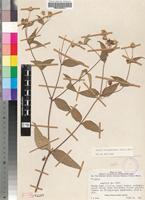
4 Images see all

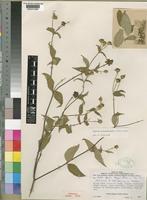
Holotype of Aspilia vernayi Brenan [family COMPOSITAE]
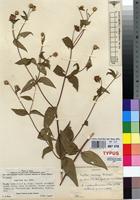
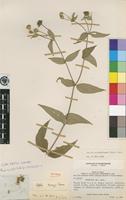
Isotype of Aspilia vernayi Brenan [family ASTERACEAE]
Previous
Next

Name

Identification
Isotype of Aspilia vernayi Brenan [family ASTERACEAE ] Verified by Not on sheet, Aspilia mossambicensis (Oliv.) Wild [family ASTERACEAE ] (stored under name); Verified by Not on sheet,
Related name
  • Aspilia mossambicensis
  • Aspilia vernayi

Flora

Entry for Aspilia mossambicensis (Oliv.) Wild [family COMPOSITAE]
Herbarium
Royal Botanic Gardens, Kew (K)
Collection
Flora of Tropical East Africa
Resource Type
Reference Sources
Entry From
Flora of Tropical East Africa, Part Part 3, page 547, (2005) Author: H. Beentje, C. Jeffrey & D.J.N. Hind
Names
Aspilia mossambicensis (Oliv.) Wild [family COMPOSITAE], in Kirkia 5: 221 (1965) & in Kirkia 6: 46 (1967); Blundell, Wild Fl. E. Afr.: pl. 351 (1987); Lisowski, Asterac. Fl. Afr. Centr. 1: 203 (1991); U.K.W.F. ed. 2: 216, t. 88 (1994). Type: Tanzania, 6°S, 3800 feet, Grant s.n. (K!, holo.)
Menotriche strigosa Steetz [family ], in Peters, Reise Mossamb. Bot. 2: 475 (1863). Type: Mozambique, Rios de Sena, Peters s.n. (B†, holo.) [non Aspilia strigosa (Hook. & Arn.) W.B.Hemsl., 1881)
Wedelia mossambicensis Oliv. [family ], in Trans. Linn. Soc. 29: 97 (1873); Oliv. & Hiern, F.T.A. 3: 377 (1877)
Wedelia menotriche Oliv. & Hiern [family ], F.T.A. 3: 377 (1877). Type as for Menotriche strigosa
Aspilia wedeliiformis Vatke [family COMPOSITAE], in Osterr. Bot. Zeit. 27: 197 (1877), as wedeliaeformis; Oliv. & Hiern, F.T.A. 3: 461 (1877); Muschler in E.J. 50, suppl.: 338 (1914). Type: Kenya, Lamu, Hildebrandt 1908 (B†, holo., W, fragm.)
Aspilia monocephala Baker [family COMPOSITAE], in K.B. 1898: 152 (1898); Muschler in E.J. 50, suppl.: 337 (1914). Type: Malawi, Zomba, Whyte & McClounie s.n. (K!, SYN.)
Aspilia holstii Engl. [family COMPOSITAE], P.O.A. C: 413 (1895); Muschler in E.J. 50, suppl.: 340 (1914). Type: Kenya, Teita, Hildebrandt 2380 (B†, SYN.), Tanzania, Lushoto District: Usambara, Holst 148 (B†, SYN.) & Holst 4334 (BM!, COI, EA, K!, M, SYN.)
Coreopsis aspiliodes Baker [family COMPOSITAE], in K.B. 1898: 153 (1898). Type: Malawi, Zomba, Whyte s.n. (K!, holo.)
Wedelia instar S.Moore [family ], in J.L.S. 35: 343 (1902). Type: Malawi, Buchanan 67 (BM!, holo.)
Aspilia chrysops S.Moore [family COMPOSITAE], in J.L.S. 38: 459 (1900); Muschler in E.J. 50, suppl.: 338 (1914). Type: Somalia, Laskaroto, Donaldson Smith s.n. (BM!, holo.)
Aspilia aspilioides (Baker) S.Moore [family COMPOSITAE], in J.L.S. 40: 115 (1911); Lisowski, Asterac. Fl. Afr. Centr. 1: 202 (1991)
Wedelia affinis De Wild. [family ], in F.R. 13: 209 (1914). Types: Congo (Kinshasa), Shaba [Katanga], Corbisier in herb. Homblé 606 (BR!, SYN.), 612 (BR, SYN.)
Wedelia katangensis De Wild. [family ], in F.R. 13: 209 (1914). Types: Congo (Kinshasa), Shaba [Katanga], Welgelegen, Homblé 794 (BR!, SYN.), Esschen, Homblé 887 (BR!, SYN.), 894 (BR!, SYN.)
Aspilia ritellii Chiov. [family COMPOSITAE], Fl. Somal. 2: 266 (1932). Type: Somalia, Isola di Alexandra, Tozzi 280 (FT, holo.)
Aspilia tanganyikensis Lawalrée [family COMPOSITAE], in B.J.B.B. 19: 222 (1949); Lisowski, Asterac. Fl. Afr. Centr. 1: 202 (1991). Type: Congo (Kinshasa), Mtoto, Van Meel 1169 (BR!, holo.)
Aspilia vernayi Brenan [family COMPOSITAE], in Mem. N.Y. Bot. Gard. 8, 5: 479 (1954). Type: Malawi, Zomba Mt, Brass 16215 (K!, holo., PRE, SRGH, iso.)
Aspilia natalensis [family COMPOSITAE], sensu Wild in Kirkia 5: 213 (1965), except South African material, & Wild in Kirkia 6: 44 (1967) & Lisowski, Asterac. Fl. Afr. Centr. 1: 197, t. 44 (1991), non Wedelia natalensis Sond. sensu stricto
Aspilia gillettii Wild [family COMPOSITAE], in Kirkia 5: 215 (1965), nov. Type: Ethiopia, Mt Mega, Gillett 14355 (K, holo., not found)
Information
Perennial herb or shrub 10–250 cm high, with a single or many stems from short rootstock with numerous fibrous roots and stiff branching; stems often reddish or purple near base; branches scabrid-pubescent, sometimes also glandular. Leaves sessile or with petiole to 1 cm long, ovate, narrowly elliptic or lanceolate, 2.5–20 cm long, 1–8.5 cm wide, base rounded to cuneate, margins serrate or subentire, apex attenuate or acuminate, less often obtuse, very scabrid on both surfaces; 3-veined from base. Capitula terminal and solitary or in few-headed lax racemes; stalks of individual capitula to 14 cm long; involucre ovoid, 2–3-seriate, 5–17 mm long; outer phyllaries foliaceous, green, scabrid-pilose and sometimes glandular; paleae 6.5–12 mm long with acute to attenuate apex, keel often purple. Ray florets cream, yellow to orange, (5–)7–17, with or without styles, the ray 7–18.5 mm long, to 6.5 mm wide, tube 1.5–4.5 mm long; disc florets cream, yellow or orange, sometimes with purple line down from the lobes, 5.5–9 mm long, the lower part of tube and lobes puberulous; anther appendages yellow. Achenes narrowly obovoid or sub-cylindrical, 2.5–5.5 mm long, pubescent to almost glabrous; pappus a lacerate cupule to 1 mm high and with or without 1–2 setae to 3 mm long. Fig. 158 (page 752).
Range
DISTR. U 1–4; K 1–7; T 1–8 Congo (Kinshasa), Burundi, Ethiopia, Somalia, and southward to South Africa
Altitude range
45–2300 m
Distribution
KENYA Turkana District Oropoi, Feb. 1965, Newbould 6892!KENYA Naivasha District Lake Naivasha SW, Apr. 1968, Mwangangi 772!KENYA Kwale District Shimba Hills, Longo Mwagandi, Mar. 1968, Magogo & Glover 325!TANZANIA Lushoto District W Usambara Mts 3 km N of Mashewa, Apr. 1987, Borhidi et al. 87/013!TANZANIA Ufipa District Mbizi Forest reserve, Oct. 1987, Ruffo & Kisena 2846!TANZANIA Iringa District Livingstone Mts 9 km N of Mbilwa, Mar. 1991, Gereau & Kayombo 4400!UGANDA Karamoja: Napak Mts, June 1957, J.Wilson 354!UGANDA Toro District Matiri, Jan. 1996, Freidberg & Yarom 43a!UGANDA Mengo District Entebbe, July 1971, Willemse 3!
Notes
USES.Minor medicinal for sore eyes and sore gums (Tanner) and against lumbago (Ruffo); roots used for snuff (Tanner); possibly used as medicine by chimpanzees (Turner); leaves fed to animals to cure ulcers (Murugu)CONSERVATION Least concern (LC) “One of the most characteristic plants of East Africa” (Burtt, 1932, T 5).  A very polymorphic species. Wild (1967): “Extremely polymorphic, at times approaches A. africana but differs in cuneately based leaves and yellow rather than dark or black anther appendages. The purple markings on paleae and disc florets appear apparently at random througout the range; intermediates are frequent”. HB has struggled long over the systematics of A. monocephala/mossambicensis and the host of synonyms. I believe the East and Central African material is all one polymorphic taxon (Charles Jeffrey agrees, pers. comm.), and the oldest available name is mossambicensis. It is quite possible the South African natalensis is the same as well but I feel it best to await a critical revision. All the characters used to keep the constituent taxa separate were gradual rather than absolute, and seem to boil down to the number of capitula (one or 2–3) and the phyllary apices (obtuse or rounded/subacute or obtuse). The name gillettii is brought into synonymy here, as no differences can be upheld. Richards 21242 fromT7, Ruaha National Park, is described as an annual, but with yellow florets with yellow anther appendages and the other characters apparent can only be this species. The type of Wedelia katangensis is described as being annual shoots from a perennial base in a fire-induced vegetation. Wild considered Wedelia ringoetii to be a synonym of A. mossambicensis. HB agrees with Lisowski that it is a synonym of A. ciliata instead .

Related Materials

  • Terms and Conditions
  • Privacy Policy
  • Cookie Policy
  • Cookie Settings
  • Accessibility
  • Help
  • Contact Us
  • Facebook
  • Twitter
ITHAKA

JSTOR is part of ITHAKA, a not-for-profit organization helping the academic community use digital technologies to preserve the scholarly record and to advance research and teaching in sustainable ways.

©2000-2026 ITHAKA. All Rights Reserved. JSTOR®, the JSTOR logo, JPASS®, Aluka®, and ITHAKA® are registered trademarks of ITHAKA.

╳