JSTOR Global Plants Home
  • Home
  • Browse
  • About
  • Access
  • Account
    • Saved Items
    • Profile
  • Log in

Global Plants

Skip to Main Content
  • JSTOR Global Plants Home
  • Global Plants

    • Browse
    • About
    • Access
    • Account
      • Saved Items
      • Profile
Log in
  • Browse
  • About
  • Access
  • Account
    • Saved Items
    • Profile
Advanced Search

Compilation
Asparagus cooperi

3 Images see all

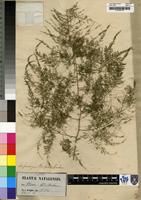
Type of Asparagus plumosus Baker [family LILIACEAE]
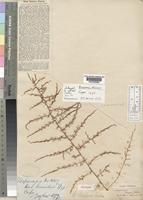
Holotype of Asparagus cooperi Baker [family ASPARAGACEAE]
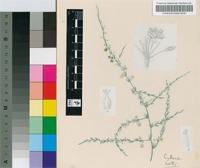
Asparagus cooperi Baker
Previous
Next

Name

Identification
Asparagus cooperi Baker [family ASPARAGACEAE ]
Related name
  • Asparagus cooperi

Flora

Entry for ASPARAGUS Cooperi Baker [family ASPARAGACEAE]
Herbarium
Royal Botanic Gardens, Kew (K)
Collection
Flora Capensis
Resource Type
Reference Sources
Entry From
Flora Capensis, page 253, (1897) Author: (By J. G. BAKER).
Names
ASPARAGUS Cooperi Baker [family ASPARAGACEAE], in Gard. Chron. 1874, i. 818;—Baker in Journ. Linn. Soc. xiv. 613.
Information
stems terete, glabrous, green, wide-climbing; prickles woody, spreading, pungent, 1/6 in. long; branches spreading, slender, copiously decompound, with patent branchlets; cladodia very slender, subulate, often a dozen or more in a cluster, 1/4– 1/3 in. long; flowers axillary, 1–3-nate; pedicels 1/6 in. long, articulated below the middle; perianth campanulate, 1/12 in. long; segments oblanceolate-oblong, spreading horizontally; stamens nearly as long as the perianth-segments; berry globose, 1/6 in. diam., 1-seeded. null
Distribution
CENTRAL REGION Somerset Div.; in woods on the sides of Bosch Berg, 2800–4000 ft., MacOwan, 1810!
Notes
Originally described from specimens in the garden of Mr. Wilson Saunders in 1871, collected by Mr. Thos. Cooper.

Related Materials

  • Terms and Conditions
  • Privacy Policy
  • Cookie Policy
  • Cookie Settings
  • Accessibility
  • Help
  • Contact Us
  • Facebook
  • Twitter
ITHAKA

JSTOR is part of ITHAKA, a not-for-profit organization helping the academic community use digital technologies to preserve the scholarly record and to advance research and teaching in sustainable ways.

©2000-2026 ITHAKA. All Rights Reserved. JSTOR®, the JSTOR logo, JPASS®, Aluka®, and ITHAKA® are registered trademarks of ITHAKA.

╳