JSTOR Global Plants Home
  • Home
  • Browse
  • About
  • Access
  • Account
    • Saved Items
    • Profile
  • Log in

Global Plants

Skip to Main Content
  • JSTOR Global Plants Home
  • Global Plants

    • Browse
    • About
    • Access
    • Account
      • Saved Items
      • Profile
Log in
  • Browse
  • About
  • Access
  • Account
    • Saved Items
    • Profile
Advanced Search

Compilation
Aspalathus alpestris

5 Images see all

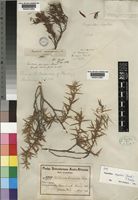
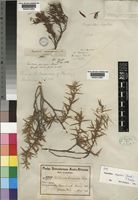
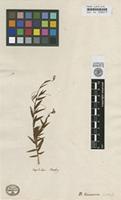
Lectotype of Borbonia pungens Mundt ex Benth. [family LEGUMINOSAE-PAPILIONOIDEAE]
Aspalathus alpestris (Benth.) R.Dahlgren [family LEGUMINOSAE-PAPILIONOIDEAE]
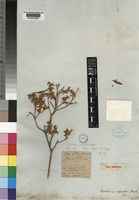
Filed as Aspalathus alpestris (Benth.) Dahlgr. [family LEGUMINOSAE/FABACEAE]
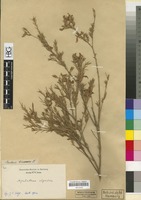
Aspalathus alpestris (Benth.) R.Dahlgren [family LEGUMINOSAE-PAPILIONOIDEAE]
Type of Borbonia trinervia Thunb. [family FABACEAE]
Previous
Next

Name

Identification
Aspalathus alpestris (Benth.) R.Dahlgren [family LEGUMINOSAE-PAPILIONOIDEAE ] (stored under name); Verified by Dahlgren, R., Borbonia pungens Mundt ex Benth. [family LEGUMINOSAE-PAPILIONOIDEAE ] Borbonia monosperma DC. [family LEGUMINOSAE-PAPILIONOIDEAE ]
Related name
  • Borbonia monosperma
  • Aspalathus alpestris
  • Borbonia trinervia
  • Borbonia pungens
  • Borbonia alpestris
  • Borbonia parviflora

Flora

Entry for Aspalathus alpestris [family FABACEAE]
Herbarium
South African National Biodiversity Institute, Compton Herbarium, Cape Town (SAM)
Collection
Flora of Southern Africa
Resource Type
Reference Sources
Entry From
Flora of South Africa, (2003) Author: Dr J.P. Roux
Names
Aspalathus alpestris [family FABACEAE]
Common names
Borbonia alpestris Benth. in Hooker, Lond. J. bot. 2: 461 (1843); Harv., Fl. Cap. 2: 29 (1862); Phill. in S. Afr. J. Sci. 16:407(1920). Borbonia pungens Mund ex Benth. in Hooker, Lond. J. Bot. 2: 461 (1843). Type: 'Borbonia monosperma\ sine loco, Drege (K, lecto.!; S). The name 'Borbonia mono-sperma Cand.' was incorrectly used for this specimen in E. Mey.,Comm. 1: 15(1836). 'Borbonia trinervia' auct. non L. in Thunb., Prodr. 2: 122 (1800); Diss. Bot. Borbonia: 4 (1811); Eckl. & Zeyh., Enum. 2: 164 (1836); Walp. in Linnaea 13: 468 (1839); Harv., Fl. Cap. 2: 28 (1862); Phill. in S. Afr. J. Sci. 16: 401 (1920). Linnaeus (Sp. PI., 707, 1753) based this on a name in Hort. Cliff.: 494 (1739), which refers to a speci­men of Cliffortia ruscifolia L. (herbarium Clifford, BM).
Information
An (erect-) ascending or decumbent to prostrate shrublet with spreading branches up to 0,5 (-1) m long, slender or weak to strong and rigid. Young branches ferruginous, glabrous, subterete or ± compressed. Leaves flat, simple (unifoliolate), linear-lanceolate (ovate), 10-20(-32) x l,2-5,5(-8) mm, rigid, hard, sharply spine-tipped, glabrous, (yellowish-) green to glaucous, with 3-9 prominent longitu­dinal veins (beside marginal ones). Inflores­cence unifloral or a sparse raceme with up to 6 flowers on a glabrous inflorescence axis which is the continuation of a ± peduncle-like inter-node 3-35 mm long. Bract subulate-acicular, (0,6-) 3,5-6,5 x 0,3-0,9 mm, rigid, ± spine-like, glabrous. Pedicel 1,2-2,5 (-3) mm long, glabrous. Bracteoles l-5,5(-6,5) mm long. Calyx tube infundibular-campanu­late, glabrous; lobes triangular-subulate, l,4-3,5(-4,5) mm long, sharply spine-tipped, glabrous. Petals light or bright yellow. Stand­ard blade broadly obovate or almost circular, 6,2-7,5(-8) X 6-8,5 mm, rounded to retuse (often with a short ktip'), short-sericeous on the back. Wing blades narrowly ovate-elliptic, 5-6,5(-7) x 2,4-3,5 mm. Keel blades 4,5-6 x 2,5-3,5 mm, apically slightly up-curved, with concave upper margin. Pistil gla­brous; ovary elongate, with 6-10 ovules; style upcurved. Pod lanceolate or linear, 18-27 x 3,5-4,5 mm, glabrous, smooth. Chromosome number. 2n= 18. Figure 28: 1-15.
Habitat
The species is very variable in habit, floral size and length of bracts, calyx lobes and pods. Forms in the Mon­tagu-Robertson-Worcester Divisions may become suberect, with stiff, coarse branches, and broad leaves with 7-11 veins. Most other forms are lower and have narrower, fewer-veined leaves, the easternmost forms being decum­bent and weak and having slender branches. Very small-flowered is a form in Kruisvallei in the Uniondale Division CBorbonia trinervia).
Use
59. Aspalathus alpestris (Benth.) Dahlg. in Op. bot. Soc. bot. Lund 9 (1): 270, 210 (1963); ibid. 22: 40 (1968). Type: Cape, Koghman's Kloof, Montagu Division, Mund 79 (K,lecto.!).
Range
A. alpestris has a surprisingly scattered distribution and has been collected in the Caledon, Bredasdorp, Worcester, Robertson, Swellendam, Montagu, Ceres, Laingsburg, Riversdale, Mossel Bay and Uniondale Divi­sions, without being common in any region. The type was recorded from 'subalpine bushy places near Koghman's Kloof, which is the reason for its specific name, but this is misleading: the species occurs mainly on shaley, clayey ground, the rocks being frequently of the Bokkeveld Series. It is often associated with renosterbos but also with general fynbos elements. Map 25.

Related Materials

  • Terms and Conditions
  • Privacy Policy
  • Cookie Policy
  • Cookie Settings
  • Accessibility
  • Help
  • Contact Us
  • Facebook
  • Twitter
ITHAKA

JSTOR is part of ITHAKA, a not-for-profit organization helping the academic community use digital technologies to preserve the scholarly record and to advance research and teaching in sustainable ways.

©2000-2026 ITHAKA. All Rights Reserved. JSTOR®, the JSTOR logo, JPASS®, Aluka®, and ITHAKA® are registered trademarks of ITHAKA.

╳