JSTOR Global Plants Home
  • Home
  • Browse
  • About
  • Access
  • Account
    • Saved Items
    • Profile
  • Log in

Global Plants

Skip to Main Content
  • JSTOR Global Plants Home
  • Global Plants

    • Browse
    • About
    • Access
    • Account
      • Saved Items
      • Profile
Log in
  • Browse
  • About
  • Access
  • Account
    • Saved Items
    • Profile
Advanced Search

Compilation
Asclepias decipiens

11 Images see all

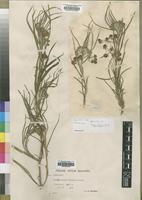
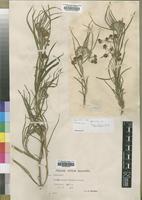
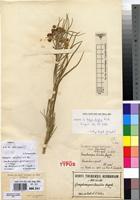
Syntype of Asclepias decipiens N.E.Br. [family ASCLEPIADACEAE]
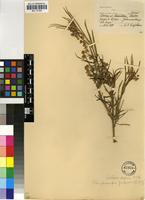
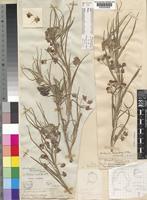
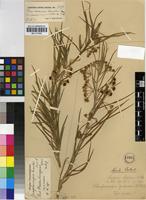
Isolectotype of Asclepias decipiens N.E.Br. [family ASCLEPIADACEAE]
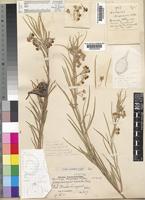
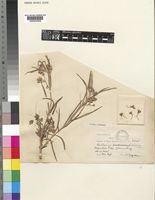
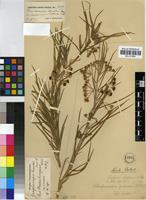
Syntype of Asclepias decipiens N.E.Br. [family APOCYNACEAE]
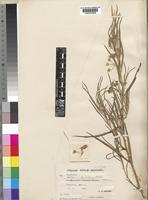
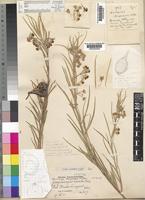
Syntype of Asclepias decipiens N.E.Br. [family ASCLEPIADACEAE]
Syntype of Asclepias decipiens N.E.Br. [family APOCYNACEAE]
Syntype of Asclepias decipiens N.E.Br. [family ASCLEPIADACEAE]
Previous
Next

Name

Identification
Asclepias decipiens N.E.Br. [family ASCLEPIADACEAE ] (stored under name);
Related name
  • Gomphocarpus fruticosus
  • Asclepias fruticosa
  • Asclepias decipiens
  • Gomphocarpus lanatus

Flora

Entry for ASCLEPIAS decipiens N. E. Br. [family ASCLEPIADACEAE]
Herbarium
Royal Botanic Gardens, Kew (K)
Collection
Flora Capensis
Resource Type
Reference Sources
Entry From
Flora Capensis, Vol 4, page 518, (1909) Author: By N. E. BROWN.
Names
ASCLEPIAS decipiens N. E. Br. [family ASCLEPIADACEAE]
Information
a branching shrubby plant, 2–3 ft. high, with the habit of A. fruticosa, Linn.; stems white-tomentose on the young parts; leaves ascending, 3–5 in. long, 1/2–3 lin. broad, linear, tapering to an acute point, with revolute margins, narrowed at the base into a petiole 1–3 lin. long, puberulous with curved hairs above and on the midrib beneath; umbels numerous, lateral at the nodes, racemose, 4–6-flowered; peduncles 1/2–1 in. long, white-tomentose; bracts 1/3– 1/2 in. long, linear, tapering to an awn-like point, tomentose, very deciduous; pedicels 3/4–1 1/6 in. long, white-tomentose; sepals reflexed, 3 lin. long, 3/4–1 lin. broad at the base, thence tapering to a very acute point, tomentose; corolla-lobes reflexed; 3–4 lin. long, 2–3 lin. broad, elliptic or elliptic-ovate, obtusely pointed, ciliate on one or both margins, apparently white or pale yellowish, tinted with purplish on the back; corona-lobes arising 1/2– 3/4 lin. up the staminal column and reaching its top, 1 1/2–1 3/4 lin. long, subquadrate and 1–1 1/2 lin. broad when viewed sideways, compressed-complicate, shallowly divided or grooved along the top and inner side, otherwise solid, without a tooth or process within, top margin slightly rounded, notched in front of a backwardly directed falcate tooth at the inner apical angles, inner margins narrowly winged, the wing often ending in a small tooth at the apex; staminal column 2–2 1/2 lin. long; anther-appendages suborbicular or elliptic, their obtuse tips inflexed on the rim of the truncate style-apex; follicles ellipsoid or ellipsoid-ovoid at the lower part, abruptly contracted into a stout subulate beak, white-tomentose and covered all over with fine dark filiform processes 3–4 lin. long. null
Distribution
EASTERN REGION Natal; Mooi River, Gerrard, 1290!KALAHARI REGION Transvaal; Hennops Valley, near Irene, Conrath, 997! Wonderboom Poort, 4600 ft., Miss Leendertz, 607! near Johannesburg, Rand, 858! 1128! Gilfillan in Herb. Galpin, 6045! Pretoria, Schlechter, 3589!
Notes
This closely resembles A. Burchellii, Schlechter, but differs from that species by the presence of the falcate recurved tooth at the top of the corona-lobes and by the follicles abruptly contracted into a beak, not gradually tapering to the apex, and, when they open, the basal part remains very much more concave and bag-like than in A. Burchellii.

Related Materials

  • Terms and Conditions
  • Privacy Policy
  • Cookie Policy
  • Cookie Settings
  • Accessibility
  • Help
  • Contact Us
  • Facebook
  • Twitter
ITHAKA

JSTOR is part of ITHAKA, a not-for-profit organization helping the academic community use digital technologies to preserve the scholarly record and to advance research and teaching in sustainable ways.

©2000-2026 ITHAKA. All Rights Reserved. JSTOR®, the JSTOR logo, JPASS®, Aluka®, and ITHAKA® are registered trademarks of ITHAKA.

╳